
Betterworks Review: Enterprise Performance Management Software for 2026
 Mar 20,2026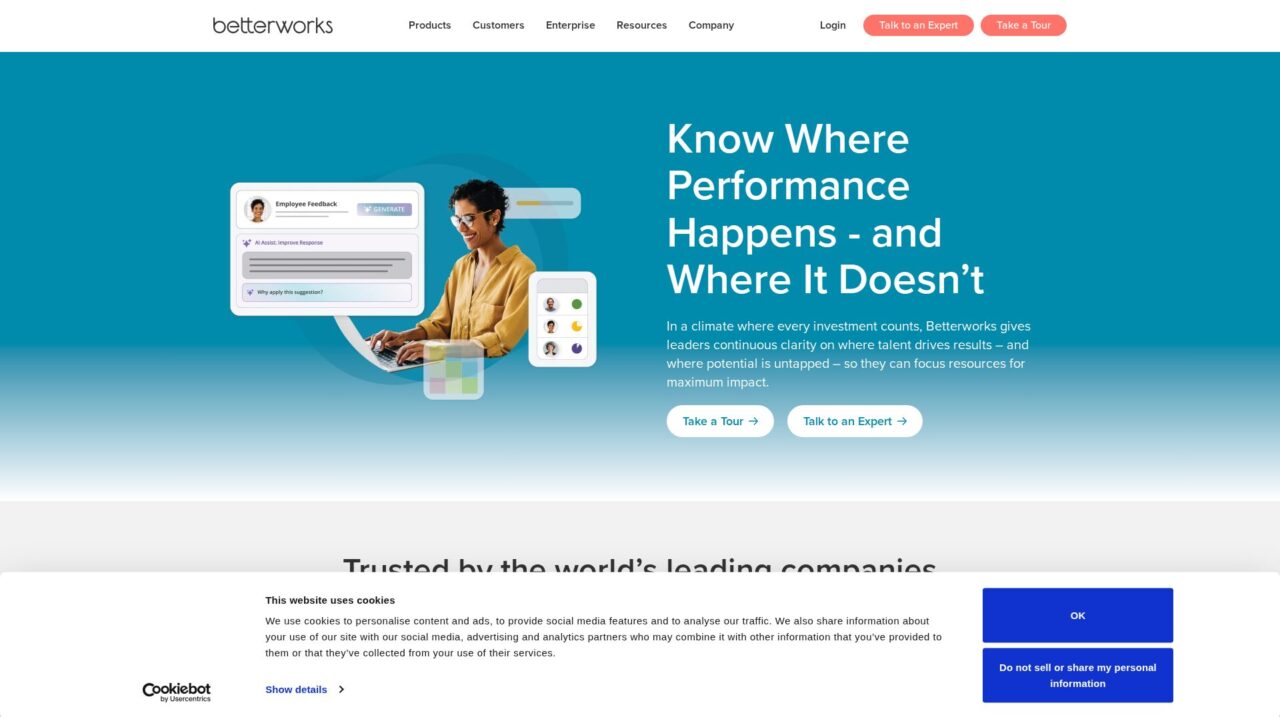

Betterworks is an enterprise-grade performance management platform that combines OKRs, continuous feedback, check-ins, and people analytics to help HR and business leaders align goals, grow talent, and drive outcomes.
I have evaluated Betterworks across its capabilities in performance management, employee development, and people analytics to understand where it truly adds value and where it may not be the best fit. This review is part of our broader coverage of performance management software, where we compare tools on features, usability, and long-term impact on culture.
Betterworks has become a familiar name among HR leaders looking to move beyond annual reviews toward continuous performance and growth. Still, its positioning toward enterprise buyers and its rapidly evolving AI features can make it hard to judge from marketing materials alone whether it is the right fit for your organization.
In this review, you will get a clear look at Betterworks’ pros and cons, core features, and ideal use cases, along with practical guidance on when it outperforms typical HRIS performance modules and when a leaner tool might be enough. The focus is on how it works in real organizations, not just what it promises.
This review will be most useful if you are an HR, People, or business leader at a mid-sized or large organization, especially one that wants to align teams around shared goals, create a culture of continuous feedback, and support data-driven talent decisions. We will anchor everything in the core problems Betterworks is built to solve: fragmented performance processes, inconsistent coaching, and limited insight into where performance and potential truly live in the business.
Betterworks Review Summary
Overall, Betterworks is a strong choice for organizations that see performance management as a strategic lever rather than a compliance task. Its depth in goal alignment, continuous check-ins, feedback, and analytics makes it more capable than typical performance modules bundled into HRIS platforms, especially for companies that manage complex, cross-functional objectives.
The tradeoffs are largely around scale and commitment: Betterworks shines when HR and leadership are willing to invest in process design, change management, and adoption. For smaller teams or organizations looking for an all-in-one HR suite, the platform may feel heavier than necessary and will need to be paired with other systems. If you are ready to modernize performance at scale, however, Betterworks offers a solid and future-forward foundation.
How We Review Tools and Assign the CX Score
We've developed a comprehensive scoring system to evaluate software tools objectively. Our CX Score (1.0–5.0) reflects how strong a product is within its category, based on hands-on testing and analysis across multiple criteria.
Core Functionality
Does the tool deliver the essential features users expect? We assess whether core capabilities meet category standards and if key features are accessible across pricing tiers.
Standout Features
We evaluate unique capabilities that go beyond the basics—features that make the product faster, more efficient, or offer additional value compared to competitors.
Ease of Use
How intuitive is the interface? We consider design quality, mobile apps, templates, and whether complex tasks feel simple to execute.
Onboarding
We measure how quickly new users can get productive with minimal training. High-scoring tools require little to no external support to get started.
Integrations
We assess native integrations, third-party connections, and API access. Tools that connect easily with common tech stacks score higher.
Customer Support
How easy is it to get help? We evaluate support channels, response times, and quality of documentation. Real-time human support scores best.
Value for Money
We compare pricing against features delivered. Software that offers more functionality at competitive prices receives higher marks.
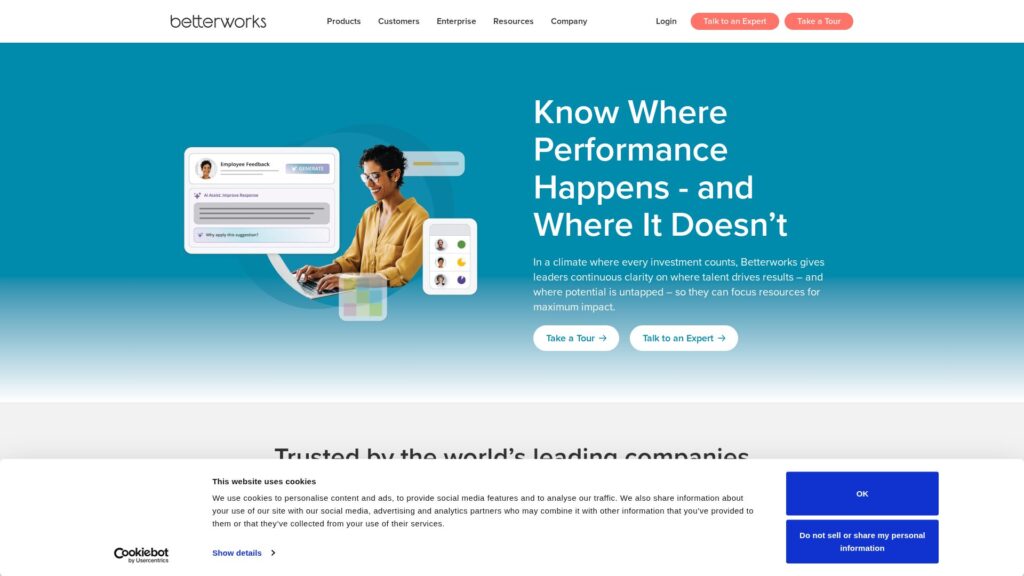
Features of Betterworks
- OKR and Goal Management
- Continuous Check-ins
- 1:1 and Conversation Templates
- Real-time Feedback and Recognition
- Performance Reviews and Appraisals
- Calibration and Talent Reviews
- Succession Planning
- High-potential Identification
- People Analytics and Dashboards
- AI-assisted Insights and Coaching
- Manager Coaching Tools
- Employee Development Planning
- Engagement-level Feedback
- HRIS Integrations
- Single Sign-On (SSO)
- Open API
- Mobile-friendly Experience
- Multi-language Support
- Role-based Permissions and Governance
- Custom Review Cycles and Templates
- Pulse Surveys
- Compensation Management
- Time and Attendance
- Full HRIS / Core HR
- On-premise Deployment
Goal Setting and Alignment That Ties Work to Strategy
Betterworks offers a robust goal management engine built around OKRs and similar frameworks, helping organizations translate strategy into specific, measurable objectives. Leaders can set high-level goals and cascade or align them with team and individual goals, providing clear visibility into how day-to-day work connects to business outcomes. This is more sophisticated than the simple goal fields in many HRIS tools, supporting shared goals, cross-functional ownership, and real-time status tracking.
For employees and managers, updating goals is straightforward and can be embedded in regular check-ins, ensuring goals stay alive rather than stagnate as one-time entries. This continuous alignment is especially valuable for fast-moving organizations where priorities shift frequently and traditional annual goal-setting becomes obsolete quickly.
Continuous Check-ins and Structured Performance Conversations
Instead of anchoring everything in an annual review, Betterworks emphasizes frequent, structured conversations between managers and employees. HR teams can configure recurring check-ins with templates, prompts, and questions that guide discussions about progress, blockers, development, and well-being. This ensures a consistent experience across teams while still allowing flexibility for local adaptation.
These conversations generate a continuous record of performance and development, reducing end-of-year surprises and providing a richer context for formal evaluations. Compared with tools that treat reviews purely as forms to fill, Betterworks supports a more human, ongoing dialogue about performance and growth.
Real-time Feedback and Recognition for Continuous Growth
Betterworks includes mechanisms for employees and managers to give and request feedback throughout the year, not just during review cycles. Feedback can be tied to goals, competencies, or behaviors, helping organizations reinforce the outcomes and values that matter most. Peer feedback and upward feedback features also give a more holistic view of how someone is showing up across the organization.
This continuous feedback loop supports coaching, strengthens relationships, and surfaces developmental needs early. It also reduces bias that comes from relying only on recent memories, a problem that plagues many traditional performance processes.
Performance Reviews, Calibration, and Talent Decisions
When it is time to run formal review cycles, Betterworks uses the data gathered from goals, check-ins, and feedback to support more objective and equitable evaluations. HR teams can configure review forms, competencies, ratings structures, and workflows that match their philosophy, whether that is ratings-based, narrative, or a hybrid approach. Calibration features help leaders review ratings across teams, identify inconsistencies, and ensure fairness.
The same information can be repurposed for promotion, compensation, and succession planning decisions, giving talent leaders a unified view of performance and potential. This is a notable step up from manual spreadsheet-based processes and fragmented systems.
High-potential Identification and Succession Planning
Betterworks supports identifying and nurturing high-potential employees, often through talent matrices and configurable criteria that combine performance, potential, and other factors. HR leaders can visualize talent pools, understand bench strength for critical roles, and plan development pathways for future leaders.
This capability helps organizations move beyond ad hoc or relationship-driven succession decisions, promoting more transparent and data-supported leadership pipelines. It is particularly useful in larger enterprises where talent visibility across regions or business units can be challenging.
AI-assisted Insights and In-the-moment Coaching
The platform incorporates AI features that help summarize performance data, suggest conversation topics, and provide in-the-moment coaching prompts for managers. For example, AI can highlight trends in feedback, flag stalled goals, or recommend ways to reframe a performance conversation, allowing managers to spend less time sifting through information and more time engaging with their teams.
While AI capabilities are still evolving, Betterworks is clearly investing in this area to make performance management less administratively heavy and more insight-driven. This goes beyond basic reporting, giving managers and HR professionals intelligent nudges that improve the quality and timeliness of interactions.
People Analytics and Executive Reporting
Betterworks aggregates data from goals, conversations, and feedback into analytics dashboards tailored for HR and business leaders. These dashboards help leaders answer questions like where performance is strongest, where engagement or progress is lagging, and which teams may be at risk of attrition or misalignment.
Advanced segmentation and trend analysis allow organizations to spot inequities, track the impact of performance programs, and make more informed decisions about investments in talent. Compared with average performance tools, Betterworks’ analytics are more substantial and better aligned with the needs of data-driven HR teams.
Day-to-day usability for employees and managers is generally straightforward. Updating goals, completing check-ins, and giving or requesting feedback follows familiar patterns, and the workflows are structured enough that new users quickly understand what is expected. The biggest shift for end users is behavioral: adopting a cadence of continuous conversations rather than relying on annual reviews.
On the admin and HR side, Betterworks is more complex, reflecting its enterprise orientation. Configuring goal hierarchies, performance cycles, competencies, templates, and permissions requires thoughtful setup and a clear performance management strategy. Implementation is usually handled as a managed project with support from Betterworks’ customer success team, and successful rollouts depend on solid change management, internal communication, and manager training. Organizations that invest the time up front tend to see smoother adoption and better long-term results.
Betterworks is typically deployed alongside a core HRIS, collaboration tools, and identity systems in mid-market and enterprise environments. It offers integrations with common HR platforms for employee data synchronization, single sign-on through standard identity providers, and calendar or collaboration integrations to bring check-ins and reminders closer to where employees already work. These connections reduce duplicate data entry and help embed performance workflows into the broader employee experience.
Because detailed integration specifics can vary by edition and implementation, prospective buyers should confirm available native integrations with their existing HRIS, identity provider, and communication tools, and ask about open APIs or integration partners if they have more complex requirements. Clarifying how data flows between systems is key to ensuring accurate reporting, smooth onboarding and offboarding, and a cohesive employee view across platforms.
Betterworks Overview
Pros
- Strong focus on continuous performance with goals, check-ins, and feedback tightly integrated
- Robust goal and OKR alignment features suited to complex organizations
- People analytics and insights help leaders see where performance and potential truly live
- Supports high-potential identification, calibration, and succession planning workflows
- Enterprise-grade configuration and governance for large HR and People teams
- Growing AI capabilities that summarize data and assist managers with coaching
- Recognized by industry analysts and awards, signaling maturity and reliability
Cons
- Implementation and configuration can be heavy for smaller or less mature HR teams
- Primarily focused on performance, not a full HRIS, requiring other systems alongside
- Pricing and packaging are not immediately transparent and typically require sales conversations
- Change management demands are significant to fully realize the benefits
- May feel overpowered for very small companies or those new to structured performance processes
Betterworks: Frequently Asked Questions
What type of companies is Betterworks best suited for?
Betterworks is best for mid-market and enterprise organizations that want structured, continuous performance management with strong goal alignment and analytics.
Is Betterworks a full HRIS system?
No, Betterworks focuses on performance management, goals, feedback, and talent decisions and is typically used alongside a separate HRIS or payroll system.
How difficult is it to implement Betterworks?
Implementation requires thoughtful design of performance processes, configuration, and change management, and is usually run as a guided project with support from Betterworks and internal HR leaders.
Does Betterworks support OKRs and goal alignment?
Yes, Betterworks has a mature OKR and goal management engine that allows organizations to align company, team, and individual goals and track progress in real time.
Can Betterworks help with succession planning and high-potential talent?
Yes, Betterworks includes tools for identifying high-potential employees, running talent reviews, and supporting data-driven succession planning.
Does Betterworks integrate with existing HR and identity systems?
Betterworks typically integrates with common HRIS and identity providers for employee data sync and single sign-on; buyers should confirm specific integrations and API options during evaluation.
Is Betterworks suitable for small businesses?
Smaller organizations can use Betterworks, but its feature depth and implementation effort tend to make it a better fit for larger or rapidly scaling companies with dedicated HR resources.
How does Betterworks use AI in performance management?
Betterworks uses AI to summarize information, surface insights, and suggest prompts or talking points for managers, helping them run better conversations and focus on higher-value decisions.
