
Dayforce Review: Global HCM, Payroll, and Workforce Platform for 2026
 Jan 06,2026

Dayforce is an enterprise-grade global HCM platform that unifies HR, payroll, time, benefits, and talent management, aimed at mid-market and large, often multinational organizations.
After evaluating Dayforce across real-world implementations and use cases, this review distills how well it performs as a global HCM and payroll platform. The goal is to help you understand whether it is the right foundation for your people and pay operations.
If you are still at the research stage and considering alternatives, you may also want to browse our broader coverage of HR and payroll software tools, where we compare platforms by size, complexity, and industry fit.
Dayforce has become a widely recognized option for mid-market and enterprise organizations that need to manage complex, often global, workforces. Despite that reputation, buyers still need a clear, practical view of its strengths, tradeoffs, and what it really takes to implement successfully.
In this review, you will find an overview of Dayforce’s core capabilities, its pros and cons, and guidance on which types of organizations are most likely to see strong ROI. The focus is on HR, payroll, finance, and operations leaders in mid-sized and large businesses, especially those with hourly, distributed, or international employees. At its core, Dayforce aims to solve the fragmentation between HR, time, and payroll by unifying them into a single, analytics-ready platform.
Dayforce Review Summary
Overall, Dayforce is a mature, capable HCM suite that makes the most sense for organizations with complex payroll, scheduling, and compliance needs. Its single data model and continuous calculation engine provide clear advantages over loosely integrated HR and payroll stacks, particularly when it comes to reducing pay errors and providing trustworthy workforce insights.
However, realizing that value requires a serious commitment to implementation, configuration, and change management, as well as a budget aligned with mid-market or enterprise software. If you need deep workforce management and global coverage in a single system, Dayforce is a strong candidate; if you are smaller or more cost-sensitive, lighter HRIS and payroll options will likely be more appropriate.
How We Review Tools and Assign the CX Score
We've developed a comprehensive scoring system to evaluate software tools objectively. Our CX Score (1.0–5.0) reflects how strong a product is within its category, based on hands-on testing and analysis across multiple criteria.
Core Functionality
Does the tool deliver the essential features users expect? We assess whether core capabilities meet category standards and if key features are accessible across pricing tiers.
Standout Features
We evaluate unique capabilities that go beyond the basics—features that make the product faster, more efficient, or offer additional value compared to competitors.
Ease of Use
How intuitive is the interface? We consider design quality, mobile apps, templates, and whether complex tasks feel simple to execute.
Onboarding
We measure how quickly new users can get productive with minimal training. High-scoring tools require little to no external support to get started.
Integrations
We assess native integrations, third-party connections, and API access. Tools that connect easily with common tech stacks score higher.
Customer Support
How easy is it to get help? We evaluate support channels, response times, and quality of documentation. Real-time human support scores best.
Value for Money
We compare pricing against features delivered. Software that offers more functionality at competitive prices receives higher marks.
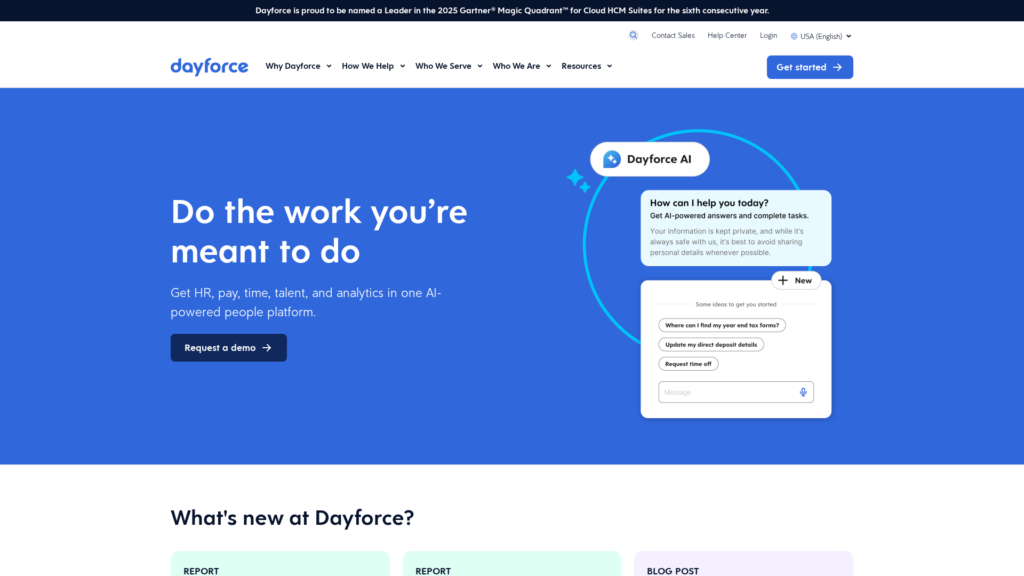
Features of Dayforce
- Core HRIS
- Payroll Processing
- Continuous Payroll Calculation
- Time and Attendance
- Shift Scheduling
- Workforce Management
- Benefits Administration
- Talent Management
- Recruiting and Applicant Tracking
- Onboarding
- Performance Management
- Learning Management
- Global Payroll Support
- Multi-country HR
- Compliance Management
- Employee Self-Service Portal
- Manager Self-Service
- Mobile App
- Advanced Reporting and Dashboards
- AI and Predictive Insights
- Open API
- SSO and SAML Support
- Integration with ERP/Finance Systems
- Data Import and Export Tools
- Custom Workflows and Approvals
- Role-based Access Control
- Document Management
- Audit Trails
- Multi-language Support
- Multi-currency Support
- On-premise Deployment
- Cloud SaaS Deployment
- SMB-specific Pricing Tier
Unified Payroll and Time Calculation for Complex Workforces
Dayforce continuously calculates payroll as time, schedules, and HR events change, rather than leaving everything until a final pre-payroll batch. This continuous calculation model is particularly effective for organizations with hourly workforces, multiple pay groups, or complex overtime and premium rules. It reduces last-minute surprises, off-cycle checks, and manual reconciliations that plague traditional payroll setups.
Compared to typical tools where time and payroll are separate systems, this unified approach significantly improves data integrity and speed. It gives payroll teams confidence that their numbers reflect near real-time activity and allows managers to catch errors before they become costly.
Core HR and Employee Records in a Single System of Record
At the heart of Dayforce is core HR: employee profiles, job and position data, compensation structures, employment history, documents, and organizational hierarchies. Keeping this information in one system of record underpins accurate payroll, time, and analytics. HR teams can manage lifecycle events such as hiring, promotions, transfers, and terminations without re-entering data in multiple places.
Compared with lightweight HRIS platforms, Dayforce’s core HR capabilities are more suited to complex organizational structures and multi-entity setups. It is designed to support shared services models, role-based access, and global HR standards while still accommodating local variations.
Workforce Management and Scheduling for Hourly and Shift Workers
Dayforce offers robust workforce management features, including scheduling, time and attendance, leave management, and labor forecasting. Managers can build compliant schedules, account for skills and availability, and track time through physical clocks, web, or mobile devices. The system can automatically flag potential violations of labor rules or company policies.
In industries with large frontline or shift-based workforces, this module can displace standalone scheduling tools by linking labor plans directly to payroll and analytics. That said, organizations with extremely specialized scheduling needs should still validate that Dayforce’s model fits their edge cases.
Talent Management Across the Employee Lifecycle
Dayforce supports talent workflows such as recruiting, onboarding, performance management, learning, and succession planning. While the depth of each area may not match best-of-breed point solutions, the benefit is keeping the entire employee lifecycle on a single platform, with shared data and consistent experiences for employees and managers.
For many organizations, Dayforce offers “good enough” talent capabilities that are significantly more integrated than running separate ATS, performance, and learning systems. Where specialized features are critical, integrations with external tools are often still possible.
Benefits Administration and Employee Self-Service
The platform includes benefits administration tools to manage plan eligibility, enrollment, and life events, with employees able to review and choose options through self-service portals. This reduces paper processes and centralizes benefits data alongside payroll and HR records, which improves accuracy for deductions and reporting.
Compared with basic HR systems that only track high-level benefits data, Dayforce tends to offer more robust configuration and rules, particularly for organizations with multiple plan options, eligibility rules, or complex contribution structures.
Global HR and Compliance Support
Dayforce is built to support global operations, with capabilities across multiple countries for HR records, time, and payroll, supported by local expertise and partners. It emphasizes staying ahead of changing tax and labor regulations so that organizations can reduce compliance risk and avoid penalties.
Relative to mid-market HRIS tools that primarily focus on a single country, Dayforce’s global posture is a major differentiator. Enterprises should still validate coverage and maturity in their specific jurisdictions, but for many, it offers a way to standardize HR and payroll globally.
Analytics, Dashboards, and AI-Driven Insights
Because Dayforce operates on a singular data model, it can deliver analytics that draw from HR, time, payroll, and talent data without complex integrations. Leaders get dashboards for labor costs, headcount, turnover, and overtime, while HR and finance teams can build custom reports tailored to their needs. AI services further enhance these capabilities by highlighting anomalies or emerging trends.
Compared with legacy HCM tools that rely heavily on static reports, Dayforce’s analytics feel more immediate and actionable, particularly for line managers who need clear, contextual insights rather than raw data dumps.
Dayforce is not a plug-and-play HR app; it is an enterprise-grade platform that benefits from careful implementation and structured training. Initial setup typically involves mapping complex pay rules, schedules, organizational structures, and data flows, which can be demanding for smaller or resource-constrained HR teams. Many organizations engage implementation partners or vendor-led projects to ensure configuration is robust and compliant.
Once configured, day-to-day use for employees and managers is generally straightforward, with modern web and mobile interfaces and self-service flows for common tasks. Administrators face a steeper learning curve, especially around payroll and workforce management configuration, but the tradeoff is fine-grained control and automation that lighter tools cannot match. In short, usability is good for end users and powerfully configurable for admins, but expect a serious ramp-up period rather than an instant rollout.
Dayforce offers a range of integration options, including native connectors to common ERP, finance, and benefits providers, as well as APIs and file-based interfaces for custom connections. It is typically deployed as the central HCM and payroll system, with integrations to recruiting, learning, identity management, and other enterprise systems as needed. Single sign-on and directory synchronization are commonly implemented in larger organizations.
Compared with newer, API-first HR platforms, Dayforce’s integration experience can feel more traditional, especially for organizations that expect low-code self-service connectors. However, for enterprises with established IT teams and integration middleware, the platform is flexible enough to be woven into a broader application landscape. Prospective buyers should ask for detailed integration documentation and confirm availability of prebuilt connectors for their critical systems.
Dayforce Overview
Pros
- Unified HR, payroll, and time on a single data model improves accuracy
- Continuous payroll calculation reduces errors and off-cycle corrections
- Strong workforce management for complex hourly and shift-based workforces
- Robust global HR and compliance capabilities for multinational organizations
- Modern employee and manager self-service reduces administrative burden
- Real-time analytics and AI-driven insights support better decisions
- Scales well for mid-market and enterprise deployments
- Trusted reputation in regulated and compliance-heavy industries
Cons
- Implementation can be long and resource-intensive
- Quote-based enterprise pricing is opaque for early-stage buyers
- Overkill for small businesses with simple HR and payroll needs
- Suite-first approach may not suit best-of-breed integration strategies
- Admin configuration has a steeper learning curve than lightweight HR tools
Dayforce: Frequently Asked Questions
What type of companies is Dayforce best suited for?
Dayforce is best for mid-sized and large organizations, especially those with complex hourly workforces, multiple locations, or operations across several countries.
Is Dayforce suitable for small businesses?
It can technically support small businesses, but its cost and implementation effort usually make it more than smaller organizations need. Simpler HR and payroll tools are often a better fit under roughly 200 employees.
Does Dayforce handle both HR and payroll in one system?
Yes, Dayforce unifies core HR, time and attendance, and payroll on a single data model, allowing continuous payroll calculation driven by HR and time data.
Can Dayforce support global workforces?
Yes, Dayforce is designed for global HR and payroll, with multi-country capabilities and access to local compliance expertise through partners and in-house specialists.
How is Dayforce priced?
Pricing is typically quote-based and depends on modules, regions, and employee counts. Buyers should expect enterprise-oriented pricing and request a tailored proposal from sales.
How long does it take to implement Dayforce?
Implementation timelines vary by complexity, but mid-market and enterprise deployments often take several months and require dedicated project resources and strong change management.
Does Dayforce offer employee self-service?
Yes, employees can usually access pay information, update personal data, manage time off, and interact with schedules through web and mobile self-service tools.
Can Dayforce integrate with our existing systems?
Dayforce supports integrations via APIs, native connectors, and file-based interfaces. You should validate available connectors for your ERP, finance, identity, and point solutions during evaluation.
Is Dayforce cloud-based?
Yes, Dayforce is delivered as a cloud-based SaaS platform rather than an on-premise deployment.
How strong are Dayforce’s compliance capabilities?
Compliance is one of Dayforce’s strengths, with strong support for changing tax and labor rules and tools that help reduce risk in complex or regulated environments.
