
Deel Review: Global Payroll and HR Platform Explained 2026
 Jan 07,2026

Deel is a global payroll and HR platform that helps companies hire, pay, and manage employees and contractors in 100+ countries with built-in compliance and HRIS tools.
After working with many payroll and HR platforms across different regions, I spent time evaluating Deel to understand where it truly fits for companies managing global teams. This review shares that analysis so you can decide whether it belongs in your HR and finance stack.
If you are still mapping the overall landscape, start with our broader comparison of global payroll and HR software on CX Everywhere to see how Deel stacks up against other options in the market. Once you have that context, it is easier to judge whether Deel’s strengths align with your particular hiring strategy.
Deel has become widely known among remote-first startups and scaling tech companies as a go-to solution for paying international contractors and employees. Its reputation for simplifying cross-border hiring is strong, but that does not mean it is the right fit for every organization or every use case. Many teams need a deeper view of features, tradeoffs, and long-term scalability before committing.
In this review, you will learn what Deel does well, where it is less comprehensive, and which types of organizations will get the most value from it. The focus is on practical considerations for finance, HR, and operations leaders at small to midsize companies and fast-growing enterprises that either already employ people in multiple countries or are preparing to expand. We will look at how Deel helps hire, pay, and manage global workers, how it compares with typical alternatives, and when you might be better served by a different kind of platform.
Deel Review Summary
Overall, Deel stands out as a strong, modern platform for companies that treat international hiring as a strategic priority. Its combination of global payroll, EOR services, contractor management, and HRIS functionality delivers a coherent experience that reduces complexity for HR and finance teams. The UX is approachable, support is generally responsive, and its coverage across 100+ countries enables relatively fast expansion compared with stitching together local vendors.
However, Deel is not a universal fit. Domestically focused organizations or companies with highly complex, mature HR processes may find more depth in single-country payroll systems or large HCM suites. For those whose main challenge is global workforce management rather than advanced HR workflows, though, Deel is one of the most compelling options available today.
How We Review Tools and Assign the CX Score
We've developed a comprehensive scoring system to evaluate software tools objectively. Our CX Score (1.0–5.0) reflects how strong a product is within its category, based on hands-on testing and analysis across multiple criteria.
Core Functionality
Does the tool deliver the essential features users expect? We assess whether core capabilities meet category standards and if key features are accessible across pricing tiers.
Standout Features
We evaluate unique capabilities that go beyond the basics—features that make the product faster, more efficient, or offer additional value compared to competitors.
Ease of Use
How intuitive is the interface? We consider design quality, mobile apps, templates, and whether complex tasks feel simple to execute.
Onboarding
We measure how quickly new users can get productive with minimal training. High-scoring tools require little to no external support to get started.
Integrations
We assess native integrations, third-party connections, and API access. Tools that connect easily with common tech stacks score higher.
Customer Support
How easy is it to get help? We evaluate support channels, response times, and quality of documentation. Real-time human support scores best.
Value for Money
We compare pricing against features delivered. Software that offers more functionality at competitive prices receives higher marks.
Features of Deel
- Global payroll support
- Employer of record (EOR)
- Contractor management
- Multi-currency payments
- Localized employment contracts
- Core HRIS / employee records
- Employee self-service portal
- Time off and leave management
- Document and contract storage
- Compliance workflows and guidance
- Analytics and reporting
- Accounting integrations
- HRIS integrations
- Open API
- Mobile-friendly access
- Performance management
- On-premise deployment
- Single-country payroll focus
- Built for global remote teams
Unified Global Payroll for Employees and Contractors
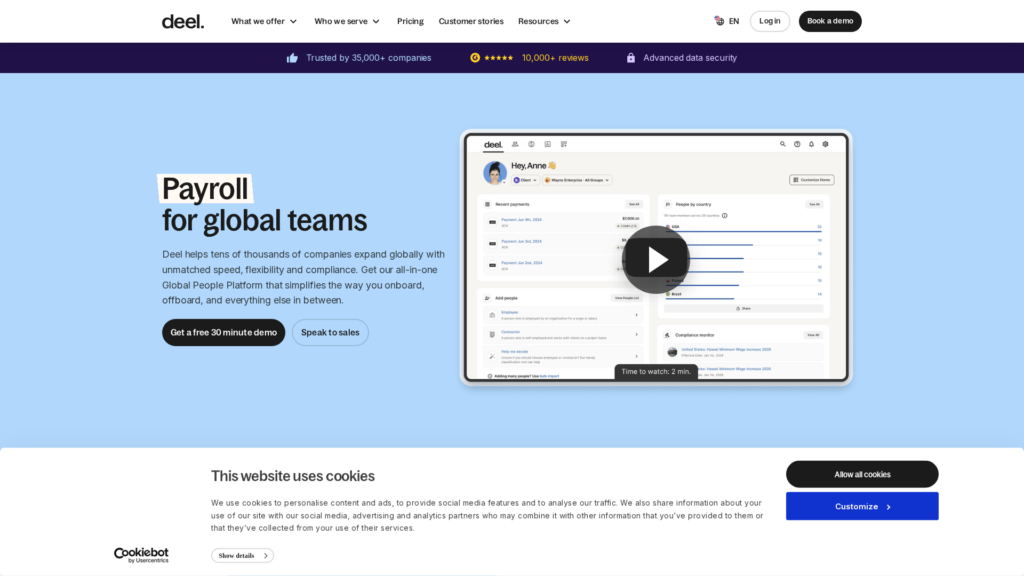
Deel’s core feature is a single platform to run payroll for both employees and contractors across more than 100 countries. Instead of juggling separate local vendors or bank transfers, admins can approve payments in one place and have Deel handle currency conversions, disbursements, and, where supported, statutory tax and benefits calculations. This unification reduces administrative overhead and gives finance leaders clearer visibility into total global payroll costs.
Compared with typical payroll tools that are regional or country-specific, Deel’s global coverage is a major advantage for distributed teams. Contractors can be paid in their preferred currencies, and employees receive payslips that reflect local norms. The result is less manual work, fewer payment errors, and a more consistent experience for workers regardless of where they are located.
Employer of Record Services for Fast Market Entry
For companies that want to hire full-time employees in countries where they do not have entities, Deel’s employer of record (EOR) service is a central feature. Deel becomes the legal employer on paper, handling local registrations, payroll taxes, and statutory benefits, while the client company directs the work and manages performance. This arrangement allows rapid hiring in new markets without waiting months to set up a subsidiary.
In practice, EOR services dramatically reduce legal and compliance complexity for expansion into multiple countries. While traditional EOR providers exist, Deel’s integration of EOR with its broader HRIS and payroll platform means HR teams have a single system of record for all worker types, rather than a separate EOR portal layered on top of existing tools.
Contractor Management and Localized Agreements
Beyond full-time employees, Deel offers a purpose-built contractor management module. Admins can create localized contract templates, invite contractors to complete details, and manage approvals without resorting to long email threads or manual PDFs. Contractors then use the platform to submit invoices or timesheets, which feed into payment runs.
What sets Deel apart from simple invoicing tools is its emphasis on compliance around worker classification and local regulations. While no tool can fully remove misclassification risk, Deel provides guidance and standardized documentation that reduces common mistakes. For companies heavily reliant on contractors across different jurisdictions, this is a significant step up from ad-hoc methods.
HRIS for Core People Data and Workflows
Deel includes a growing HRIS module that stores core worker records, personal data, compensation information, and employment documents. It provides structured onboarding workflows, self-service for employees to update their details, and tools to manage time off, approvals, and basic HR reporting. This gives organizations a central source of truth for their global workforce instead of relying on spreadsheets or fragmented tools.
While an HRIS is standard for HR software, Deel’s angle is that it is designed from the ground up for distributed, international teams. Many traditional systems assume a single-country context, which leads to awkward workarounds for different currencies, calendars, or document requirements. Deel’s HRIS, even if not the deepest on the market, is tuned to multi-country reality in a way that many legacy tools are not.
Compliance and Document Management Built Into Workflows
Deel embeds compliance and document management into everyday workflows. Offer letters, contracts, tax forms, and identity documents are all stored within worker profiles, with versioning and access controls. When roles or compensation change, updated agreements can be issued through the platform, creating a clear audit trail.
In global payroll, missing or outdated documentation often leads to delays or regulatory risk. Deel’s approach of keeping contracts, KYC documents, and compliance evidence in one place reduces the likelihood of gaps and makes audits significantly easier. This integrated document handling is a step up from typical payroll providers that treat documents as a separate, often manual, process.
Employee Self-Service and Transparent Experience
On the employee and contractor side, Deel offers self-service access to payslips, contracts, invoices, and payment histories. Workers can update bank details, change basic personal information, and see when payments are scheduled or completed. This transparency cuts down on the number of basic payroll questions HR and finance teams need to handle each cycle.
Compared with older payroll systems that are primarily admin-focused, Deel invests heavily in the end-user experience. The result is a more modern, consumer-like interface that feels familiar to remote workers and freelancers, which improves satisfaction and reduces friction in day-to-day operations.
Analytics and Visibility Into Global Workforce Costs
Deel includes reporting and analytics that help leaders understand headcount, costs, and worker distribution across countries. Because it unifies employees and contractors in one system, finance teams get a more complete picture of labor spend than they would from separate payroll and AP tools. Standard reports cover payroll totals, contractor spend, and breakdowns by country or team.
While its analytics are not as advanced as specialized BI solutions, having reliable baseline metrics directly in the payroll and HR system is a practical advantage. It enables faster decision-making about where to hire next, how to budget for expansion, and whether certain contractor conversions to employment make financial sense.
Deel is designed to be approachable for both HR and finance teams that may not have deep technical backgrounds. The user interface is clean, with guided flows for onboarding workers, generating contracts, and approving payroll. New admins generally get comfortable within a short period, especially if they start by onboarding a few contractors or a single country before rolling out more broadly.
Implementation effort depends on how complex your existing setup is. Organizations moving from spreadsheets or a patchwork of local vendors will need to focus on consolidating data and standardizing processes, but the platform itself does not require heavy configuration to become useful. For employees and contractors, the experience is intuitive; they can quickly find payslips, update bank details, and sign documents without needing detailed training, which reduces the support load on internal teams.
Deel fits into a broader HR and finance ecosystem through integrations and APIs. It offers connections to common HRIS, accounting, and collaboration tools so that core employee data and payroll outputs do not live in a silo. For example, syncing headcount and compensation data into your main HR system or pushing payroll summaries into accounting can reduce manual exports and imports.
If integrations are critical to your workflow, you should verify which native connections are currently available and whether a public API supports custom use cases such as data warehouses or bespoke internal tools. Given the sensitivity of payroll and personal data, it is also important to review how authentication, access controls, and data mapping are handled during integration design and testing.
Deel Overview
Pros
- Excellent for managing employees and contractors across many countries from one platform
- Modern, intuitive interface that is easy for admins and workers to navigate
- Strong employer of record capabilities enable fast hiring without local entities
- Localized contracts and compliance workflows reduce cross-border legal risk
- Centralized document and contract management for global teams
- Good employee self-service experience with clear access to payslips and documents
- Scales well for remote-first and distributed organizations
- Responsive support and implementation assistance for complex global setups
Cons
- HRIS depth is lighter than large enterprise HCM suites
- Can be more complex than needed for companies operating in a single country
- Some nuanced, country-specific compliance scenarios still require external legal advice
- Value is maximized mainly for organizations with clear global expansion plans
Deel: Frequently Asked Questions
What type of companies is Deel best suited for?
Deel is best for startups, scale-ups, and midsize to enterprise organizations that employ or contract people across multiple countries and want to centralize payroll and compliance.
Can Deel replace my existing HRIS?
For smaller or mid-sized companies, Deel’s HRIS can act as the primary system of record, but very large enterprises with complex HR workflows may still pair it with a dedicated HCM suite.
Does Deel only handle contractors?
No, Deel supports both contractors and full-time employees, including through its employer of record service in countries where you lack a legal entity.
How difficult is it to get started with Deel?
Most teams can start with a limited rollout, such as a few contractors or one country, and expand over time; the main work is data cleanup and process definition rather than mastering the UI.
Is Deel suitable if my company only operates in one country?
If you only run domestic payroll with simple requirements, a local payroll provider may be simpler and more cost-effective, while Deel is optimized for global scenarios.
Can Deel integrate with my accounting and HR systems?
Deel offers integrations and APIs to connect with popular accounting and HR tools, but you should confirm specific connectors and data flows during evaluation.
Does Deel eliminate the need for local legal advice?
Deel reduces routine compliance burden and provides localized templates, but for complex or high-risk scenarios you should still consult local legal or tax experts.
