
Eightfold AI Review: AI Recruiting & Talent Intelligence Platform 2026
 Jan 15,2026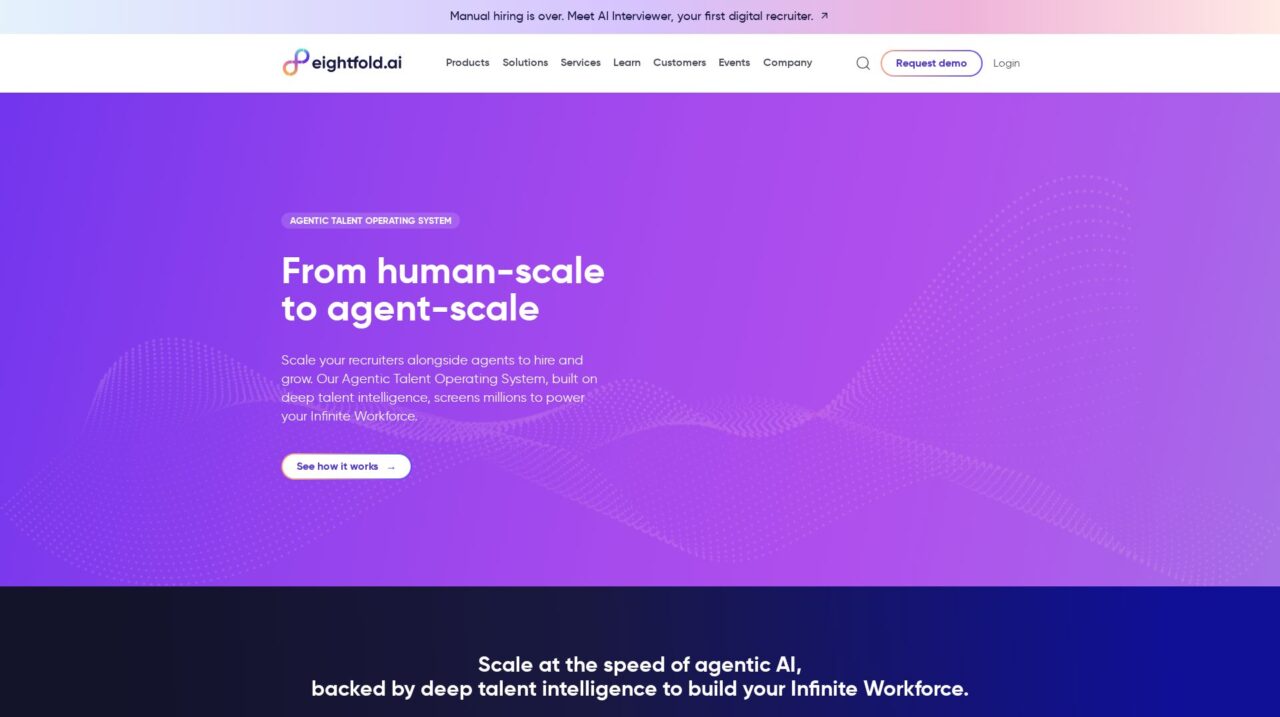

Eightfold AI is an enterprise-grade AI recruiting and talent intelligence platform that helps large organizations hire, retain, and develop talent using deep skills data and machine learning.
We’ve taken a close look at Eightfold AI to understand how its Agentic Talent Operating System actually performs for modern HR and talent teams. This review is our grounded evaluation of where it excels, where it falls short, and when it makes sense to deploy it.
If you are still exploring the broader landscape of tools, you may also want to compare it against other options in our talent and recruiting software coverage on CX Everywhere, where we look at ATS platforms, CRMs, and broader talent suites.
Eightfold AI is widely recognized in the enterprise HR tech space for its AI recruiting and talent intelligence capabilities, and it often appears on shortlists for skills-based transformation projects. Yet its positioning and marketing language can be abstract, which makes a pragmatic, use-case-oriented review important before you commit.
In the sections that follow, we will walk through Eightfold’s core strengths, limitations, and key features, and how well it serves different types of organizations. This review is most relevant for large and global companies, government agencies, and complex organizations that need help with high-volume hiring, internal mobility, and skills visibility across the workforce.
At its core, Eightfold AI aims to solve the problem of matching people to opportunities: jobs, projects, and learning paths. It does this by applying large-scale machine learning to global career data and then plugging that intelligence into everyday HR workflows, from sourcing and screening to workforce planning and employee development.
Eightfold AI Review Summary
Overall, Eightfold AI is one of the strongest options available for enterprises looking to add serious AI and skills intelligence to their talent stack. Its combination of a massive skills graph, agentic AI automations, and coverage of both external recruiting and internal mobility makes it more strategic than point solutions that only optimize a single step of the funnel.
However, the platform’s power comes with expectations: you need clean data, executive sponsorship, and a team ready to redesign hiring and mobility processes around AI-assisted decisions. For organizations that can meet those conditions, Eightfold AI is a compelling way to move toward a skills-based, future-ready workforce. For smaller or less mature teams, it may be more platform than they can realistically absorb.
How We Review Tools and Assign the CX Score
We've developed a comprehensive scoring system to evaluate software tools objectively. Our CX Score (1.0–5.0) reflects how strong a product is within its category, based on hands-on testing and analysis across multiple criteria.
Core Functionality
Does the tool deliver the essential features users expect? We assess whether core capabilities meet category standards and if key features are accessible across pricing tiers.
Standout Features
We evaluate unique capabilities that go beyond the basics—features that make the product faster, more efficient, or offer additional value compared to competitors.
Ease of Use
How intuitive is the interface? We consider design quality, mobile apps, templates, and whether complex tasks feel simple to execute.
Onboarding
We measure how quickly new users can get productive with minimal training. High-scoring tools require little to no external support to get started.
Integrations
We assess native integrations, third-party connections, and API access. Tools that connect easily with common tech stacks score higher.
Customer Support
How easy is it to get help? We evaluate support channels, response times, and quality of documentation. Real-time human support scores best.
Value for Money
We compare pricing against features delivered. Software that offers more functionality at competitive prices receives higher marks.
Features of Eightfold AI
- AI-powered candidate matching
- Internal mobility and career pathing
- Talent CRM and talent pool management
- Skills intelligence and workforce analytics
- Agentic AI automations and AI interviewers
- Responsible and explainable AI controls
- Integration with major ATS platforms
- Integration with core HRIS systems
- Open API access
- Employee self-service career portal
- Diversity-aware recommendations
- Multi-tenant cloud deployment
- Single sign-on (SSO)
- Mobile-responsive user experience
- Built-in reporting and dashboards
- Email and campaign outreach tools
- On-premise deployment
- SMB-focused simple ATS features
AI-driven candidate and employee matching for every role
Eightfold AI’s core feature is its matching engine, which uses a large global dataset of career trajectories and skills to score how well people fit specific roles, projects, or opportunities. Instead of relying on keyword matches alone, it infers adjacent skills, learning potential, and career patterns, making it far better at uncovering non-obvious fits and transferable talent. This helps recruiters and hiring managers surface strong candidates faster, including diverse and unconventional profiles that traditional tools might overlook.
Compared with typical ATS search or simple AI plugins, Eightfold’s matching is more nuanced because it is trained on billions of profiles and millions of skills across industries. That breadth allows the system to recommend candidates and employees based on true capability and potential instead of just job-title proximity.
Internal mobility and career pathing for existing employees
Beyond external recruiting, Eightfold provides internal mobility tools that allow employees to discover roles, gigs, and projects that match their skills and aspirations. The platform surfaces opportunities directly to employees, while managers and HR teams can see who in the organization could be redeployed or upskilled to fill critical needs. It also maps potential career paths and adjacent roles based on real-world data, helping employees visualize how they can grow within the company.
This goes further than basic internal job boards commonly bundled with HCM suites. Instead of expecting employees to search and guess, Eightfold proactively recommends moves and learning content, supporting a more dynamic skills-based organization where internal talent is prioritized before relying on external hiring.
Talent CRM and sourcing powered by talent intelligence
Eightfold acts as a talent CRM that aggregates candidates from various sources and enriches their profiles with inferred skills and experience. Recruiters can segment pools, rediscover past applicants, and run targeted outreach based on skills, potential, and likelihood to engage. AI-driven automation helps prioritize who to contact first and which messages to send, saving time on manual list building and bulk emailing.
While some recruiting CRMs focus mainly on campaign tooling, Eightfold differentiates by using its deep data to drive who you target in the first place. This means sourcers and recruiters can spend more time on meaningful conversations and less on manual screening and sorting.
Skills intelligence and workforce analytics for strategic planning
A major advantage of Eightfold is its ability to give leaders a skills-based view of the workforce. The platform aggregates employee skills, inferred capabilities, and external market data to show where you have strength, where gaps are emerging, and which roles can be filled internally versus externally. This skills intelligence can inform workforce plans, reskilling programs, and transformation initiatives, especially in industries undergoing rapid change.
Compared to typical HR reporting, which is often limited to headcount and turnover metrics, Eightfold adds a richer layer focused on capabilities and potential supply. It is particularly useful for organizations pursuing skills-based operating models or trying to align HR and business strategies around future talent needs.
Responsible and explainable AI for compliant decision support
Eightfold emphasizes responsible AI, building transparency and explainability into its models so HR and legal teams can understand how recommendations are generated. The system tracks variables that influence scores and provides controls to help mitigate bias, aligning with fairness and compliance requirements in highly regulated sectors. This is critical for large enterprises and government agencies that must defend hiring and promotion practices.
Many AI recruiting tools offer little visibility into how their models work, which can create risk and hesitation. Eightfold’s focus on responsible AI, combined with its track record with Fortune 500 companies and public-sector organizations, makes it a safer choice for buyers who cannot afford opaque black-box systems.
Agentic automation to reduce manual recruiter workload
The platform includes agentic AI capabilities that act as digital assistants for recruiters, HRBPs, and managers. These agents can automatically screen large volumes of applicants, prioritize outreach, nudge candidates through the process, and bring promising internal matches to the attention of hiring teams. In some scenarios, AI interviewers or screening workflows can handle early-stage interactions so humans can focus on later, higher-value conversations.
This level of automation goes beyond simple rules-based workflows available in many ATS solutions. By combining agents with deep talent intelligence, Eightfold can make more context-aware decisions about who to engage, when, and how, which typically leads to faster hiring cycles and fewer missed opportunities in existing candidate pools.
From an end-user perspective, Eightfold AI is reasonably intuitive for a system with this level of sophistication. Recruiters interact with prioritized candidate lists, AI scores, and clear filters instead of raw resume dumps, and hiring managers receive curated shortlists and talent insights rather than needing to search from scratch. Employees use a portal-like experience to see recommended roles, gigs, and learning paths, which feels more like a consumer application than a legacy HR system.
The heavier lift is in implementation and administration. Deploying Eightfold typically involves integrating with existing ATS, HRIS, and often learning platforms, mapping data fields, aligning on skills taxonomies, and configuring matching and automation rules. The learning curve for admins and HR tech teams is real, but manageable when there is a dedicated project team. Organizations that plan for change management, stakeholder training, and iterative tuning tend to get strong adoption; those hoping for an instant drop-in replacement may find it challenging.
Eightfold AI is designed to sit alongside and augment existing HR technology stacks, so integrations are central to its value. In practice, it connects to major ATS platforms, core HR systems, and often learning management systems to ingest candidate and employee data, synchronize statuses, and push recommendations back into familiar workflows. This allows recruiters and managers to access AI-driven insights without abandoning their primary systems of record.
While public documentation highlights broad integration capabilities and APIs, specifics will depend on your current stack and region. Buyers should confirm the depth of native integrations with their ATS and HRIS, understand how data flows in both directions, and verify support for SSO and security policies. For very complex or custom environments, an open API and technical support are important to ensure Eightfold can be fully embedded into existing processes rather than operating as a silo.
Eightfold AI Overview
Pros
- Extremely deep global dataset of skills and career trajectories powering accurate matching
- Strong coverage of both external recruiting and internal mobility on one platform
- Agentic AI automations significantly reduce manual screening and sourcing work
- Robust focus on responsible, explainable AI suitable for regulated enterprises
- Excellent fit for large, complex organizations with high hiring volume
- Helps shift organizations toward a skills-based workforce strategy
- Widely adopted by Fortune 500 and public-sector organizations, de-risking enterprise adoption
Cons
- Implementation can be complex and resource-intensive for HR and IT teams
- Pricing and packaging are enterprise-focused, less attractive to smaller companies
- Not a full HCM suite, so you still rely on other systems for core HR and payroll
- Value depends heavily on data quality and integration depth with existing tools
- Some niche workflows may still require complementary point solutions
Eightfold AI: Frequently Asked Questions
What type of organizations is Eightfold AI best suited for?
Eightfold AI is best for large enterprises, global organizations, and public-sector bodies that need to manage complex hiring, internal mobility, and skills-based workforce planning at scale.
Can Eightfold AI replace my existing ATS or HCM?
Eightfold can augment or partially replace ATS workflows but is not a full HCM suite; you will still need core HR, payroll, and other transactional systems, ideally integrated with Eightfold.
How difficult is it to implement Eightfold AI?
Implementation can be significant, typically requiring integrations with ATS and HRIS systems, data mapping, and process redesign, so a dedicated project team and strong stakeholder support are important.
Does Eightfold AI support internal mobility and career development?
Yes, Eightfold offers internal mobility features that recommend roles, gigs, and learning paths to employees while helping managers identify internal candidates for open opportunities.
How does Eightfold address bias and fairness in AI?
Eightfold emphasizes responsible AI, using transparent and explainable models with controls to mitigate bias and support fair, compliant hiring and talent decisions.
Is Eightfold AI suitable for small businesses or startups?
Generally no; its pricing, implementation effort, and breadth of capabilities are oriented toward mid-large enterprises rather than small teams seeking a simple ATS.
What systems can Eightfold AI integrate with?
Eightfold integrates with leading ATS and core HR systems and can connect to learning platforms; buyers should validate specific native integrations and API capabilities for their stack.
Does Eightfold provide analytics on skills and workforce gaps?
Yes, the platform includes skills intelligence and workforce analytics that show current capabilities, gaps, and potential internal supply to support strategic workforce planning.
