
Factorial Review: All-in-One HR and Business Management Software
 Feb 03,2026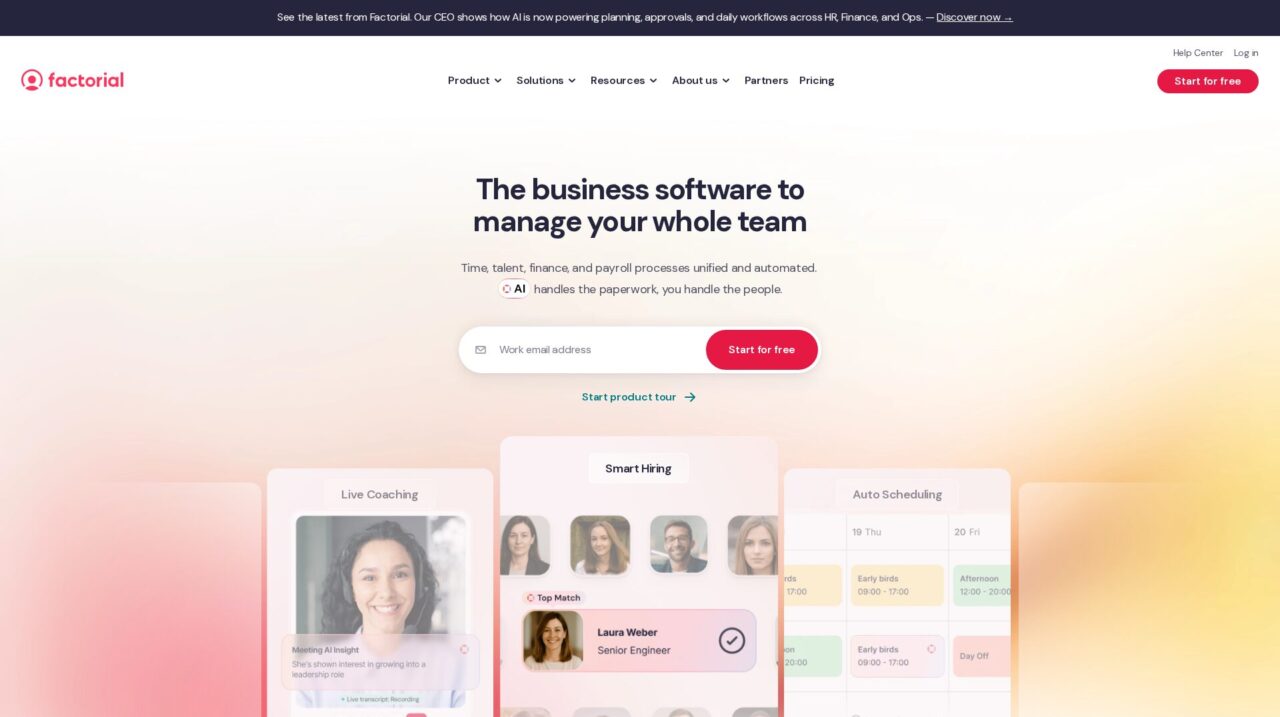

Factorial is an all-in-one HR and business management platform that centralizes people ops, time tracking, payroll, and expenses for small and mid-sized companies.
We have taken a close look at Factorial to understand how well it actually functions as an all-in-one HR and business management platform. This review pulls together what the product does in real workflows, where it shines, and where it falls short compared with other HR and business management software.
If you are still surveying the market, it may also be worth comparing Factorial against other options in our broader HR and payroll software guides on CX Everywhere, so you can see how it stacks up across different segments and use cases.
Factorial has built a strong reputation among small and midsize businesses that want to replace spreadsheets and disconnected tools with a single, more modern system. Many teams arrive at Factorial because they need a cleaner way to manage absences, contracts, payroll-related data, and performance reviews without adding complexity for managers and employees.
In this review, you will learn Factorial’s main pros and cons, the core feature set, how it handles everyday HR and finance workflows, and what types of companies it is best suited for. The focus is on practical guidance for HR leaders, finance teams, and business owners who need to decide whether Factorial is the right operational backbone for their people and administrative processes.
At its core, Factorial centralizes employee data, time tracking, absences, performance cycles, and expense management into one cloud-based platform. HR teams, managers, and employees use it to automate repetitive tasks like PTO approvals and expense submissions, while leadership gets better visibility into time, costs, and team performance so they can make more informed decisions.
Factorial Review Summary
Overall, Factorial is a well-rounded HR and business management platform that delivers solid value for small and midsize organizations looking to streamline people operations. It covers the key building blocks of an HRIS, time and attendance tracking, basic talent management, and finance workflows such as payroll support and expenses, all wrapped in a user-friendly interface that employees are willing to adopt.
It is not intended to be a full ERP or an ultra-deep best-of-breed solution in every individual category, so enterprises with complex global payroll or highly specialized talent processes may still need additional systems. But for the vast majority of growing companies, Factorial offers a strong balance of breadth, automation, and usability at a competitive price point, making it a serious contender on any HR and business management shortlist.
How We Review Tools and Assign the CX Score
We've developed a comprehensive scoring system to evaluate software tools objectively. Our CX Score (1.0–5.0) reflects how strong a product is within its category, based on hands-on testing and analysis across multiple criteria.
Core Functionality
Does the tool deliver the essential features users expect? We assess whether core capabilities meet category standards and if key features are accessible across pricing tiers.
Standout Features
We evaluate unique capabilities that go beyond the basics—features that make the product faster, more efficient, or offer additional value compared to competitors.
Ease of Use
How intuitive is the interface? We consider design quality, mobile apps, templates, and whether complex tasks feel simple to execute.
Onboarding
We measure how quickly new users can get productive with minimal training. High-scoring tools require little to no external support to get started.
Integrations
We assess native integrations, third-party connections, and API access. Tools that connect easily with common tech stacks score higher.
Customer Support
How easy is it to get help? We evaluate support channels, response times, and quality of documentation. Real-time human support scores best.
Value for Money
We compare pricing against features delivered. Software that offers more functionality at competitive prices receives higher marks.
Features of Factorial
- Core HRIS and employee records
- Employee self-service portal
- Time and attendance tracking
- PTO and absence management
- Onboarding workflows
- Performance reviews and feedback
- Expense management
- Payroll management or integrations
- Basic HR and workforce analytics
- Mobile apps (iOS and Android)
- Integrations marketplace
- Open API
- SSO and identity provider support
- Document management and e-signatures
- Multi-country support
- Dedicated ATS / recruiting suite
- Advanced learning management (LMS)
- Full ERP and accounting functionality
- On-premise deployment
Centralized employee records and self-service portal
Factorial provides a core HR database where all employee information, contracts, and documents are stored in a structured way. Each employee gets a profile with personal details, job information, documents, and HR-related records, which becomes the single source of truth for people data across HR and finance teams.
On top of that, a self-service portal allows employees to update certain details, access payslip information where applicable, download documents, and manage everyday requests. This reduces the back-and-forth with HR and makes the experience less bureaucratic for both employees and managers.
Automation for time tracking, leave, and attendance
Time and attendance is one of Factorial’s core strengths. Employees can clock in and out, record working hours, and request PTO or sick leave through the web or mobile app. Policies and approval flows can be configured so that requests are automatically routed to the right manager, with balances updated in real time.
Automating these processes means fewer errors, less manual data entry, and fewer ad-hoc questions about remaining days off or hours. Compared with simpler time-tracking tools, Factorial’s advantage is that these records live inside the same system as HR and payroll-related data, which makes compliance and reporting much easier.
Talent management for onboarding and performance
Factorial includes capabilities to structure how you bring people into the organization and how you manage their ongoing performance. HR teams can create onboarding workflows with tasks for IT, managers, and the new hire, ensuring that equipment, accounts, and documentation are ready on day one. This helps standardize the employee experience and reduces missed steps.
For performance, Factorial supports review cycles, feedback collection, and goal tracking, so managers can run recurring evaluations and tie them to development plans. While it may not replace a dedicated performance suite in large enterprises, it is more than sufficient for most SMBs and far better than fragmented spreadsheets or email-based reviews.
Payroll, expenses, and finance visibility
Factorial bridges HR and finance by connecting time, people, and cost data. In supported countries, it can help manage payroll workflows, and even where a separate payroll provider is used, the system acts as the source of key inputs such as hours worked, leave taken, and contractual terms. This reduces manual reconciliation and helps avoid costly errors.
Expense management is another important piece. Employees can submit expenses, attach receipts, and have them approved through the same platform that handles their HR tasks. Finance teams benefit from centralized records and clearer visibility into spending by person, team, or project, with reporting that supports budgeting and compliance needs.
Analytics and decision support for managers and leaders
One of the reasons to adopt a business management system is to get better insight into how the organization operates. Factorial provides analytics on attendance, absences, headcount, and costs, which help HR and leadership understand patterns such as overtime usage, absenteeism, or the distribution of labor across teams.
These reports are not intended to match a full BI tool, but they are a substantial upgrade over what most SMBs have when running HR from spreadsheets. Real-time data from time tracking, HR records, and expenses are combined to support more informed, data-driven decisions without constant export and manipulation.
Flexible modular packaging and configuration
Factorial offers its capabilities in modules, allowing businesses to activate only the areas they need, such as core HR, time tracking, talent management, or finance-oriented features. This modularity helps control costs and reduces feature bloat for teams that want to adopt the platform gradually.
Within each module, admins can configure policies, workflows, approval chains, and access levels to reflect how their organization actually functions. This balance of structure and flexibility is important: it lets smaller companies adopt best practices quickly while still supporting the more nuanced processes of larger or more regulated organizations.
Factorial is designed for non-technical users, with a modern, clean interface that feels closer to consumer apps than many legacy HR or payroll systems. Navigation is straightforward, with clear areas for employees, managers, and administrators, and most everyday actions such as requesting leave, submitting expenses, or completing a review are only a few clicks away. The strong mobile experience further reduces friction, since many employees prefer handling quick HR tasks from their phones.
Implementation effort depends on how many modules you adopt and how complex your policies are. Simple rollouts focused on core HR and absence tracking can be configured relatively quickly, especially with guidance from Factorial’s onboarding team. More advanced deployments that include multiple countries, intricate approval chains, or deep finance workflows require a more structured project, but still generally sit below the complexity of traditional enterprise HR suites. Ongoing administration is manageable for a small HR or operations team, as most changes involve updating configurations rather than technical work.
Factorial promotes a broad integrations ecosystem, with the ability to connect to hundreds of external tools. Common integration categories include payroll providers, accounting systems, calendars, identity and SSO platforms, collaboration tools, and specialized HR apps like ATS or benefits platforms. These integrations help keep data consistent across systems and reduce duplicate entry, which is critical for businesses that already rely on a set of core finance or IT tools.
For scenarios where a ready-made connector does not exist, Factorial offers an open API so engineering or operations teams can build custom integrations or push data into analytics warehouses and internal systems. Buyers with complex stacks should verify which native integrations are available for their region and test API-based connections during evaluation. Overall, for small and midsize organizations with mainstream tools, Factorial’s integration capabilities are usually sufficient, while enterprises should pay close attention to specific technical and security requirements.
Factorial Overview
Pros
- Broad coverage across HR, time tracking, talent management, and expenses in one platform
- Modern, intuitive interface that is easy for employees and managers to adopt
- Strong automation for routine tasks like PTO approvals, time tracking, and expenses
- Modular packaging so companies only pay for the capabilities they need
- Good mobile apps with high user ratings, supporting on-the-go HR tasks
- Open API and integrations marketplace to connect with existing tools
- Centralized employee data improving compliance, reporting, and audit readiness
- Well-reviewed onboarding experience that helps teams implement quickly
Cons
- Depth of features may lag best-of-breed tools for advanced talent management
- Payroll capabilities and compliance vary by country and may require local providers
- Not a full ERP or accounting system, so finance teams may still need separate tools
- Enterprises with highly complex global structures may find customization limiting
Factorial: Frequently Asked Questions
What type of companies is Factorial best suited for?
Factorial is best for small and midsize organizations that want to centralize HR, time tracking, and basic finance workflows in a single, easy-to-use platform.
Does Factorial replace my accounting or ERP system?
No, Factorial focuses on HR and people-centric business management; you will typically still need an accounting or ERP system for full financial operations.
Can Factorial handle multi-country teams?
Factorial supports multi-country setups, but depth of payroll and compliance features varies by region, so global teams should validate coverage country by country.
Is Factorial easy for employees to use?
Yes, Factorial emphasizes a modern, intuitive interface and mobile apps so employees can handle tasks like PTO requests and expenses with minimal training.
How flexible is Factorial’s pricing?
Factorial uses modular, per-employee pricing, allowing you to select only the modules you need and request personalized quotes for more complex environments.
Can we integrate Factorial with our existing tools?
Factorial offers a marketplace of integrations and an open API, making it possible to connect with many common HR, finance, and IT systems.
How long does implementation usually take?
Simple deployments for core HR and leave management can be set up relatively quickly, while multi-module, multi-country projects require a more structured rollout with Factorial’s onboarding support.
Does Factorial support performance management processes?
Yes, Factorial includes tools for running performance reviews, collecting feedback, and tracking goals, suitable for most small and midsize businesses.
