
Gem Review: AI-First Recruiting Platform for Modern Talent Teams
 Mar 21,2026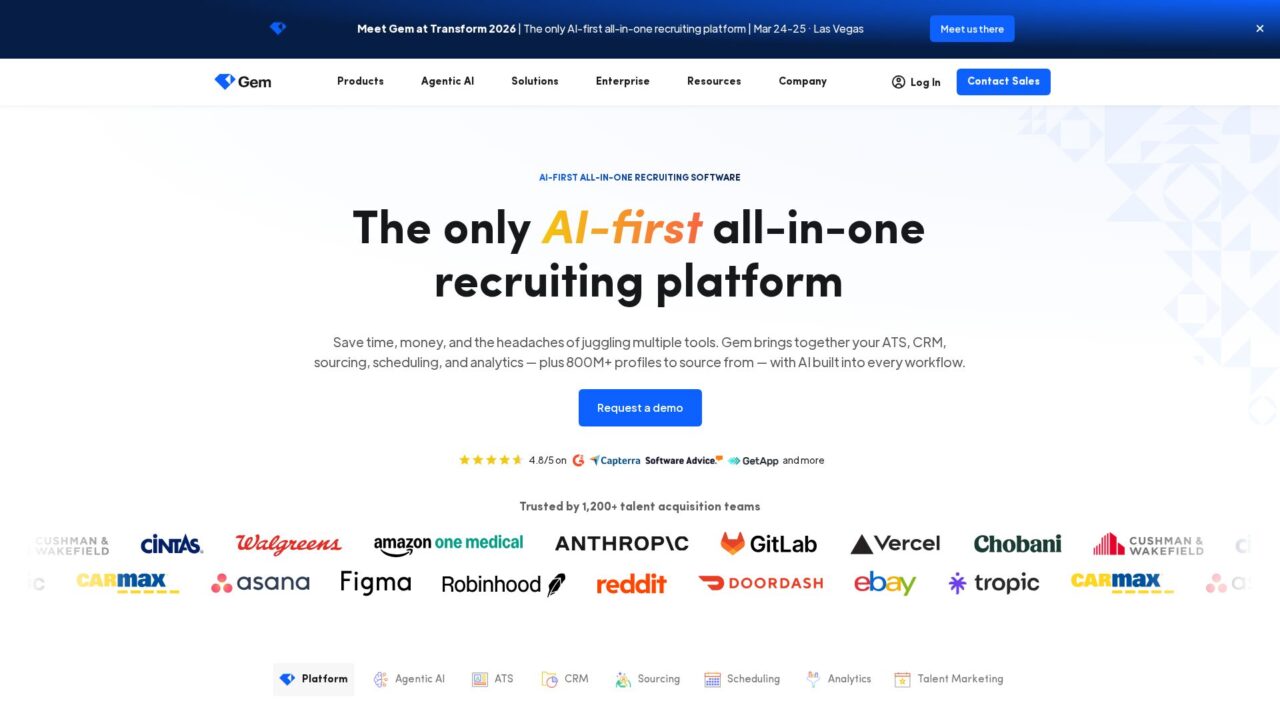

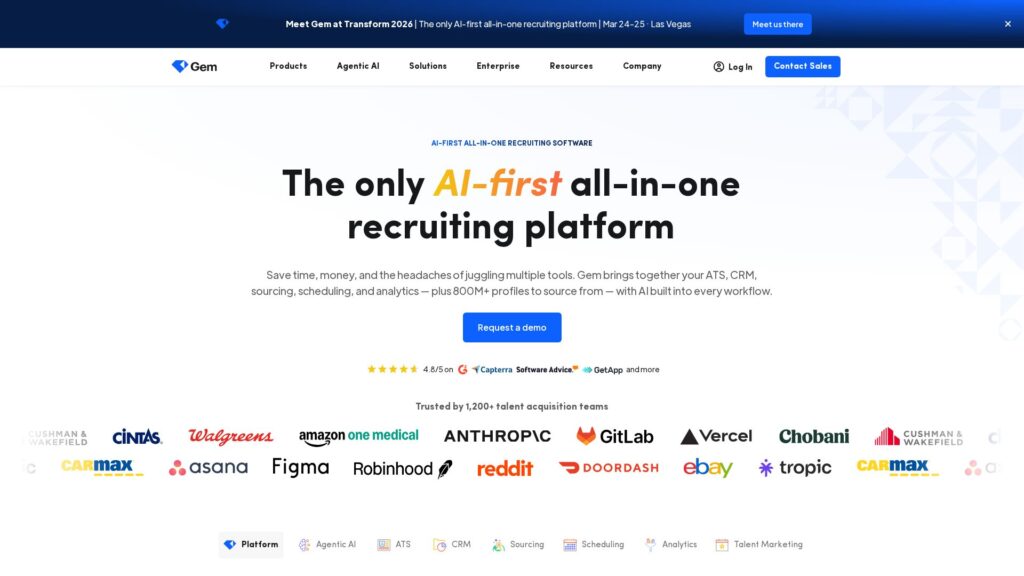
Gem is an AI-first, all-in-one recruiting platform that combines ATS, CRM, sourcing, scheduling, and analytics to help in-house talent teams hire faster and more efficiently.
After analyzing Gem across its modules and real-world use cases, this review lays out how the platform actually performs for modern recruiting teams. If you are evaluating recruiting software and comparing options in the broader recruiting platform category on CX Everywhere, this will help you understand where Gem fits.
Gem has built a strong reputation as an AI-first, all-in-one recruiting solution trusted by over a thousand talent acquisition teams. Many buyers hear about it through word of mouth or review sites, but still need a more detailed, practitioner-focused perspective before committing to such a central system.
In this review, you will get a clear breakdown of Gem’s strengths and weaknesses, its key features, and the types of teams and hiring environments where it excels or falls short. The goal is to give founders, talent leaders, and recruiting operations professionals enough context to decide whether Gem is a strong match for their hiring strategy.
We will focus particularly on in-house recruiting teams at growing companies, from funded startups to large enterprises, that are looking to consolidate ATS, CRM, sourcing, scheduling, and analytics into a single platform with AI embedded throughout.
Gem Review Summary
Gem delivers a robust, AI-first recruiting platform that stands out for its ability to unify ATS, CRM, sourcing, scheduling, and analytics in a single interface. For organizations dealing with tool sprawl, inconsistent data, and manual reporting, this consolidation can translate into significant efficiency gains and more strategic use of historical candidate data.
However, like most all-in-one systems, Gem is most compelling when you lean into it as a core recruiting platform rather than treating it as a small add-on. Teams should budget for implementation and change management to fully realize the benefits. For scaling companies that see talent acquisition as a strategic function, Gem offers a strong balance of power, usability, and long-term scalability.
How We Review Tools and Assign the CX Score
We've developed a comprehensive scoring system to evaluate software tools objectively. Our CX Score (1.0–5.0) reflects how strong a product is within its category, based on hands-on testing and analysis across multiple criteria.
Core Functionality
Does the tool deliver the essential features users expect? We assess whether core capabilities meet category standards and if key features are accessible across pricing tiers.
Standout Features
We evaluate unique capabilities that go beyond the basics—features that make the product faster, more efficient, or offer additional value compared to competitors.
Ease of Use
How intuitive is the interface? We consider design quality, mobile apps, templates, and whether complex tasks feel simple to execute.
Onboarding
We measure how quickly new users can get productive with minimal training. High-scoring tools require little to no external support to get started.
Integrations
We assess native integrations, third-party connections, and API access. Tools that connect easily with common tech stacks score higher.
Customer Support
How easy is it to get help? We evaluate support channels, response times, and quality of documentation. Real-time human support scores best.
Value for Money
We compare pricing against features delivered. Software that offers more functionality at competitive prices receives higher marks.
Features of Gem
- Applicant Tracking System (ATS)
- Recruiting CRM
- AI-assisted sourcing
- AI application screening
- Talent rediscovery in ATS/CRM
- Built-in candidate database
- Email and outreach sequencing
- Interview scheduling
- Recruiting analytics and reporting
- Pipeline and funnel visualization
- Team collaboration and hiring manager portal
- Custom workflows and stages
- Role-based permissions
- Calendar integrations
- Email integrations
- Open API
- HRIS integrations
- Diversity sourcing and tracking tools
- Chrome or browser extension for sourcing
- Mobile access via responsive web
- On-premise deployment
- Staffing agency specific workflows
Unified ATS and Candidate Relationship Management
Gem combines traditional applicant tracking with a full-featured candidate relationship management layer. Recruiters can manage live requisitions, move candidates through pipeline stages, and at the same time maintain long-term relationships with prospects for future roles. This reduces the common fragmentation between where candidates apply and where talent teams build pipelines.
Compared with legacy ATS tools that bolt on a simple “talent pool” feature, Gem’s CRM capabilities are designed for proactive recruiting. You can segment candidates, track engagement history, and nurture them over time, which is especially valuable for companies that hire repeatedly for the same roles or want to build strategic talent communities.
AI Recruiting Agents for Sourcing and Screening
AI recruiting agents are a central part of Gem’s value proposition. They assist with sourcing by surfacing candidates from external databases as well as from your existing ATS and CRM, helping rediscover strong profiles that might otherwise be overlooked. They can also support reviewing inbound applications, prioritizing candidates that fit predefined criteria.
This automation helps recruiters focus on conversations and decision-making rather than manual profile review. Unlike basic keyword matching or simple rules engines found in some tools, Gem’s AI components are more deeply integrated into the platform’s unified data model, which allows them to learn from interactions and outcomes over time.
Large Talent Data Pool for Outbound Sourcing
Gem provides access to a substantial external profile database, giving teams a built-in alternative to separate sourcing tools. Recruiters can search across hundreds of millions of profiles, filter by role, location, and other criteria, and add promising candidates directly into CRM campaigns or live requisitions.
For teams that previously relied on multiple extensions and subscriptions to gather candidate data, this consolidation simplifies workflows and licensing. It also ensures that sourced candidates flow into the same system used for tracking and nurturing, reducing duplication and data loss.
Simplified Interview Scheduling and Coordination
Scheduling interviews is often one of the most time-consuming parts of recruiting. Gem includes scheduling capabilities that help coordinate between candidates, recruiters, and hiring managers, reducing the email ping-pong that slows down hiring. Automated slot suggestions and calendar integrations streamline the process and keep candidates moving through the funnel.
Compared with standalone scheduling tools, Gem’s scheduling is tightly tied to pipeline stages, so changes in interview status automatically reflect in candidate records and dashboards. This connection prevents scheduling from becoming an off-system workflow that breaks analytics.
End-to-End Recruiting Analytics and Funnel Visibility
Gem’s analytics give talent leaders visibility across the entire recruiting funnel, from source and outreach through to offer acceptance. You can track performance by role, recruiter, channel, or hiring manager, and identify bottlenecks or drop-off points that are costing time and candidates. This is a significant upgrade from the basic, often rigid reporting offered by many ATS platforms.
The unified data architecture means reports can blend information from sourcing, CRM campaigns, ATS stages, and scheduling in one view. This enables more nuanced questions, such as which nurture campaigns drive the highest-quality hires or how time-to-hire varies by recruiter or business unit.
Single Interface and Unified Permissions
One of Gem’s practical advantages is that recruiters, hiring managers, and operations teams all work in a single interface. Permissions and access can be controlled centrally, reducing administrative overhead and lowering the risk of inconsistent security practices across multiple tools. This is particularly valuable in larger organizations with complex org structures.
While many stacks attempt to approximate this cohesion through integrations, Gem’s native unification generally results in fewer sync delays, fewer data conflicts, and a more straightforward onboarding experience for new recruiters or hiring managers who only need to learn one system.
Designed for Recruiter Productivity and Ease of Adoption
Despite its breadth, Gem is designed with simplicity for recruiters in mind. Workflows such as sourcing, outreach, moving candidates through stages, and logging interactions are streamlined so that the platform feels like a productivity tool rather than a compliance chore. This focus improves adoption and ensures data is actually captured in the system.
Against traditional ATS systems that can feel rigid and form-heavy, Gem’s user experience is more modern and oriented around day-to-day recruiter tasks. That said, teams still need to invest in initial training, particularly for hiring managers who may be transitioning away from email-centric workflows.
Gem is built to be approachable for recruiters, with a modern UI and workflows that mirror how talent teams naturally work. Common tasks like sourcing, sending outreach sequences, moving candidates between stages, and scheduling interviews are accessible from intuitive views. For recruiters coming from traditional ATS systems, Gem typically feels more responsive and less cluttered.
Implementation effort varies by company size and existing stack. For small to mid-sized teams consolidating a few tools, rollout can be relatively straightforward, especially if you adopt Gem as your primary system of record. Larger enterprises with complex legacy ATS or CRM setups should expect a more involved project that includes data migration, process mapping, and stakeholder training. Once configured, everyday usability is strong, but the full benefits are realized only when the organization commits to standardizing processes within Gem.
Gem is designed to sit at the center of the recruiting ecosystem, integrating with existing ATS platforms when used in a layered model, and with core business tools such as calendars and email to support scheduling and outreach. It also connects to HR systems and other HR tech where needed so that candidate and hire data can move downstream without manual exports and imports.
The exact set of native integrations and API capabilities will depend on your plan and implementation. Buyers should verify support for their current ATS or HRIS, email and calendar platform, background check provider, and any specialty tools they rely on. Where native integrations are not available, Gem’s API can typically be used to build custom connections, but this may require internal engineering or a third-party integration partner. As with any central recruiting platform, ensuring that Gem fits cleanly into your existing architecture is a key part of vendor evaluation.
Gem Overview
Pros
- Unified ATS, CRM, sourcing, scheduling, and analytics in a single platform
- AI recruiting agents help with sourcing, screening, and rediscovering past candidates
- Access to a large external profile database for outbound sourcing
- Strong end-to-end funnel analytics for data-driven recruiting decisions
- Modern, recruiter-friendly interface that improves day-to-day productivity
- Can significantly reduce tool sprawl and overlapping recruiting software costs
- Designed to work for both growing startups and large enterprise TA teams
- High customer satisfaction ratings and broad adoption in the TA market
Cons
- May be more complex and powerful than very small teams require
- Requires thoughtful implementation and change management to realize full value
- Best suited to in-house talent teams, less tailored to staffing agencies
- Value depends on consolidating systems, which may be difficult with long-term legacy contracts
Gem: Frequently Asked Questions
What type of teams is Gem best suited for?
Gem is primarily designed for in-house talent acquisition teams at growing startups, mid-market companies, and enterprises that want to centralize ATS, CRM, sourcing, scheduling, and analytics in one platform.
Can Gem work alongside an existing ATS?
Yes, Gem can operate as an AI-driven layer with sourcing and CRM capabilities on top of certain existing ATS platforms, or you can use Gem ATS as part of its all-in-one recruiting solution.
Does Gem include AI features out of the box?
Yes, Gem includes AI recruiting agents that help with sourcing candidates, reviewing applications, and rediscovering talent already stored in your ATS and CRM.
Is Gem suitable for small businesses with low hiring volume?
Very small businesses or teams with occasional hiring may find Gem more powerful than they need; simpler ATS tools or HRIS modules might be more cost-effective for low-volume recruiting.
How difficult is it to implement Gem?
Implementation effort depends on your size and stack. Smaller teams consolidating a few tools can implement relatively quickly, while larger enterprises with legacy systems should plan for a structured rollout with data migration and training.
Does Gem support analytics on the entire recruiting funnel?
Yes, Gem provides robust analytics covering sourcing, outreach, pipeline stages, and hiring outcomes so you can understand performance by channel, recruiter, role, and more.
