
JobAdder Review: ATS and CRM Recruitment Software Explained 2026
 Mar 23,2026

JobAdder is a cloud-based recruitment ATS and CRM platform for agencies and in-house talent teams, focused on simplifying hiring and leveraging AI for speed and quality.
I have evaluated JobAdder as part of a broader analysis of modern recruitment software, focusing on how it performs as an ATS and CRM platform for real-world recruitment teams. This review distils that evaluation into practical guidance for buyers deciding whether it is the right fit.
If you are still mapping the landscape of recruitment technology in general, it is worth comparing JobAdder with other tools in the wider recruitment software and ATS ecosystem before committing. Understanding the strengths and tradeoffs of this category will help you interpret where JobAdder is genuinely differentiated and where it simply meets the standard.
JobAdder is widely used among recruitment agencies, staffing firms and in-house talent acquisition teams, and has built a reputation for being easier and more pleasant to use than many legacy ATS systems. Yet that does not automatically mean it is the best choice for every organisation or hiring model, which is why a deeper, critical look is important.
In this review, you will learn how JobAdder works, its core features, where it excels, the limitations to watch for and the types of companies and teams it tends to suit best. The focus is on helping agency owners, recruitment leaders and HR and talent heads decide whether JobAdder fits their processes, scale and technology strategy.
At its core, JobAdder aims to solve the problem of fragmented, manual recruitment by bringing applicant tracking, recruitment CRM and marketing together in one cloud platform. It supports both agencies and internal talent teams, spanning permanent, temporary and contract recruitment and providing AI-assisted workflows to speed up sourcing, screening and placements.
JobAdder Review Summary
Overall, JobAdder is a well-designed recruiting platform that balances breadth and usability unusually well for an ATS and CRM combination. It covers the end-to-end recruitment lifecycle for agencies and in-house teams, with special attention to user adoption, embedded learning and AI features that reduce busywork and make existing databases more valuable.
The main limitations relate less to quality and more to scope and fit. JobAdder is not intended to replace a full HRIS or payroll system, and very large enterprises with heavily customised requirements may find other platforms better suited to deep, organisation-wide standardisation. For its target segments though, particularly recruitment agencies and mid-sized talent teams, JobAdder offers a compelling mix of capability, simplicity and support.
How We Review Tools and Assign the CX Score
We've developed a comprehensive scoring system to evaluate software tools objectively. Our CX Score (1.0–5.0) reflects how strong a product is within its category, based on hands-on testing and analysis across multiple criteria.
Core Functionality
Does the tool deliver the essential features users expect? We assess whether core capabilities meet category standards and if key features are accessible across pricing tiers.
Standout Features
We evaluate unique capabilities that go beyond the basics—features that make the product faster, more efficient, or offer additional value compared to competitors.
Ease of Use
How intuitive is the interface? We consider design quality, mobile apps, templates, and whether complex tasks feel simple to execute.
Onboarding
We measure how quickly new users can get productive with minimal training. High-scoring tools require little to no external support to get started.
Integrations
We assess native integrations, third-party connections, and API access. Tools that connect easily with common tech stacks score higher.
Customer Support
How easy is it to get help? We evaluate support channels, response times, and quality of documentation. Real-time human support scores best.
Value for Money
We compare pricing against features delivered. Software that offers more functionality at competitive prices receives higher marks.
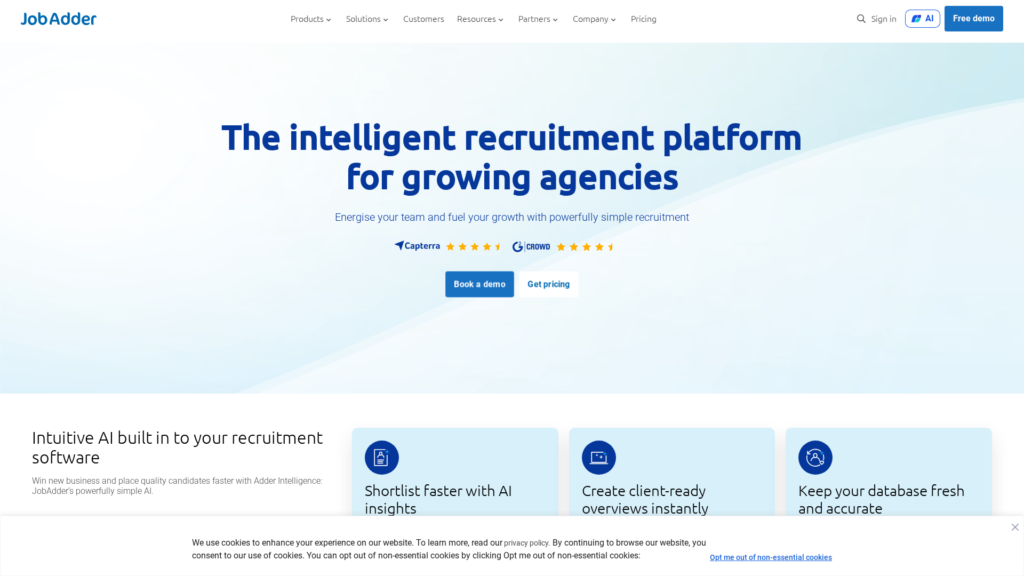
Features of JobAdder
- Cloud-based deployment
- Applicant tracking system (ATS)
- Recruitment CRM
- Support for recruitment agencies
- Support for in-house talent teams
- Permanent recruitment workflows
- Temporary and contract recruitment workflows
- AI-powered search and matching
- Recruitment marketing tools
- Placement management
- Recruitment analytics and reporting
- Self-serve learning and walkthroughs
- In-app support centre
- Webinars and training resources
- Email and calendar integration
- Job board posting
- Open API
- Mobile-friendly access
- Single sign-on (SSO)
- On-premise deployment
- Full HRIS capabilities
- Built-in payroll
Unified ATS and CRM for Recruitment Teams
JobAdder combines applicant tracking with a purpose-built recruitment CRM, allowing agencies and in-house teams to manage candidates, jobs, clients and contacts in one environment. This means recruiters do not have to jump between separate ATS and CRM tools to track pipelines, relationships and activity history, which reduces data duplication and makes reporting more reliable than patchwork systems.
For agencies, the CRM layer is particularly important because it supports proactive client development, account management and business development workflows. In-house teams can use similar capabilities to manage hiring manager relationships and internal stakeholders, helping align demand for talent with real-time pipeline visibility.
AI-Enhanced Search, Matching and Workflow Efficiency
AI is woven into JobAdder to help recruiters find and prioritise candidates faster. This includes more intelligent search, ranking and matching across the database, plus suggestions that bring underused but relevant candidates back into view. These capabilities help recruitment teams extract more value from their existing data instead of relying purely on new job ads or external sourcing.
In addition, AI-supported workflows can reduce the number of clicks and manual steps required for common tasks such as shortlist building, communication and movement of candidates through stages. This not only saves time but also standardises processes, which is crucial when scaling a team or introducing new recruiters.
Support for Permanent, Temporary and Contract Recruitment
JobAdder is structured to support different recruitment models, including permanent placements, temporary staffing and contract roles. Separate but integrated views and workflows allow teams to handle the nuances of each type, such as high-volume temp assignments or long-running contract engagements, within the same platform.
This flexibility is valuable for multi-vertical agencies or organisations that run both traditional permanent recruitment and contingent staffing. Instead of maintaining multiple disconnected systems, they can configure JobAdder to reflect their operational mix and reporting needs across all placement types.
Recruitment Marketing and Employer Brand Tools
Beyond pure applicant tracking, JobAdder includes recruitment marketing capabilities designed to help teams attract and nurture talent. These include tools to promote roles, engage candidates and support employer branding initiatives so that talent pipelines stay warm and responsive over time.
For in-house HR and talent acquisition teams, these features support a stronger, more consistent candidate experience and help differentiate the organisation in competitive markets. Agencies can use them to keep their candidate communities active and ready for new opportunities, which shortens time-to-shortlist when new roles appear.
Placement and Recruitment Operations Management
Placement Management features help recruiters manage the final stages of the hiring process, including offers, start dates and other placement details that impact revenue, candidate satisfaction and client relationships. Centralising this information inside the same system as the sourcing and screening activity makes it easier to track performance and forecast revenue or hiring capacity.
Recruitment Operations tooling within JobAdder supports leaders in standardising workflows, monitoring activity and measuring outcomes such as placement ratios and time-to-hire. This operational visibility is essential for identifying bottlenecks and coaching opportunities, as well as for justifying investments in additional headcount or sourcing channels.
Embedded Learning, Support and Adoption Tools
JobAdder includes a self-serve learning experience with interactive walkthroughs that guide users through key workflows while they are doing the work. This reduces the need for extensive up-front training and shortens the time it takes for new recruiters to become productive in the system.
The ability to launch a support centre directly from inside the product, along with access to live and on-demand webinars with experts, further encourages ongoing adoption and deeper use of available features. Compared to many ATS tools that assume users will learn via external documentation alone, JobAdder’s embedded enablement is a meaningful differentiator.
JobAdder is designed to be intuitive for recruiters, with a clean interface and workflows that mirror how agencies and talent teams actually work. The learning curve for core tasks such as creating jobs, managing pipelines, communicating with candidates and logging activity is relatively gentle, especially for users familiar with other cloud-based business applications.
Implementation effort will vary by organisation size and complexity, but small and mid-sized teams can typically get up and running without the multi-month projects associated with large enterprise suites. Interactive walkthroughs, self-serve learning and an in-app support centre significantly reduce training overhead, making it realistic to drive high adoption even among less tech-confident recruiters. As with any ATS, the main effort lies in mapping and refining your processes so that JobAdder reflects them clearly.
JobAdder sits in the recruitment and talent stack, which means integrations with job boards, sourcing platforms, HR systems and productivity tools are important for most buyers. While specifics are not fully detailed in the material here, JobAdder supports connections typical for modern ATS platforms, such as publishing jobs to external channels, integrating with email and calendars and connecting to downstream HR or payroll solutions when needed.
Prospective customers should clarify which native integrations are available for their key systems, such as HRIS, background checking, assessment platforms and communication tools, and whether an API is available for custom connections. For agencies operating across multiple regions or with unique tech stacks, it is worth validating integration depth and support before committing, to ensure JobAdder can function as the central hub rather than an isolated system.
JobAdder Overview
Pros
- Clean, intuitive interface that recruiters generally adopt quickly
- Combined ATS and recruitment CRM reduces tool sprawl for agencies
- AI-assisted search and workflows help reduce time-to-hire and manual effort
- Supports permanent, temporary and contract recruitment in one platform
- Strong focus on self-serve learning, interactive walkthroughs and embedded support
- Good fit for both recruitment agencies and in-house talent acquisition teams
- Emphasis on measurable outcomes like reduced clicks and job ad spend
- Comprehensive product suite without overwhelming complexity
Cons
- Not a full HRIS or payroll solution, so additional systems are required
- Very large enterprises with highly bespoke processes may outgrow its configurability
- Value from AI and analytics depends on disciplined data and process design
- Integration details and depth require careful validation for complex tech stacks
JobAdder: Frequently Asked Questions
What is JobAdder used for?
JobAdder is used by recruitment agencies, staffing firms and in-house talent teams to manage jobs, candidates, clients and placements in a single ATS and CRM platform.
Is JobAdder more suited to agencies or in-house talent teams?
JobAdder is designed for both, with dedicated workflows and capabilities for recruitment agencies as well as HR and talent acquisition teams managing internal hiring.
Does JobAdder replace my HRIS or payroll system?
No, JobAdder focuses on recruitment and candidate management. Most organisations will still use a separate HRIS and payroll system for broader employee lifecycle and compensation processes.
Can JobAdder handle temporary and contract placements?
Yes, JobAdder supports temporary and contract recruitment as well as permanent roles, allowing agencies and organisations to manage all placement types in one system.
How easy is it to onboard recruiters to JobAdder?
Onboarding is relatively straightforward thanks to interactive walkthroughs, self-serve learning and an in-app support centre, which help new users become productive quickly.
Does JobAdder offer AI features?
Yes, JobAdder includes AI capabilities that enhance candidate search, matching and workflow efficiency, helping reduce time spent on manual, repetitive tasks.
What should I check about integrations before buying JobAdder?
You should confirm native integrations for your HRIS, job boards, communication tools and any specialist platforms, and verify API availability and support for any custom or complex requirements.
Is JobAdder suitable for very large enterprises?
It can work for larger organisations, but very large enterprises with highly bespoke workflows or strict governance may prefer an enterprise HCM suite and should assess JobAdder’s configurability carefully.
