
JobTarget Review: Recruitment Advertising Platform Explained 2026
 Feb 16,2026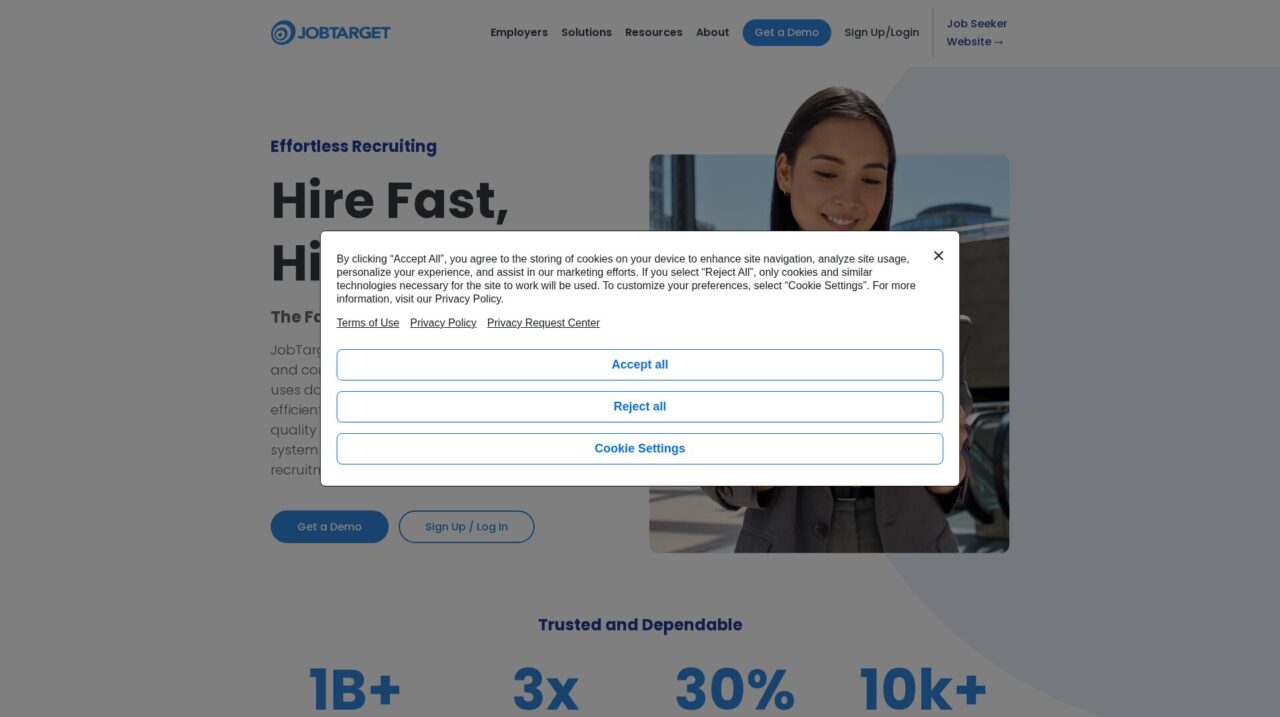

JobTarget is a recruitment advertising platform that helps employers distribute job postings, optimize spend, and meet compliance needs across thousands of job sites.
We have evaluated JobTarget in depth to understand how well it actually helps employers attract more qualified candidates and manage recruitment advertising. This review is part of our broader coverage of HR and recruiting tools; if you are comparing options, it is worth pairing this with our analysis of applicant tracking and recruiting software on CX Everywhere.
JobTarget is a familiar name in the recruitment advertising space, especially among US employers and federal contractors. Many teams know it for its job board marketplace and compliance support, but are less clear on where it fits alongside their ATS and newer AI hiring tools. That uncertainty is exactly what this review aims to address.
In the sections that follow, you will get a clear view of JobTarget’s pros and cons, its key features like job distribution, analytics, job description writing and compensation insights, and the types of organizations that are most likely to benefit. The goal is to give talent acquisition leaders, HR teams, and staffing firms enough context to decide whether to include JobTarget in their shortlist.
At its core, JobTarget is about making job advertising more effective and more compliant. It connects your open roles to thousands of job sites, helps you craft better job descriptions and set appropriate pay ranges, and provides data on which channels are actually working. If you manage hiring for a growing or complex organization, understanding how that fits into your tech stack is critical.
JobTarget Review Summary
Overall, JobTarget is a strong choice for organizations that treat job advertising as a managed, data-driven function rather than a quick administrative task. Its network of job sites, combined with compliance-aware distribution and supporting tools like AI job descriptions and compensation analysis, offers clear value for volume hiring and regulated environments.
However, it remains a specialized layer in the recruiting stack, not an end-to-end hiring platform. Prospective buyers should confirm ATS integrations, clarify how job posting budgets and contracts will be managed, and ensure they have the internal ownership to make use of the platform’s analytics and optimization features. For the right profile of employer, that investment can significantly improve applicant flow and recruiting efficiency.
How We Review Tools and Assign the CX Score
We've developed a comprehensive scoring system to evaluate software tools objectively. Our CX Score (1.0–5.0) reflects how strong a product is within its category, based on hands-on testing and analysis across multiple criteria.
Core Functionality
Does the tool deliver the essential features users expect? We assess whether core capabilities meet category standards and if key features are accessible across pricing tiers.
Standout Features
We evaluate unique capabilities that go beyond the basics—features that make the product faster, more efficient, or offer additional value compared to competitors.
Ease of Use
How intuitive is the interface? We consider design quality, mobile apps, templates, and whether complex tasks feel simple to execute.
Onboarding
We measure how quickly new users can get productive with minimal training. High-scoring tools require little to no external support to get started.
Integrations
We assess native integrations, third-party connections, and API access. Tools that connect easily with common tech stacks score higher.
Customer Support
How easy is it to get help? We evaluate support channels, response times, and quality of documentation. Real-time human support scores best.
Value for Money
We compare pricing against features delivered. Software that offers more functionality at competitive prices receives higher marks.
Features of JobTarget
- Job distribution marketplace
- Programmatic job advertising
- OFCCP and compliance support
- AI job description writer
- Compensation benchmarking tool
- Recruitment analytics and reporting
- ATS integrations
- HRIS integrations
- Custom career site hosting
- Candidate relationship management (CRM)
- Interview scheduling
- Onboarding workflows
- Open API
- Single sign-on (SSO)
- Multi-location and multi-brand support
- Diversity job board outreach
Centralized Job Distribution Across Thousands of Boards
JobTarget’s core feature is centralized job distribution to a large marketplace of general and niche job boards. Instead of managing separate contracts and logins, you can route jobs by geography, industry, or profession through one system. This matters in practice because recruiters can spend less time on manual posting and more on candidate engagement, while still tapping into specialized talent pools.
Compared to an ATS that offers a handful of default boards, JobTarget’s breadth gives you more levers to pull for hard-to-fill roles. You can use it to systematically expand beyond the usual major aggregators and reach communities aligned with specific skills, certifications, or demographics.
Compliance-Focused Distribution for Regulated Employers
JobTarget has a long-standing focus on helping employers meet OFCCP and related outreach requirements. It can ensure jobs are distributed to appropriate diversity and state job banks, and provide a documented, repeatable process. For federal contractors and other regulated organizations, this reduces the manual overhead and risk associated with meeting affirmative action and posting rules.
While many ATS platforms offer some compliance features, JobTarget’s specialization in this domain can be deeper, especially when it comes to linking job distribution with compliance reporting. This can be particularly valuable for organizations undergoing frequent audits or operating across multiple jurisdictions.
AI-Powered Job Description Writer
The Job Description Writer uses AI to help teams generate clear, compelling job postings. Users can start from structured templates tailored to role type and adjust content to align with brand voice and inclusivity guidelines. In real workflows, this reduces the time hiring managers spend drafting and redrafting descriptions, and helps maintain consistent quality across departments.
Compared to generic AI writing tools, having the generator embedded into the recruitment advertising platform keeps the output aligned with posting requirements and ready for distribution, limiting copy-paste friction between systems.
Compensation Analyzer with Market Data
The Compensation Analyzer ingests market data to suggest competitive salary ranges for roles, helping organizations set pay bands or advertised ranges that reflect current conditions. This is increasingly critical as pay transparency laws spread and candidates expect realistic salary information up front.
Many HR teams rely on static surveys or outdated spreadsheets for compensation decisions. JobTarget’s embedded analyzer offers more dynamic insight at the point where jobs are being defined and advertised, which can improve both candidate response and internal equity discussions.
Recruitment Analytics for Channel Performance
JobTarget’s analytics capabilities aggregate performance data across your job postings, showing which boards and campaigns drive views, clicks, applications, and ultimately hires. This visibility allows TA leaders to shift budget toward the highest-performing sources and reduce spending on underperforming channels.
In contrast to the limited reporting often available in individual job boards, having a cross-channel view in one place makes it much easier to calculate cost per apply, cost per hire, and time-to-fill by source, improving the sophistication of your recruitment marketing decisions.
Integrations with ATS and HR Systems
JobTarget is designed to plug into existing ATS and HR systems so that jobs and sometimes candidate metrics can flow automatically. Once integrated, new requisitions can appear in JobTarget without manual entry, and posting status or source-of-hire data can be fed back into the ATS.
While integration depth varies by partner, this approach minimizes double data entry and ensures recruiters can keep their primary workflow in the ATS while still leveraging JobTarget for advertising and analytics. Buyers should validate specific connectors and data flows for their systems of record.
From a usability perspective, JobTarget is generally approachable for recruiters familiar with job boards, but it is still a specialized tool that requires some configuration. Initial setup involves connecting to your ATS or HRIS, defining posting rules, and selecting which job boards or campaigns you want to use. For organizations with established recruiting operations, this is manageable, though it benefits from having an internal owner who understands both recruiting and budget management.
Day to day, recruiters typically interact with JobTarget through a web interface or via workflows embedded in the ATS. Creating campaigns, selecting boards, and reviewing analytics are straightforward once users are onboarded, but making the most of the platform’s optimization features does demand some comfort with performance data and experimentation. Training and support from JobTarget can help flatten this learning curve, especially for teams new to programmatic or multi-board strategies.
JobTarget is built to sit alongside existing recruiting tools, so integrations are an important part of its value proposition. It commonly connects with mainstream applicant tracking systems and HR platforms, enabling automatic import of requisitions and, in some cases, feedback of application or hire data for more complete reporting. This reduces manual data entry and keeps recruiters working primarily in their ATS while JobTarget handles the distribution logic in the background.
However, specific integration capabilities vary by system, and details are not always fully visible from the outside. Prospective customers should confirm whether a certified or native connector exists for their ATS, what data is synchronized in each direction, and how frequently it updates. Where no direct integration exists, buyers should ask about API options, file-based feeds, or implementation support to avoid creating a fragmented workflow.
JobTarget Overview
Pros
- Access to a very large network of general and niche job boards
- Strong focus on OFCCP and compliance-oriented job distribution
- AI Job Description Writer helps standardize and improve postings
- Compensation Analyzer supports market-aligned salary ranges and transparency
- Cross-channel analytics to optimize job board spend
- Integrates with major applicant tracking and HR systems
- Mature, specialized vendor focused on recruitment advertising
- Centralizes contracts and posting workflows across multiple job sites
Cons
- Not an ATS, requires separate recruiting or HR system to manage candidates
- Best value realized by teams hiring at higher volumes or complexity
- Configuration and ongoing optimization require some admin sophistication
- Pricing and packaging are not immediately transparent from the outside
- Smaller organizations with simple hiring may find it more than they need
JobTarget: Frequently Asked Questions
Is JobTarget an applicant tracking system?
No, JobTarget focuses on job advertising and distribution, and is typically used alongside an ATS that manages candidates and workflows.
What types of companies benefit most from JobTarget?
It is best suited to mid-sized and larger employers, staffing firms, and federal contractors that hire at volume and use multiple job boards.
Can JobTarget help with OFCCP and compliance requirements?
Yes, JobTarget is known for compliance-oriented job distribution, including outreach needed for OFCCP and similar regulations.
Does JobTarget integrate with existing ATS platforms?
JobTarget offers integrations with many mainstream ATS and HR systems so jobs can flow automatically into its distribution engine.
Does JobTarget handle pay transparency requirements?
The Compensation Analyzer helps set competitive salary ranges, which can support pay transparency when publishing salary information on job postings.
Is JobTarget suitable for very small businesses?
Smaller businesses with simple hiring may find sufficient job posting features in their ATS or direct job boards, making JobTarget less essential.
Do I need technical resources to implement JobTarget?
Basic implementation is manageable for HR or TA teams, but more advanced optimization or custom integrations may benefit from IT or vendor support.
