
Lattice Review: HR and Performance Management Platform for 2026
 Mar 15,2026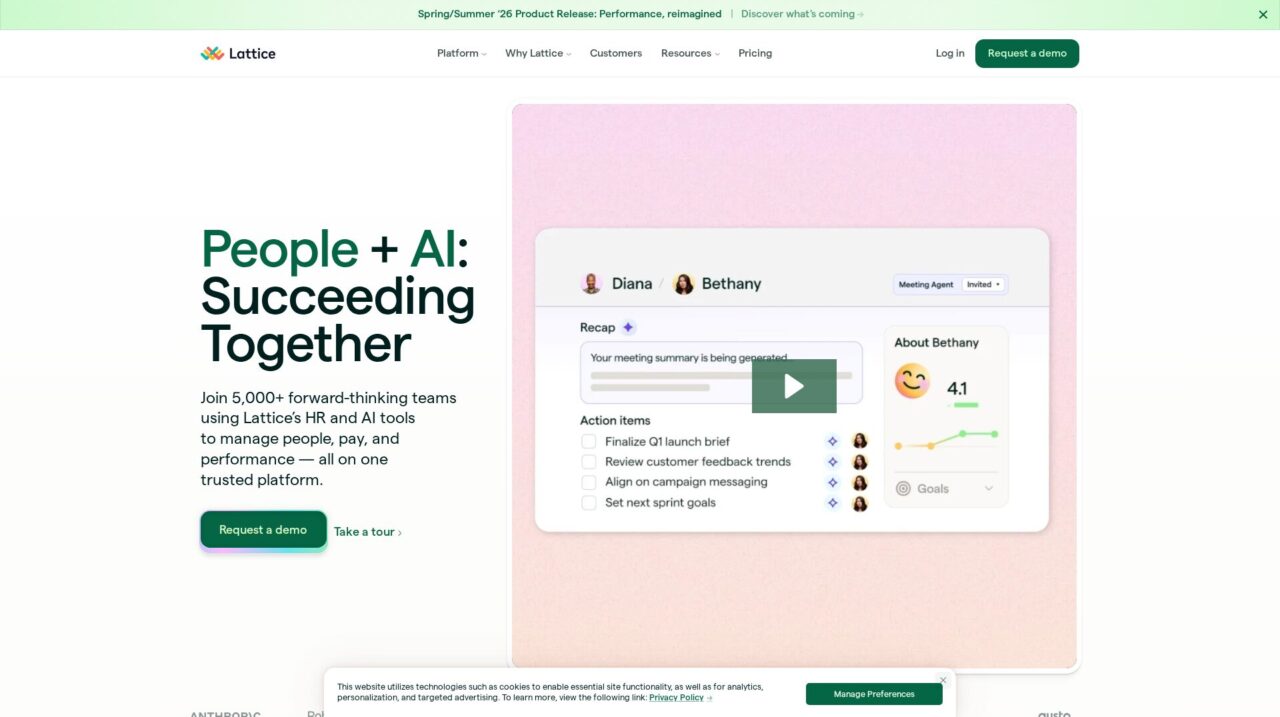

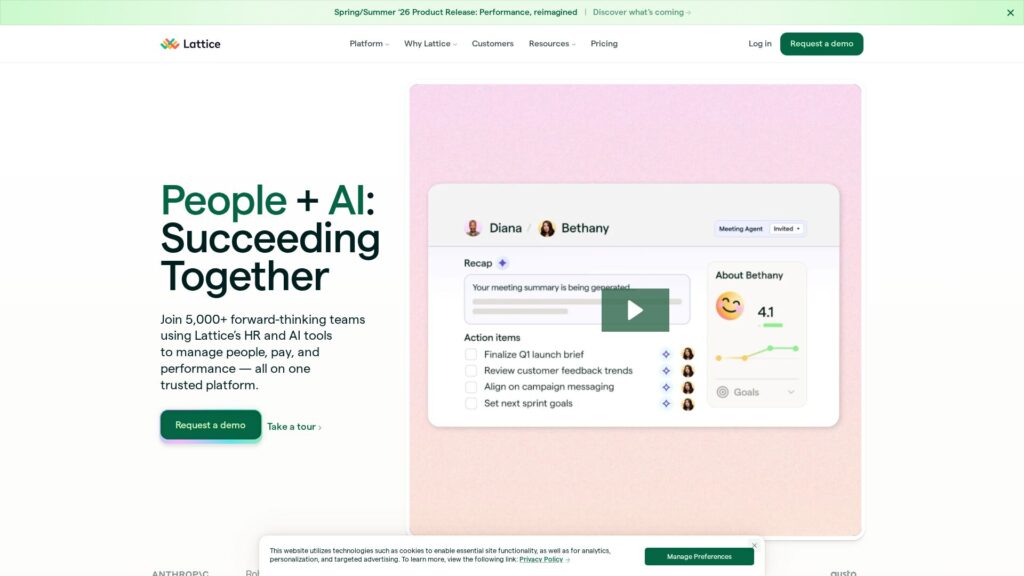
Lattice is a unified HR and performance management platform designed for modern, growth-oriented companies to manage people, performance, engagement, compensation, and development.
After analyzing Lattice across real-world implementations and its evolving feature set, this review breaks down how the platform actually performs for modern HR and people teams. If you are comparing options in the broader HR and performance management software space, you may also want to explore our other HR and performance management tools reviews on CX Everywhere to understand how Lattice stacks up.
Lattice has become a well-known name among People Ops leaders, especially in mid-market tech and high-growth companies, but its expanding scope and new AI capabilities make it worth a closer look. Buyers often hear about it from peers or investors and want to know whether it is still primarily a performance review tool or a true HR platform.
In this review, you will learn the main pros and cons of Lattice, how its key features work in practice, and which kinds of organizations tend to be most successful with it. The goal is to give you enough context to decide whether it fits your people strategy and tech stack, not just repeat feature lists.
Lattice is generally best suited for mid-sized and larger businesses with dedicated HR or People Ops teams, particularly those focused on performance management, engagement, and manager enablement. It addresses problems like inconsistent reviews, lack of visibility into performance and engagement, and ad-hoc promotion and compensation decisions by providing a structured, centralized platform for managing the employee lifecycle from onboarding through growth and rewards.
Lattice Review Summary
Overall, Lattice provides a robust, integrated platform for performance management, engagement, development, and compensation that aligns well with the needs of modern, people-focused organizations. Its emphasis on usability, templates, and AI assistance helps HR teams run more sophisticated programs without building everything from scratch, while managers and employees benefit from clearer expectations and better feedback tools.
The tradeoffs are mainly around scope and complexity: it is not a full payroll and benefits solution, and smaller or less process-mature organizations may find implementation and ongoing administration demanding. For companies that are ready to invest in a more strategic approach to people operations, however, Lattice offers strong value and a feature set that continues to move the category forward.
How We Review Tools and Assign the CX Score
We've developed a comprehensive scoring system to evaluate software tools objectively. Our CX Score (1.0–5.0) reflects how strong a product is within its category, based on hands-on testing and analysis across multiple criteria.
Core Functionality
Does the tool deliver the essential features users expect? We assess whether core capabilities meet category standards and if key features are accessible across pricing tiers.
Standout Features
We evaluate unique capabilities that go beyond the basics—features that make the product faster, more efficient, or offer additional value compared to competitors.
Ease of Use
How intuitive is the interface? We consider design quality, mobile apps, templates, and whether complex tasks feel simple to execute.
Onboarding
We measure how quickly new users can get productive with minimal training. High-scoring tools require little to no external support to get started.
Integrations
We assess native integrations, third-party connections, and API access. Tools that connect easily with common tech stacks score higher.
Customer Support
How easy is it to get help? We evaluate support channels, response times, and quality of documentation. Real-time human support scores best.
Value for Money
We compare pricing against features delivered. Software that offers more functionality at competitive prices receives higher marks.
Features of Lattice
- Performance reviews and check-ins
- Continuous feedback and recognition
- Goals and OKR management
- Engagement surveys and pulse checks
- People analytics and dashboards
- Career paths and competency frameworks
- Compensation planning and cycles
- AI assistant / AI Agent
- Core HRIS / employee records
- Payroll processing
- Benefits administration
- Open API
- Single sign-on (SSO)
- HRIS integrations (e.g. Workday, BambooHR)
- Mobile app
- Multi-language support
- Role-based permissions
- Custom review templates and workflows
- Engagement heatmaps and segmentation
- On-premise deployment
Performance Reviews and Calibration for Fair Evaluations
Lattice offers configurable performance review cycles that can support self, peer, upward, and manager reviews, along with calibrated ratings. HR teams can define templates, competencies, questions, and rating scales, then orchestrate companywide or team-specific cycles with clear timelines and reminders. Compared with many HRIS-native review tools, the workflows are more flexible and the experience is less clunky for reviewers.
Calibration tools let HR and leadership see rating distributions across teams and departments, adjust ratings where necessary, and ensure alignment with performance expectations. This is especially valuable for mid to large organizations that need consistency across multiple managers and functions, reducing bias and ensuring that ratings map logically to compensation and promotion decisions.
Continuous Feedback, 1:1s, and Check-ins to Support Ongoing Coaching
Beyond formal review cycles, Lattice emphasizes continuous performance conversations. Employees and managers can give real-time feedback, request feedback from others, and publicly or privately recognize peers. This creates a richer data set than once-a-year reviews and helps reinforce desired behaviors throughout the year.
The 1:1 and check-in tools provide shared agendas, talking point templates, and note-taking spaces so managers and employees come to meetings prepared. Compared with basic calendar notes or docs, embedding 1:1s into the performance system makes it easier to connect discussions to goals, feedback, and development plans, and gives HR visibility into whether managers are consistently engaging with their teams.
Goals and OKRs to Align Teams on Outcomes
Lattice supports goal and OKR management so individuals, managers, and executives can set, track, and update objectives at different levels of the organization. Goals can be linked to teams or company priorities, and progress can be updated manually or via integrations with work tools in some cases. Visibility into who owns what and how it ladders up helps combat misalignment and competing priorities.
While there are specialized OKR platforms with more advanced features, Lattice’s goal functionality is typically sufficient for organizations that want OKRs integrated directly with performance and review processes. Tying goals to review templates and check-ins ensures they are not forgotten and keeps performance conversations grounded in measurable outcomes.
Engagement Surveys and People Analytics for Insightful Decisions
Lattice includes survey capabilities for running engagement surveys, pulses, and custom questionnaires. HR teams can measure engagement, eNPS, and other people metrics, then slice results by department, manager, tenure, and more. Heatmaps and drill-downs make it easier to identify at-risk teams, problematic managers, or systemic issues such as workload or recognition gaps.
Combined with performance and turnover data, these analytics give People Ops and leadership a more holistic view of organizational health than standalone survey tools provide. While very analytics-heavy organizations may still export data for deeper BI work, Lattice’s built-in dashboards are generally strong enough for executive and board conversations about culture and performance.
Career Paths and Development Planning for Employee Growth
Career paths and growth plans are a major value driver for employees who want clarity on how to advance. Lattice allows HR and functional leaders to define role frameworks, levels, and competencies, then attach them to employees and teams. Employees can see what is expected at their current level and what would be required to move up, while managers can structure development conversations around these frameworks.
Development plans can include specific skills, milestones, and timelines, and can be referenced in 1:1s and review cycles. Compared with organizations that rely on ad-hoc career conversations, formalizing paths in Lattice brings more fairness and transparency, though it does require investment from HR and functional leaders to design and maintain these frameworks.
Compensation and Promotions Linked to Performance
Lattice’s compensation capabilities help HR teams run structured compensation review cycles aligned with performance and career levels. You can define budgets, guidelines, and approval workflows, then allow managers to make salary and equity recommendations informed by performance ratings, level, and market benchmarks where available.
This linkage between performance, promotion, and pay reduces spreadsheet chaos and improves auditability. It is particularly valuable in high-growth companies where headcount and pay bands are evolving quickly. That said, organizations with highly complex global compensation structures may still need supplemental tools for niche needs, especially around tax or regulatory compliance.
AI Agent and AI-Enhanced Workflows for Faster Support
The Lattice AI Agent is designed to give employees and managers quick answers to HR and policy questions, such as leave eligibility, promotion criteria, or how to give effective feedback. It uses company-specific data and policies to tailor responses, turning many routine questions into self-service interactions and freeing HR to focus on more strategic work.
Beyond Q&A, AI can assist with drafting performance feedback, coaching tips, or survey questions, lowering the barrier for busy managers. Compared to competitors that are just starting to experiment with AI, Lattice’s investment in AI as a core layer of the platform is a notable strength, provided organizations put governance in place around accuracy and bias.
Lattice offers a modern, clean interface that most users find intuitive once they understand the underlying processes. For employees and managers, the primary workflows such as completing reviews, giving feedback, or updating goals are straightforward, supported by in-app guidance and templates. This ease of use is a major advantage over older HR suites that often feel rigid and confusing.
Implementation, however, is not trivial. HR and People Ops teams must define review philosophies, rating scales, career frameworks, and communication plans before configuration. The platform is flexible, which is powerful but also means there are many options and settings to decide on. Organizations that invest in a structured rollout, administrator training, and manager enablement usually see strong adoption, while those that skip this groundwork may find the system underused or inconsistently applied.
Lattice is built to integrate with core HRIS and identity systems so that employee data, org structures, and access are always up to date. Common connections include HR and payroll systems for user provisioning and data sync, SSO providers for secure access, and communication tools for notifications and engagement. These integrations reduce double entry and keep reporting accurate across platforms.
There is also an API and a growing ecosystem of native integrations with tools for collaboration, productivity, and communication, which can be used for things like pulling in goals or surfacing feedback where people work. Buyers should confirm that their primary HRIS and identity providers are supported out of the box and evaluate to what extent custom integrations or middleware will be needed for their specific stack, especially in more complex or global environments.
Lattice Overview
Pros
- Broad coverage of performance, engagement, development, and compensation in one platform
- Modern, user-friendly interface that managers and employees actually use
- Strong tools for structured performance reviews and calibration across teams
- Career paths and growth plans improve transparency around promotion criteria
- Engagement surveys and analytics connect culture insights to performance data
- AI Agent reduces routine HR questions and supports better self-service
- Well suited for mid-market and growth-stage companies with People Ops teams
- Integrates with core HRIS and identity systems to keep data in sync
Cons
- Not a full payroll or benefits administration replacement for complex needs
- Implementation and change management can be demanding for smaller HR teams
- Best value realized by mid-sized and larger organizations, may feel heavy for very small companies
- Total cost can rise with headcount and additional modules
- Requires clear internal frameworks for competencies and career paths to shine
Lattice: Frequently Asked Questions
What type of company is Lattice best for?
Lattice is best suited to mid-sized and larger organizations, typically 100+ employees, that have or are building a dedicated HR or People Ops function and want structured performance, engagement, and development programs.
Can Lattice replace our payroll and benefits systems?
No, Lattice focuses on performance, engagement, development, people data, and compensation workflows, but it does not offer full-scale payroll or benefits administration, so most companies keep a separate HRIS or payroll tool.
How difficult is it to implement Lattice?
Implementation is manageable but requires thoughtful planning; HR teams need to define review processes, rating scales, competencies, and communication plans, and many organizations roll out modules in phases to reduce change fatigue.
Does Lattice offer AI capabilities?
Yes, Lattice includes an AI Agent that can answer HR and policy questions and assist with tasks like drafting feedback or guidance, helping reduce manual HR workload and support employees with self-service.
How does Lattice integrate with existing HR systems?
Lattice typically integrates with core HRIS and identity providers to sync employee data, reporting lines, and access, and it also offers APIs and native integrations for collaboration and productivity tools.
Is Lattice suitable for very small startups?
Very small teams can use Lattice, but many find it more platform than they need; the product delivers the most value once a company reaches a size where formal performance cycles, engagement surveys, and career frameworks are practical.
Can managers link performance to compensation decisions in Lattice?
Yes, compensation modules allow HR to run structured compensation cycles where managers make pay recommendations informed by performance ratings, levels, and guidelines set centrally.
How does Lattice support employee development?
Lattice offers career paths, competency frameworks, growth plans, and integrated 1:1 tools, giving employees visibility into expectations and helping managers structure development conversations and track progress over time.
