
Leapsome Review: AI-Powered HR and People Enablement Platform
 Jan 29,2026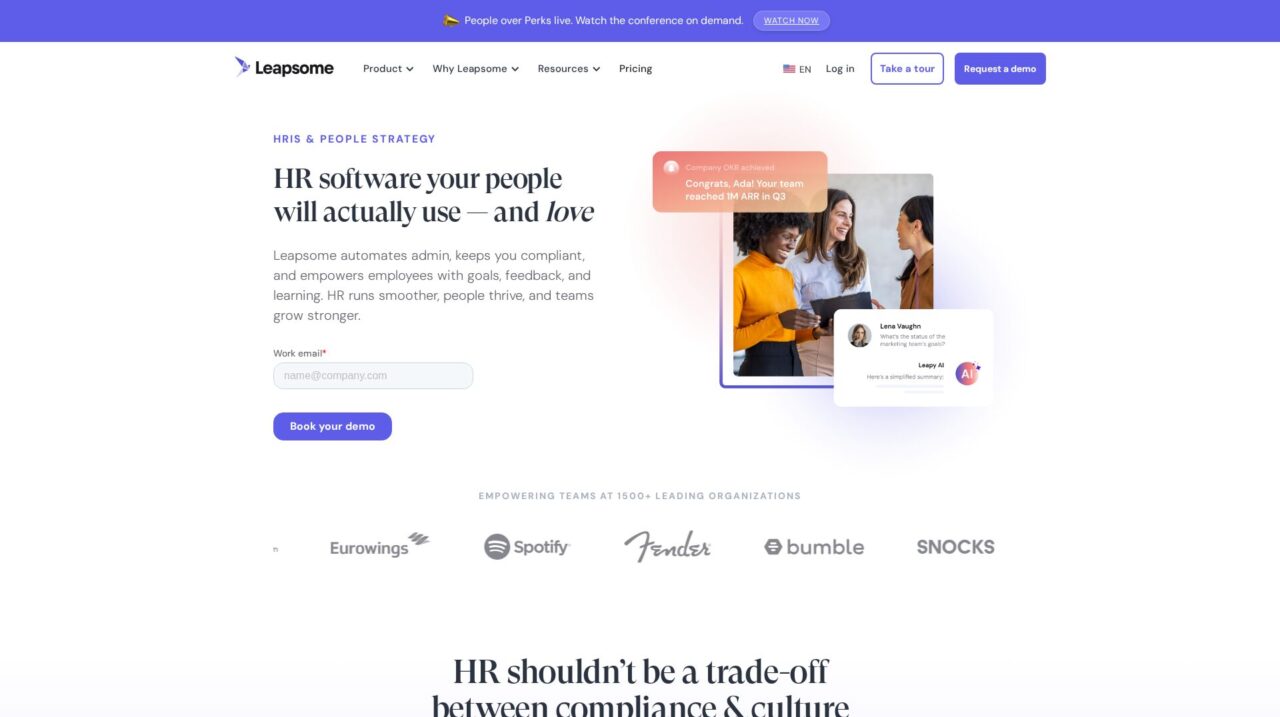

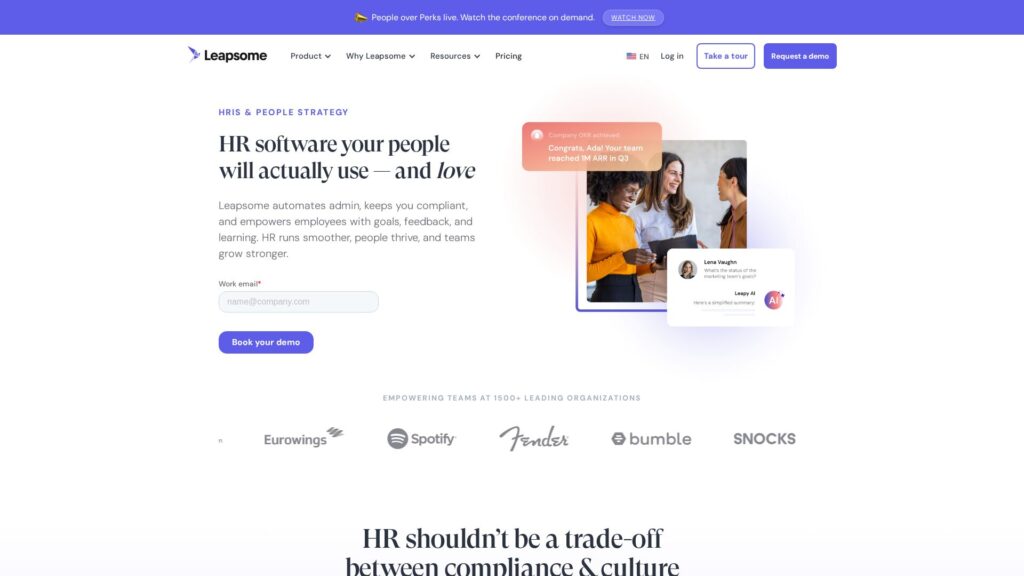
Leapsome is an AI-powered HR and people enablement platform that combines HRIS, performance management, goals, feedback, and learning for modern, growing organizations.
After analyzing Leapsome in depth across its HRIS and people enablement capabilities, this review summarizes how it actually performs for modern HR and leadership teams. The goal is to help you understand where it shines, where it has tradeoffs, and whether it fits into your HR tech stack.
If you are still comparing categories more broadly, start with our overview of HR software tools on CX Everywhere to see how platforms like Leapsome compare to traditional HRIS and point solutions. Once you know you want an integrated HR and people enablement platform, the question becomes which one best matches your size, complexity, and culture.
Leapsome is widely adopted among fast growing organizations that want to move beyond clunky, compliance only HR systems. Its reputation comes from strong performance management, goals, and engagement tooling, now combined with a more complete HRIS layer and AI features under the Leapy assistant. That popularity makes it a common contender, but it also means buyers need a clear, critical view rather than marketing claims.
In this review, you will learn Leapsome’s key strengths, real limitations, and the types of companies it serves best. We will look at core features, day to day usability, integration considerations, and the balance between HR operations and people development so you can decide whether it is the right fit for your team and growth plans.
Leapsome Review Summary
Leapsome delivers a solid blend of HR operations and people enablement in one platform, with AI features that feel meaningfully embedded in real workflows. It reduces manual admin for HR while giving managers and employees clear structures for goals, feedback, and growth, which is where many legacy HRIS tools remain weak.
It is not a one size fits all solution: very small companies may find it more than they need, and highly complex enterprises may still lean on heavyweight HCM suites for deep payroll and compliance. But for the growing mid market organization that wants a single, user friendly system to anchor both HR data and ongoing development, Leapsome is a strong, future oriented choice.
How We Review Tools and Assign the CX Score
We've developed a comprehensive scoring system to evaluate software tools objectively. Our CX Score (1.0–5.0) reflects how strong a product is within its category, based on hands-on testing and analysis across multiple criteria.
Core Functionality
Does the tool deliver the essential features users expect? We assess whether core capabilities meet category standards and if key features are accessible across pricing tiers.
Standout Features
We evaluate unique capabilities that go beyond the basics—features that make the product faster, more efficient, or offer additional value compared to competitors.
Ease of Use
How intuitive is the interface? We consider design quality, mobile apps, templates, and whether complex tasks feel simple to execute.
Onboarding
We measure how quickly new users can get productive with minimal training. High-scoring tools require little to no external support to get started.
Integrations
We assess native integrations, third-party connections, and API access. Tools that connect easily with common tech stacks score higher.
Customer Support
How easy is it to get help? We evaluate support channels, response times, and quality of documentation. Real-time human support scores best.
Value for Money
We compare pricing against features delivered. Software that offers more functionality at competitive prices receives higher marks.
Features of Leapsome
- Core HRIS and employee records
- Document management for HR files
- Payroll data sync
- Absence and time tracking
- Performance reviews module
- Continuous feedback and recognition
- Goals and OKR tracking
- Engagement and pulse surveys
- Learning and development paths
- AI assistant (Leapy)
- AI powered insights and summaries
- Automated HR workflows
- Slack integration
- Microsoft Teams integration
- Calendar integration
- SSO and identity provider support
- Open API
- Mobile responsive web app
- Native mobile apps
- On prem deployment
- Multi language support
- Role based access controls
- Analytics and reporting dashboards
- Engagement benchmarking and segmentation
Centralized Employee Records and HRIS Workflows
Leapsome includes a modern HRIS that serves as the secure system of record for employee data, documents, payroll related information, absences, and time tracking. This replaces spreadsheets and scattered tools with a single, structured source of truth that HR can trust. Automated workflows for onboarding, offboarding, and data changes reduce repetitive admin, while role based access and auditability support compliance requirements.
Compared with traditional HRIS platforms, Leapsome’s HRIS is designed with a more modern interface and closer integration into performance and engagement workflows. It may not match the deepest enterprise payroll capabilities, but for many organizations it offers enough breadth to centralize core HR operations without sacrificing usability.
Performance Reviews and Continuous Feedback for Real Development
Performance management is one of Leapsome’s strongest areas. HR can configure review cycles that align with company specific competency models, roles, and growth frameworks, while managers receive guided workflows for evaluations and calibration. Built in prompts and templates make it easier to run consistent, fair reviews across teams.
Beyond periodic reviews, continuous feedback and 1:1 tooling encourage ongoing conversations rather than once a year scores. Employees and managers can exchange feedback, recognize peers, and track action items within the same platform that holds their goals and growth plans, which leads to a more coherent development experience than standalone review tools.
Goals and OKRs Connected to Performance
Leapsome’s goals and OKR functionality helps organizations set, track, and cascade objectives across the company. Teams can connect high level goals to individual objectives and key results, then link those to performance reviews so evaluations are grounded in real progress rather than vague impressions. Progress updates and status summaries make it easy to see where teams are on track or at risk.
This connection between goals and performance is an area where many HR systems fall short or rely on manual workarounds. Leapsome’s approach provides a structured but flexible framework that aligns strategic priorities with daily work, and it is particularly useful for organizations that already operate with OKRs or want to introduce them gradually.
Engagement Surveys and Employee Listening
Engagement and pulse surveys allow HR and leaders to continuously listen to their workforce. Leapsome supports configurable question sets, anonymity options, and segmentation by team or demographic attributes stored in the HRIS. Results are presented with clear visualizations and, with AI support, can be summarized into key themes and recommended focus areas.
Compared with simple survey tools, Leapsome’s advantage is that engagement data lives in the same environment as performance, goals, and learning. This makes it easier to tie insights to actionable changes, such as adjusting development plans, role expectations, or communication practices based on what employees are actually reporting.
Learning Paths and Skill Development
Leapsome includes learning features that allow HR and managers to build structured learning paths tied to roles and competencies. Employees can consume curated content, complete assignments, and track their progress against development plans. Because learning is connected to performance and feedback, it is easier to identify skill gaps and recommend relevant materials.
While it may not replace a full scale learning management system for heavily regulated training environments, Leapsome’s learning module is well aligned with career growth and upskilling in knowledge work organizations. It turns performance reviews into actionable growth plans rather than static reports.
AI Assistance and Insights Through Leapy
Leapy, the built in AI assistant, runs across the platform to transform raw data into insights and practical help. It can draft HR policies, suggest survey questions, summarize large sets of feedback or engagement responses, and recommend next steps for HR and managers. This helps teams move from data collection to decision making much more quickly.
In contrast with many tools that treat AI as a standalone chatbot, Leapsome’s implementation is tightly woven into specific workflows. For example, AI can assist when writing performance feedback or planning a review cycle, which saves time and also nudges managers toward more consistent, higher quality communication.
Automation and Reporting for HR Efficiency
Automation underpins much of Leapsome’s promise of reducing admin time. Recurring processes like reviews, surveys, onboarding tasks, and reminders can be configured once and then run with minimal manual intervention. Payroll syncs and AI powered checks further cut down on data entry and error prone updates.
Reporting brings together data from HRIS, performance, engagement, and learning to give HR and leadership a more complete view of the organization. With AI accelerating analysis, HR can provide insights to the business faster than with manual spreadsheet work, helping people teams operate as strategic partners rather than administrators.
Leapsome is designed to be approachable for employees and managers, with a clean interface and guided workflows that reduce friction around reviews, feedback, and goal updates. From a user perspective, most day to day tasks are straightforward, and the tight integration with tools like Slack and Microsoft Teams makes participation feel like part of normal work rather than an extra system to remember.
For HR admins, there is a more significant setup effort, especially if you are configuring review frameworks, competencies, and custom workflows from scratch. However, once initial configuration is done, automation and templates substantially reduce ongoing effort. Organizations with a dedicated people ops function will find the learning curve manageable, while very small teams without HR expertise may need more support to fully harness the platform’s breadth.
Leapsome connects with key tools across collaboration, identity, and payroll to fit into existing workflows rather than replacing them. Native integrations with Slack and Microsoft Teams allow notifications, reminders, and feedback requests to surface where employees already spend time. Calendar integrations support scheduling and reminders for reviews and 1:1s, and SSO connections streamline secure access management.
On the HR and IT side, Leapsome offers integrations and syncs with payroll and HR systems so that employee data does not have to be maintained in multiple places. Buyers should confirm which specific payroll and HRIS integrations are available for their region and stack, and evaluate how bidirectional the sync is. For organizations with more complex environments, it is also worth asking about API options or middleware support to ensure data flows cleanly between systems.
Leapsome Overview
Pros
- Strong combination of HRIS, performance, goals, feedback, and engagement in one platform
- Modern, employee friendly interface that increases adoption compared to legacy HR tools
- Leapy AI assistant accelerates reporting, content creation, and insight generation
- Deep performance management and continuous feedback features relative to typical HRIS
- Goals and OKRs can be tightly connected to reviews and individual performance
- Automated workflows and payroll syncs materially reduce repetitive HR admin
- Integrations with Slack, Microsoft Teams, calendars, and SSO support daily workflows
- Well suited to fast growing, people centric organizations that value culture and development
Cons
- May not fully replace specialized payroll or enterprise HCM in very complex environments
- Initial configuration of competencies, review cycles, and workflows requires meaningful HR effort
- Breadth of features can feel heavy for very small businesses with simple needs
- Larger global enterprises may still need separate systems for intricate compliance and benefits
Leapsome: Frequently Asked Questions
What type of companies is Leapsome best suited for?
Leapsome is best for small to mid sized organizations and scale ups that want a unified HR and people enablement platform, particularly in knowledge work environments where performance, goals, and engagement are strategic priorities.
Can Leapsome fully replace my existing HRIS and payroll system?
Leapsome can act as a modern HRIS for many organizations, but companies with highly complex payroll or regulatory requirements may still keep a dedicated payroll system and use Leapsome as the core HR and people enablement layer on top.
How difficult is it to implement Leapsome?
Implementation is manageable but requires thoughtful setup of employee data, performance frameworks, and workflows. Teams with a dedicated HR or people ops function generally handle this well, and the payoff is significant automation once configured.
Does Leapsome integrate with collaboration tools like Slack or Microsoft Teams?
Yes, Leapsome integrates with Slack and Microsoft Teams so that notifications, reminders, and some interactions can happen directly in those tools, improving adoption and reducing context switching.
Is Leapsome suitable for very small businesses?
Very small businesses with only basic payroll and time tracking needs may find Leapsome more powerful than necessary and might not fully leverage its enablement features without a clear people strategy.
How does Leapsome use AI in the product?
Leapsome uses AI through its assistant Leapy and embedded features to draft content such as policies or feedback, summarize survey results, highlight insights, and recommend next steps, helping HR and managers act faster on their people data.
