
Mo Review: Employee Recognition & Culture Platform Explained 2026
 Feb 08,2026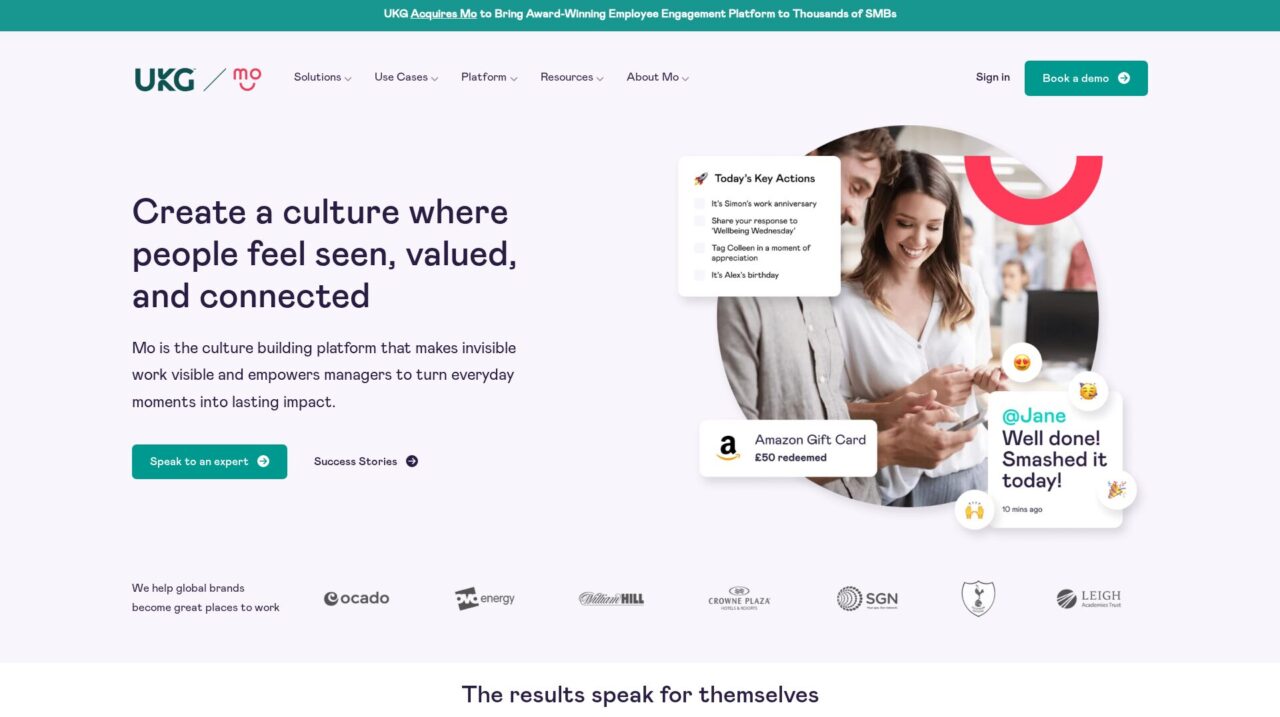

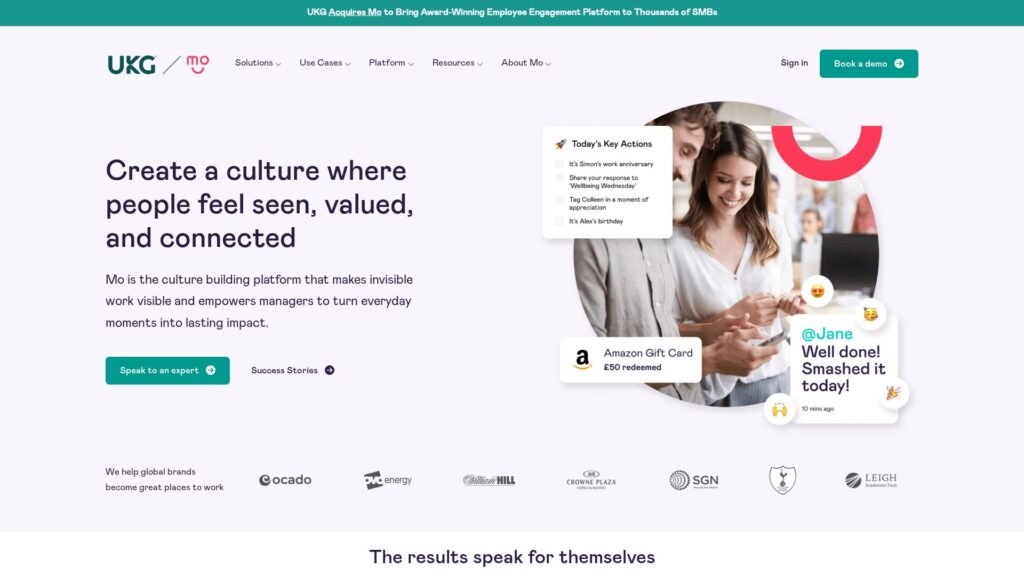
Mo is an employee recognition and culture-building platform that helps managers celebrate wins, connect teams, and improve engagement and retention across the organisation.
After analysing Mo in depth as part of our broader research into engagement and recognition tools, this review pulls together how it actually performs as a culture-building platform. The goal is to help you decide if it deserves a place in your HR and people-tech stack.
If you are just starting to evaluate options in this space, you may also want to compare it against other tools in our guide to employee engagement and feedback software on CX Everywhere, which covers the wider category landscape and selection criteria.
Mo has built a solid reputation as an award-winning employee recognition and culture platform, with customer stories that highlight tangible improvements in turnover, engagement, and manager participation. Many teams hear about it through word of mouth or review sites, but still need a clearer view of where it shines, where it is opinionated, and where it may not fit.
In this review, we will walk through Mo’s strengths and limitations, key features, and ideal use cases, with practical guidance on when to choose it and when you might be better served by an alternative. It is most relevant for HR leaders, People and Culture teams, and line managers in mid-sized to large organisations that want to improve recognition, connection, and retention without overhauling their entire HR stack.
At its core, Mo helps teams show appreciation, celebrate progress, and build connection across locations and working patterns. It gives managers and employees a dedicated space to recognise contributions, share wins, and make everyday work visible, supporting broader goals around engagement, eNPS, and culture.
Mo Review Summary
Mo is a focused, well-designed platform for employee recognition and culture-building that goes beyond simple rewards catalogs to target real behaviour change. Its strongest value lies in helping managers and teams build consistent habits of appreciation and communication, which in turn supports improvements in engagement, eNPS, and turnover.
However, it is intentionally not a full HR suite, so buyers should view it as a specialist layer alongside their HRIS and communication tools rather than a replacement. The best results come when HR and leadership are prepared to sponsor and support adoption among managers. If that aligns with your priorities and you want a dedicated culture tool rather than a generic add-on, Mo is a compelling option.
How We Review Tools and Assign the CX Score
We've developed a comprehensive scoring system to evaluate software tools objectively. Our CX Score (1.0–5.0) reflects how strong a product is within its category, based on hands-on testing and analysis across multiple criteria.
Core Functionality
Does the tool deliver the essential features users expect? We assess whether core capabilities meet category standards and if key features are accessible across pricing tiers.
Standout Features
We evaluate unique capabilities that go beyond the basics—features that make the product faster, more efficient, or offer additional value compared to competitors.
Ease of Use
How intuitive is the interface? We consider design quality, mobile apps, templates, and whether complex tasks feel simple to execute.
Onboarding
We measure how quickly new users can get productive with minimal training. High-scoring tools require little to no external support to get started.
Integrations
We assess native integrations, third-party connections, and API access. Tools that connect easily with common tech stacks score higher.
Customer Support
How easy is it to get help? We evaluate support channels, response times, and quality of documentation. Real-time human support scores best.
Value for Money
We compare pricing against features delivered. Software that offers more functionality at competitive prices receives higher marks.
Features of Mo
- Peer-to-peer recognition
- Manager-driven recognition
- Values-based recognition tagging
- Company-wide feed of moments
- Awards and milestone celebrations
- Engagement and activity analytics
- Goal or OKR tracking
- Built-in performance reviews
- Pulse surveys and eNPS measurement
- Reward catalog and gift cards
- Multi-location and remote team support
- User provisioning via HRIS or SSO
- Open API
- Mobile-friendly experience
- On-premise deployment
- Custom branding and themes
- Single sign-on (SSO)
- Multi-language support
Structured Employee Recognition That Reinforces Values
Mo provides a central space for employees and managers to recognise each other in a way that is visible across teams. Recognitions can be tied explicitly to company values or specific behaviours, which helps move culture from slogans on a wall to observable actions. Compared with generic chat tools or basic kudos features, Mo’s recognition flows are more intentional and easier for HR to align with strategic culture goals.
The benefit in real-world use is that employees start to see examples of what “good” looks like in their organisation. Recognition posts create a living library of success stories and contributions, which can be used in onboarding, leadership communications, and performance conversations.
Ongoing Culture Rituals for Distributed Teams
Beyond one-off shout-outs, Mo supports recurring rituals such as weekly highlights, project wins, or themed prompts that get teams sharing updates regularly. These rituals are particularly important for hybrid, remote, or shift-based workforces where people rarely meet in person. Instead of relying on sporadic town halls or newsletters, Mo makes culture rituals part of the weekly cadence.
Compared to many tools that only surface recognition during formal events, Mo’s approach keeps connection and visibility alive throughout the year. This continuous drumbeat tends to have more impact on belonging and engagement than occasional, large-scale campaigns.
Manager-Centric Workflows and Nudges
A standout feature of Mo is its deliberate focus on managers. The platform includes prompts, reminders, and workflows that make it easier for managers to recognise their teams, share updates, and engage with posts. This is a critical differentiator from tools where managers are passive observers and engagement is driven solely by HR.
Because managers are central to day-to-day employee experience, giving them simple, repeatable ways to show appreciation and visibility can materially change how teams feel. Mo’s reported high manager engagement rates reflect how effectively the platform supports manager workflows compared with more generic engagement tools.
Visibility Into Engagement and Cultural Momentum
While Mo is not a full analytics or survey platform, it does provide visibility into recognition activity, participation, and trends. HR and leadership can quickly see which teams are engaged, who is actively recognising others, and where additional support might be needed. This helps organisations spot both pockets of strong culture and areas at risk.
In contrast to tools that bury insight in complex dashboards, Mo focuses on actionable signals related to recognition and participation. That makes it easier for HR and people leaders to have targeted conversations with managers and to connect recognition activity to broader metrics like eNPS or attrition.
Support for Awards, Milestones and Celebrations
Mo also shines in making company-wide awards, milestones, and celebrations more visible and inclusive. Whether it is work anniversaries, project completions, or recognition programs, the platform provides a structured way to highlight these moments so they reach the whole organisation rather than a small circle.
This is particularly valuable in larger or dispersed teams where people may not see or hear about great work happening outside their immediate group. By centralising celebrations, Mo helps create a sense of shared story and progress, something many standard HR systems do not handle well.
Alignment With Retention and eNPS Goals
An important aspect of Mo is its explicit alignment with hard business outcomes like employee turnover, engagement scores, and eNPS. The platform’s design is less about ornamental perks and more about creating the conditions where people feel valued and connected, which reduces the likelihood they will leave.
Compared with lightweight kudos widgets that do not move the needle, Mo has customer examples showing meaningful improvements in attrition and engagement. For organisations that already track these metrics, integrating a tool that is built around influencing them can be a strategic advantage.
Mo is designed to be approachable for both employees and managers, with a consumer-like interface that focuses on quick actions such as posting recognition, reacting to updates, and browsing a feed of moments. Most users can understand the basics with minimal training, especially if you anchor the launch around clear use cases like celebrating wins or calling out values-based behaviours.
From an admin perspective, HR teams need to invest time upfront configuring values, recognition rules, communication cadences, and any integrations with HRIS or messaging tools. However, this setup is typically far lighter than implementing a new HR core system. The largest determinant of ease of use is change management: how well you communicate expectations to managers, embed Mo into existing rhythms like team meetings, and support leaders in using it consistently.
Mo generally sits alongside your existing HR and communication stack, so integrations matter. While specific connectors are not detailed in the information provided, tools in this category commonly integrate with HRIS systems for user provisioning and with collaboration platforms like Slack, Microsoft Teams, or email for notifications and participation. Prospective buyers should verify which HR, SSO, and messaging tools Mo integrates with natively and whether there is an open API for custom connections.
If you rely heavily on particular systems for identity management, shift scheduling, or engagement analytics, it is worth asking Mo’s team how data flows between platforms, what events can trigger recognition or communications, and how you can export activity for reporting. Ensuring that Mo fits smoothly into your existing ecosystem will minimise admin overhead and help drive higher adoption.
Mo Overview
Pros
- Strong focus on everyday culture habits, not just transactional rewards
- Reported impact on turnover, eNPS and engagement is above typical recognition tools
- Manager-centric design encourages high participation from people leaders
- Well suited to dispersed, hybrid and shift-based workforces needing more connection
- User experience is lightweight and approachable for non-technical employees
- Clear alignment with business outcomes like retention and engagement scores
- Flexible enough to complement existing HRIS and survey platforms
Cons
- Not a full HR suite, requires integration with existing HR and payroll systems
- Impact depends heavily on leadership sponsorship and manager adoption
- Very small or informal teams may find the structure more than they need
- Limited public detail on integrations and technical ecosystem from the outset
Mo: Frequently Asked Questions
What type of software is Mo?
Mo is an employee recognition and culture-building platform focused on helping managers and teams create consistent habits of appreciation and connection.
Who is Mo best suited for?
Mo is best for mid-sized and larger organisations, especially hybrid or multi-site companies that want to improve engagement, retention and culture.
Does Mo replace our HRIS or payroll system?
No, Mo is a specialist layer for recognition and culture that complements, rather than replaces, your core HRIS and payroll tools.
How long does it take to implement Mo?
Implementation is typically much lighter than a full HR system, with most effort going into configuring programs, values and communications and then onboarding managers.
Does Mo help improve retention and eNPS?
Mo is designed specifically to influence metrics like turnover and eNPS by building daily recognition and connection habits, and customer examples report meaningful improvements.
Can Mo work for remote or shift-based teams?
Yes, Mo is particularly well suited to distributed, hybrid and shift-based teams where people rarely meet in person but still need visibility and connection.
What should we check before buying Mo?
You should confirm technical integrations with your HRIS and communication tools, clarify your culture goals, and ensure leadership is prepared to sponsor adoption among managers.
