
Paradox Review: Conversational Hiring Software for High-Volume Recruiting
 Apr 05,2026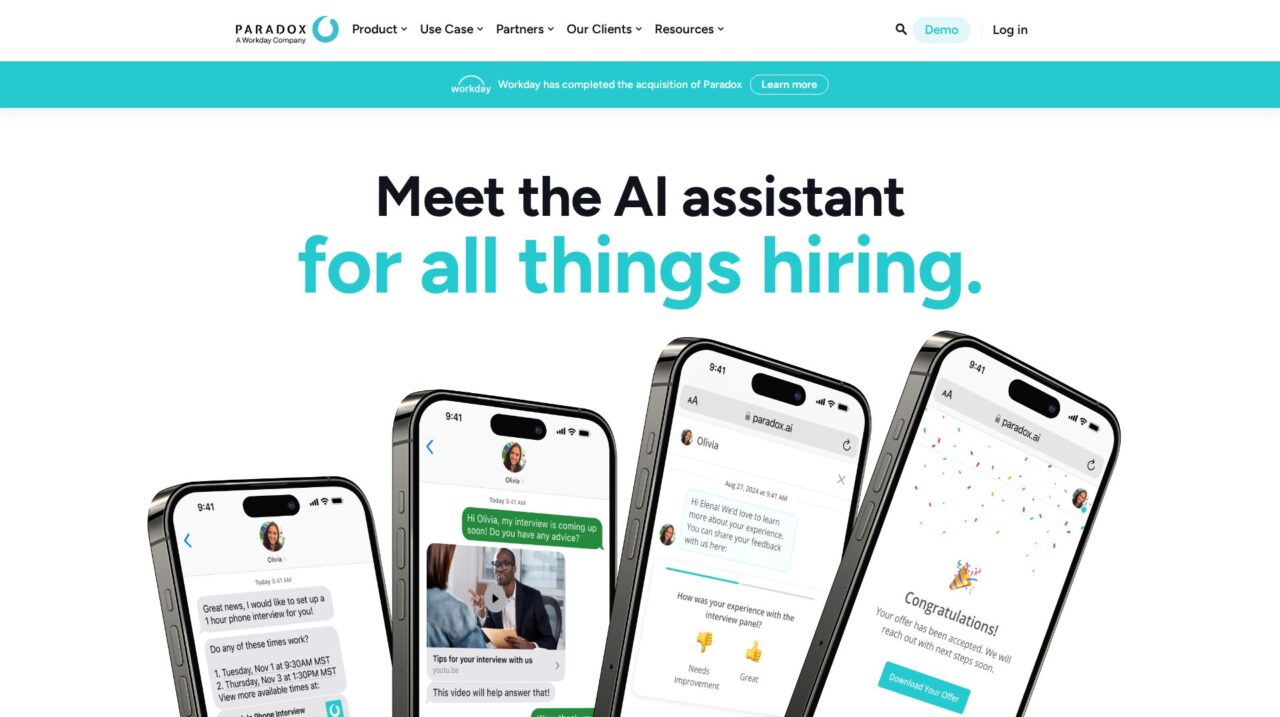

Paradox is a conversational recruiting platform built around its AI assistant Olivia to automate high-volume hiring workflows like screening, scheduling, and apply flows for enterprises, franchises, and mid-sized businesses.
After analyzing Paradox from the perspective of both talent acquisition leaders and frontline hiring managers, this review breaks down where the platform genuinely helps and where it may not be the right fit. If you are exploring conversational recruiting software as an alternative or complement to a traditional ATS, you are exactly the audience this is written for.
For readers who are still surveying the broader market, it is worth comparing Paradox against other tools in the wider applicant tracking and recruiting tech ecosystem you will find in our applicant-tracking-software roundup on CX Everywhere. Once you have that landscape in mind, it becomes easier to see how a conversational assistant like Olivia fits into your strategy.
Paradox has become a well-known name in high-volume hiring, particularly in industries that rely on frontline and hourly workers. The pitch is simple: move routine tasks out of email and clunky forms into fast, mobile-friendly conversations. But understanding how that plays out in real workflows, and whether it aligns with your hiring profile, requires a closer look than a short marketing blurb.
In this review, you will learn how Paradox works, its main strengths and weaknesses, the types of businesses it serves best, and the situations where alternative recruiting tools may make more sense. The main audience here is talent acquisition teams at mid-sized to enterprise organizations, HR and Operations leaders supporting multi-location businesses, and franchise owners who want to give hiring managers better tools without overwhelming them with complex software.
At its core, Paradox aims to streamline how candidates find and apply for jobs, how they are screened, and how interviews get scheduled, all through an AI assistant that feels more like a chat than a form. That can be a solid foundation for teams trying to reduce drop-off and speed up time-to-hire in competitive markets.
Paradox Review Summary
Overall, Paradox is a strong choice for organizations that need to hire at scale and are bottlenecked by manual screening and scheduling in their ATS. Its conversational approach maps well to how hourly and frontline candidates actually behave, and the product has enough enterprise capabilities to plug into Workday and SAP SuccessFactors without requiring a full rip-and-replace.
However, the platform’s value is most pronounced in high-volume scenarios, and buyers should go into an evaluation expecting a thoughtful implementation, not a quick self-serve signup. If that matches your context, Paradox belongs on your shortlist; if not, you may be better served by a more traditional ATS or a lighter-weight recruitment tool.
How We Review Tools and Assign the CX Score
We've developed a comprehensive scoring system to evaluate software tools objectively. Our CX Score (1.0–5.0) reflects how strong a product is within its category, based on hands-on testing and analysis across multiple criteria.
Core Functionality
Does the tool deliver the essential features users expect? We assess whether core capabilities meet category standards and if key features are accessible across pricing tiers.
Standout Features
We evaluate unique capabilities that go beyond the basics—features that make the product faster, more efficient, or offer additional value compared to competitors.
Ease of Use
How intuitive is the interface? We consider design quality, mobile apps, templates, and whether complex tasks feel simple to execute.
Onboarding
We measure how quickly new users can get productive with minimal training. High-scoring tools require little to no external support to get started.
Integrations
We assess native integrations, third-party connections, and API access. Tools that connect easily with common tech stacks score higher.
Customer Support
How easy is it to get help? We evaluate support channels, response times, and quality of documentation. Real-time human support scores best.
Value for Money
We compare pricing against features delivered. Software that offers more functionality at competitive prices receives higher marks.
Features of Paradox
- Conversational AI assistant (Olivia)
- ATS functionality
- Conversational career sites
- Conversational apply flows
- Automated interview scheduling
- High-volume hiring optimization
- Workday integration
- SAP SuccessFactors integration
- Multi-language support
- SMS and messaging channel support
- Recruiter dashboards and analytics
- API access
- Mobile-optimized candidate experience
- Enterprise security and compliance
- Onboarding workflows
- Performance management
- Payroll processing
- Benefits administration
- On-premise deployment
- Small business self-serve setup
Conversational job discovery and apply flows for mobile-first candidates
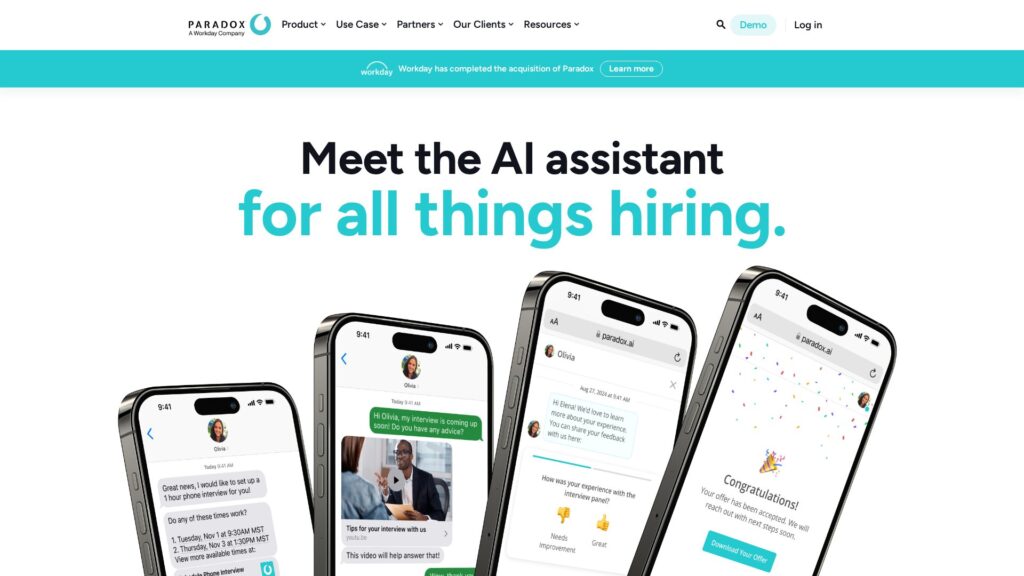
Paradox turns job search and apply into a guided conversation, helping candidates instantly find roles that match their preferences and basic eligibility. Instead of clicking through filters and multi-page forms, candidates answer simple questions and are presented with relevant openings and a streamlined way to express interest. This matters particularly in hourly and frontline hiring where candidates are often on their phones and highly sensitive to friction.
Compared to typical ATS apply flows, Paradox’s conversational approach tends to reduce abandonment and increase completed applications, especially from candidates who would drop off when forced to create accounts and navigate complex forms. It is less suited to long, detailed applications that require extensive uploads or portfolio work, but for volume hiring it is a clear usability upgrade.
Screening automation that filters candidates in real time
Within the same conversation, Olivia can ask screening questions about availability, qualifications, work authorization, and other role-specific criteria. Candidate responses are evaluated in real time, allowing the assistant to automatically progress qualified candidates, ask follow-up questions when needed, or gracefully disqualify and redirect candidates who do not meet requirements. Recruiters receive filtered lists instead of raw applicant dumps.
This real-time screening goes beyond simple knockout questions in many ATS systems by feeling more natural and adaptive. For organizations managing thousands of applicants per month, the reduction in manual triage can be substantial, though highly nuanced or subjective assessment still belongs with human recruiters and hiring managers.
Automated interview scheduling directly from chat
Paradox includes conversational scheduling that lets candidates book interviews without human intervention once they pass basic screening. The assistant surfaces available time slots based on integrated calendars, handles confirmations and reminders, and can often manage rescheduling logic if conflicts arise. This eliminates a common back-and-forth bottleneck that slows time-to-hire and frustrates candidates.
While many modern ATS platforms now offer some form of automation around scheduling, Paradox’s differentiator is keeping everything inside the same conversational flow, which reduces drop-off between passing screening and locking in a meeting. It is especially useful for multi-location or franchise environments where store managers have limited time and irregular schedules.
Conversational ATS capabilities for lighter-weight tracking
Paradox offers a Conversational ATS that can manage requisitions, candidate pipelines, and basic hiring workflows in a more lightweight way than traditional enterprise ATS systems. For mid-sized companies or divisions that do not want to live in a complex HCM suite, this can be enough to run end-to-end recruiting while reaping the benefits of conversational engagement.
Against full-featured ATS platforms, the Conversational ATS focuses more on automation and simplicity than exhaustive configurability and reporting. Enterprises that already rely on Workday or SAP SuccessFactors often still use those as systems of record, using Paradox to power front-end engagement while syncing data back.
Conversational career sites that convert traffic into applicants
Instead of static job listing pages, Paradox enables career sites where a candidate is immediately greeted by Olivia, who can guide them to relevant roles, answer common questions, and start the apply process. This reduces the cognitive load on candidates, especially those unfamiliar with job titles or organization structures, and can surface roles they might otherwise miss.
Compared with generic CMS-based career sites, a conversational layer makes it easier to capture casual visitors and convert them into applicants, which is critical when you are investing heavily in employer branding or paid traffic. The tradeoff is that it requires more design and configuration upfront to align conversations with your brand and hiring workflows.
Deep integrations with Workday and SAP SuccessFactors
Paradox has dedicated offerings for Workday and SAP SuccessFactors, indicating native or near-native integrations that allow data to flow between systems. This is important for large enterprises that want modern candidate and recruiter experiences without replacing their core HCM or ATS. Paradox can read requisitions, write candidate updates, and keep statuses in sync while handling the conversational front end.
Relative to standalone chatbots that sit on top of career sites without deep backend connectivity, this approach is more robust and sustainable. Buyers should still perform technical due diligence on exactly which objects and workflows are supported in their specific configuration, but the presence of named partner solutions is a positive signal of maturity.
Multi-segment solutions for enterprise, mid-market, and franchise
Paradox offers tailored solutions for global enterprises, mid-sized businesses, and franchises, recognizing that each segment has distinct needs. For global enterprises, features like multi-language support and compatibility with multiple messaging platforms matter for regional rollouts and compliance. For mid-sized businesses, the emphasis is on a simplified, seamless hiring experience that does not overwhelm smaller HR teams.
Franchise-focused capabilities highlight ease of use for store or location managers and automation that “does the work for you,” so local leaders can focus on operations and customers. This segmentation is a strength compared to tools that offer a one-size-fits-all experience, although it does mean buyers need to be clear on which package and configuration they are evaluating.
Paradox is designed to feel lightweight for end users, especially candidates and hiring managers. Conversational flows are intuitive, and most candidates are already comfortable with chat-style interfaces on mobile, which makes adoption relatively frictionless on the candidate side. For store managers or frontline leaders, the key benefit is avoiding deep navigation of a complex ATS and instead responding to prompts or using simple dashboards aligned with their day-to-day context.
For recruiters and admins, the learning curve is moderate. Configuring conversational flows, screening logic, and integrations requires thoughtful setup and usually involvement from both HR and IT. Once implemented, common tasks like monitoring candidate pipelines, adjusting questions, and managing scheduling become relatively straightforward, but Paradox is not a tool you casually spin up in an afternoon for enterprise use. Organizations that invest in a structured rollout, training, and clear process design typically report strong usability after initial implementation.
Paradox emphasizes integrations with major enterprise HCM and ATS platforms, most notably Workday and SAP SuccessFactors, for which it offers dedicated solutions. These integrations enable the assistant to pull requisitions, push candidate data, and synchronize statuses so that conversational workflows do not create data silos. In practice, this allows enterprises to modernize candidate experiences while keeping existing systems of record intact.
Beyond flagship integrations, Paradox typically connects to calendar systems for scheduling, communication channels such as SMS and messaging platforms, and other HR systems where needed. Buyers should request a detailed integration overview early in the evaluation, including supported objects, sync directions, and any middleware or APIs required. The available content does not enumerate a full marketplace of third-party apps, so if you rely on niche HR or recruiting tools, it is important to validate compatibility and potential custom integration effort with the Paradox team.
Paradox Overview
Pros
- Excellent for high-volume, frontline and hourly hiring at large scale
- Conversational apply flows significantly reduce candidate friction and drop-off
- Strong automation around screening and interview scheduling via AI assistant Olivia
- Proven deployments with large enterprises and franchise networks across industries
- Dedicated solutions and integrations for Workday and SAP SuccessFactors
- Supports multi-language and multi-channel candidate engagement for global use
- Designed so local managers can participate in hiring without ATS complexity
Cons
- Public pricing and packaging details are limited for quick cost comparison
- Implementation and integration can be complex in large enterprise tech stacks
- Best suited to high-volume roles, less differentiated for niche or executive hiring
- Conversational-first approach may not fit organizations needing highly detailed applications
Paradox: Frequently Asked Questions
What is Paradox used for?
Paradox is used to automate key recruiting workflows like job search and apply, candidate screening, and interview scheduling through a conversational AI assistant, with a strong focus on high-volume hiring for frontline and hourly roles.
Who is Paradox best suited for?
Paradox is best for mid-sized to enterprise organizations, franchises, and global employers that hire large numbers of frontline or hourly workers across many locations.
Does Paradox replace my ATS?
Paradox can function as a lightweight conversational ATS for some organizations, but in many enterprises it is used alongside existing systems like Workday or SAP SuccessFactors to modernize candidate and recruiter experiences.
How does Paradox integrate with existing HR systems?
Paradox offers dedicated solutions for Workday and SAP SuccessFactors and typically integrates with ATS, calendar, and communication systems to sync requisitions, candidate data, and interviews, reducing duplicate data entry.
Is Paradox suitable for executive or niche hiring?
Paradox can support communications and scheduling for executive or niche roles, but its strongest value is in high-volume hiring where streamlined, mobile-first conversational apply flows deliver the greatest ROI.
How hard is it to implement Paradox?
Implementation effort varies by company size and tech stack, but enterprises should expect a structured rollout that includes integration work, configuration of conversational flows, and training for recruiters and hiring managers.
Does Paradox support global hiring?
Yes, Paradox highlights support for global enterprises, including multiple languages and different messaging platforms, making it viable for distributed, multinational organizations.
Can store or location managers use Paradox without deep HR tech experience?
Yes, one of Paradox’s goals is to give franchise and location managers tools that automate the heavy lifting so they can participate in hiring without learning complex ATS interfaces.
