
Paycom Review: HR and Payroll Software for Growing Companies
 Apr 07,2026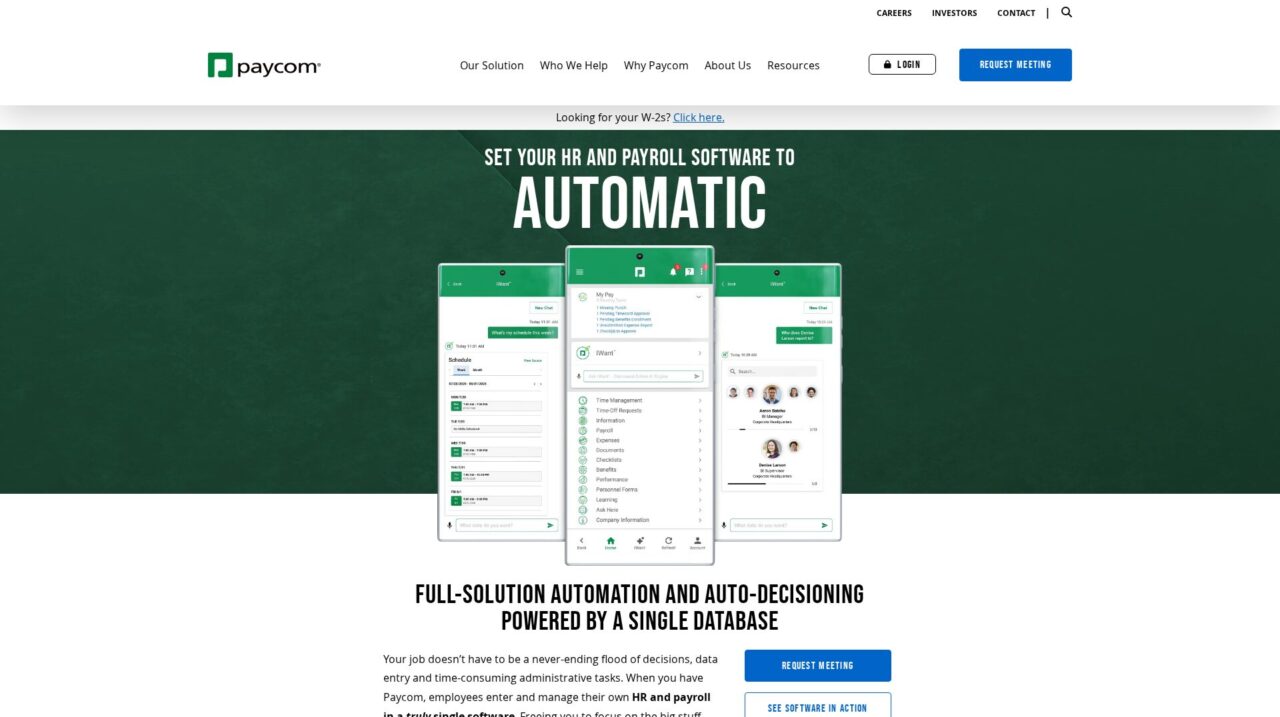

Paycom is a U.S.-focused HR and payroll platform that delivers end-to-end human capital management in a single database, with strong employee self-service and automation for mid-sized and larger organizations.
After evaluating Paycom across its core HR, payroll and automation capabilities, this review distills how the platform actually performs in real organizations. If you are still exploring the broader landscape of HR and payroll software, start with our comparison guides in that category to understand how full-suite HCM platforms stack up against lighter tools.
Paycom is a well-known player in the U.S. HR and payroll market, frequently shortlisted by mid-sized and enterprise companies looking to consolidate systems. Despite that visibility, many buyers still struggle to understand where it truly differentiates, what day-to-day life looks like for HR and payroll teams and what tradeoffs come with its automation-first design.
In this review, you will find a clear breakdown of Paycom’s strengths and weaknesses, its most important features, and how well it fits different sizes and types of organizations. The focus is on practical guidance: where Paycom excels, where it may be overkill, and what to consider before committing.
This review is most relevant for U.S.-based HR, finance and operations leaders at growing companies that need reliable payroll, tighter compliance, and a modern employee experience. We will look at how Paycom supports workflows from hiring through retirement, how its AI and self-service tools work in practice, and when it makes more sense than competing HR and payroll platforms.
Paycom Review Summary
Overall, Paycom delivers a robust, end-to-end HR and payroll solution built on a genuine single database, which translates into fewer data issues and stronger reporting than many stitched-together suites. Features like Beti, IWant and Direct Data Exchange show a clear product vision focused on automation, employee self-service and measurable ROI, supported by a secure architecture and strong mobile apps.
The platform is best suited to U.S.-based mid-market and enterprise organizations that are ready to standardize on a single system of record and willing to push more responsibility to employees via self-service. It is less ideal for very small businesses, global-first companies or buyers who want a minimal, plug-and-play payroll tool. For the right profile, however, Paycom can serve as a long-term HCM backbone rather than just another point solution.
How We Review Tools and Assign the CX Score
We've developed a comprehensive scoring system to evaluate software tools objectively. Our CX Score (1.0–5.0) reflects how strong a product is within its category, based on hands-on testing and analysis across multiple criteria.
Core Functionality
Does the tool deliver the essential features users expect? We assess whether core capabilities meet category standards and if key features are accessible across pricing tiers.
Standout Features
We evaluate unique capabilities that go beyond the basics—features that make the product faster, more efficient, or offer additional value compared to competitors.
Ease of Use
How intuitive is the interface? We consider design quality, mobile apps, templates, and whether complex tasks feel simple to execute.
Onboarding
We measure how quickly new users can get productive with minimal training. High-scoring tools require little to no external support to get started.
Integrations
We assess native integrations, third-party connections, and API access. Tools that connect easily with common tech stacks score higher.
Customer Support
How easy is it to get help? We evaluate support channels, response times, and quality of documentation. Real-time human support scores best.
Value for Money
We compare pricing against features delivered. Software that offers more functionality at competitive prices receives higher marks.
Features of Paycom
- Single database architecture
- U.S. payroll processing
- Global payroll support
- Time and attendance tracking
- Benefits administration
- Talent acquisition and onboarding
- Performance management
- Employee self-service portal
- Mobile apps (iOS and Android)
- AI-driven data assistant (IWant)
- Automated employee-led payroll (Beti)
- Automated time-off decisions (GONE)
- Real-time ROI analytics (Direct Data Exchange)
- Open API
- Prebuilt integrations marketplace
- ISO-certified security
- SOC-audited controls
- Two-factor authentication
- Role-based permissions
- Dedicated implementation support
- Phone and email support
- On-premise deployment
- Custom reporting and dashboards
End-to-End HR and Payroll in One System
Paycom provides integrated modules for payroll, time and attendance, HR management, benefits, talent acquisition and performance management, all built on a unified database. This design means employee records, pay data and time information stay synchronized without nightly syncs or separate interfaces. Compared to tools that bolt together multiple products, this yields more reliable calculations and cleaner compliance reporting.
Employee Self-Service and Beti Payroll Automation
Employee self-service is at the heart of Paycom’s product, allowing staff to manage their own profile, time, benefits and pay. Beti extends this by automatically generating each payroll and prompting employees to validate and correct their information before payroll runs. This reduces manual work for payroll admins, lowers errors and gives employees greater ownership of their compensation details than is typical in traditional payroll systems.
Command-Driven AI Access to Employee Data
The IWant AI engine lets users ask questions to retrieve employee data and insights without navigating complex menus. Drawing from the single database, it searches profiles and dashboards to surface real-time information, from basic contact details to more nuanced workforce metrics. This speeds up everyday inquiries and makes it easier for HR and managers to get answers quickly compared with legacy systems that rely strictly on reports and manual searches.
Automated Time-Off Decisions and Scheduling Safeguards
GONE automates the evaluation of time-off requests by applying business rules to prevent understaffing and ensure policy compliance. Instead of managers manually checking schedules and balances for each request, the system helps drive consistent, timely decisions. For high-volume hourly or shift-based workforces, this can cut decision fatigue and reduce the risk of being caught short-handed compared with basic PTO tracking tools.
Security, Compliance and Risk Management
Paycom deploys an enhanced security program addressing phishing and related threats, alongside ISO and SOC-audited controls, with servers kept under its direct management. These measures, combined with centralized data storage, help reduce attack surface and simplify compliance audits. In contrast to smaller payroll providers or loosely connected tool stacks, this gives risk and IT teams stronger assurances around data protection for sensitive HR and payroll information.
Real-Time ROI Tracking with Direct Data Exchange
Direct Data Exchange is Paycom’s analytics feature that quantifies how much value organizations gain from employee self-service, tracking which tasks employees complete and estimating time and cost savings. This helps HR leaders understand adoption patterns, justify investments and focus enablement efforts where they will return the most benefit. Most HR systems provide usage reports, but few translate them directly into ROI metrics as Paycom does.
Mobile-First Experience for Distributed Workforces
Paycom’s mobile apps enable employees to handle core tasks like clocking in, viewing pay, submitting expenses and managing time-off requests from their phones. Strong app store ratings indicate the interface is approachable and reliable for everyday use. For organizations with large frontline or remote populations, this mobile-first approach can significantly reduce administrative overhead compared to systems that still rely on desktop portals or paper-based processes.
From an administrator’s perspective, Paycom is feature-rich and configurable, which brings a moderate learning curve during implementation. HR and payroll teams should expect a structured rollout with data migration, configuration of pay rules and workflows, and training on modules like Beti and Direct Data Exchange. The presence of a dedicated support team mitigates this complexity, but Paycom is not a tool you fully master in a weekend.
For employees, the experience is intentionally streamlined around the mobile and web self-service interfaces. Common tasks such as reviewing pay statements, submitting time-off requests, or updating personal information are well supported and designed for frequent use. The main usability challenge is change management: shifting staff from passive recipients of payroll to active participants requires communication, training and leadership backing, especially in organizations transitioning from manual or highly centralized processes.
Paycom positions itself as a primary system of record for HR and payroll and relies heavily on its single-database model rather than a sprawling integrations marketplace. It supports connectivity where necessary, for example with benefits carriers, financial institutions, or selected third-party systems, but the core design philosophy is to minimize dependence on multiple overlapping HR tools.
Prospective buyers should clarify how Paycom will connect to their existing ecosystem, including accounting or ERP platforms, time hardware if any, and specialized systems like learning or applicant tracking if they plan to keep those. While Paycom does offer integration options and data export/import capabilities, organizations with a strong preference for an open, best-of-breed HR tech stack should carefully confirm API availability, supported connectors and any limitations on third-party integrations before committing.
Paycom Overview
Pros
- Single, unified database reduces data sync issues and improves reporting accuracy
- Strong employee self-service and Beti payroll automation significantly cut admin workload
- Command-driven AI engine helps HR and managers quickly access real-time employee data
- Robust security posture with ISO and SOC certifications and in-house servers
- Direct Data Exchange clearly quantifies ROI and employee usage of the system
- Highly rated mobile app supports distributed and frontline workforces
- Dedicated service model provides consistent implementation and ongoing support
Cons
- Primarily optimized for U.S.-based companies, limiting suitability for global payroll needs
- Better fit for mid-sized and larger organizations than for very small businesses
- Requires strong change management to drive employee adoption of self-service payroll
- All-in-one design can feel restrictive for teams that prefer best-of-breed stacks
- Implementation and configuration can be complex compared with lightweight payroll tools
Paycom: Frequently Asked Questions
What type of companies is Paycom best suited for?
Paycom is best for U.S.-based mid-sized and larger organizations that want an all-in-one HR and payroll platform with strong employee self-service and automation.
Does Paycom support global payroll?
Paycom is primarily focused on the U.S. market, so it is not a comprehensive global payroll solution for multi-country workforces.
How does Beti change the payroll process?
Beti automatically builds each payroll and prompts employees to review and correct their own pay information before the run, reducing manual work and post-payday corrections for payroll teams.
Is Paycom difficult to implement?
Implementation is structured and can be complex due to the system’s breadth, but Paycom assigns a dedicated team to guide configuration, data migration and go-live.
How secure is Paycom for sensitive HR data?
Paycom employs ISO and SOC-audited security standards, enhanced anti-phishing protections and keeps servers in-house, providing a strong security posture for HR and payroll data.
Can employees manage HR tasks from their phones?
Yes, Paycom offers highly rated mobile apps that allow employees to clock in, review pay, manage time-off requests, update personal information and complete other HR tasks.
Does Paycom integrate with other business systems?
Paycom provides integration options and data connectivity where needed, but its single-database design assumes it will be the core HR and payroll system, so buyers should verify specific integration requirements in detail.
