
Paycor Review: HR and Payroll Software for Growing Businesses 2026
 Apr 01,2026

Paycor is a cloud-based HCM platform that combines HR, payroll, talent, time, and benefits administration for small to mid-sized organizations and multi-location employers.
After analyzing Paycor in depth as an HR and payroll platform, this review pulls together how it really performs for day-to-day people operations. The goal is to look beyond marketing language and focus on how Paycor behaves in the hands of HR teams, finance leaders, and frontline managers.
If you are still deciding what category of tool you need, start with our comparison of HR and payroll software on CX Everywhere, then come back here to understand where Paycor fits. For many buyers, it shows up on the same shortlist as other mid-market HCM suites.
Paycor is widely recognized and has thousands of public reviews from HR and operations teams, which is why it often appears as a safe choice. But whether it is the right platform for you depends heavily on your size, complexity, and expectations for talent and workforce management.
In this review, you will learn Paycor’s pros and cons, see how its core features map to real-world HR workflows, and get guidance on which types of organizations benefit most from adopting it. The focus is on small to mid-sized businesses and multi-location employers that want to move from basic payroll to a unified HCM system.
Paycor Review Summary
Overall, Paycor is a strong, well-rounded HCM platform for organizations that need more than simple payroll but do not want the overhead of a full enterprise HR suite. It covers the critical bases of HR, payroll, timekeeping, scheduling, benefits, recruiting, and basic talent management in a reasonably cohesive way.
Its emphasis on a single source of truth for employee data and manager-centric workflows makes it particularly effective in operationally intensive industries. The main reasons to look elsewhere are if you either need a very light, low-touch payroll solution for a tiny team or a highly specialized tool with deep capabilities in a niche like learning or global HR. For the majority of growing businesses, Paycor strikes a pragmatic balance between breadth, usability, and scalability.
How We Review Tools and Assign the CX Score
We've developed a comprehensive scoring system to evaluate software tools objectively. Our CX Score (1.0–5.0) reflects how strong a product is within its category, based on hands-on testing and analysis across multiple criteria.
Core Functionality
Does the tool deliver the essential features users expect? We assess whether core capabilities meet category standards and if key features are accessible across pricing tiers.
Standout Features
We evaluate unique capabilities that go beyond the basics—features that make the product faster, more efficient, or offer additional value compared to competitors.
Ease of Use
How intuitive is the interface? We consider design quality, mobile apps, templates, and whether complex tasks feel simple to execute.
Onboarding
We measure how quickly new users can get productive with minimal training. High-scoring tools require little to no external support to get started.
Integrations
We assess native integrations, third-party connections, and API access. Tools that connect easily with common tech stacks score higher.
Customer Support
How easy is it to get help? We evaluate support channels, response times, and quality of documentation. Real-time human support scores best.
Value for Money
We compare pricing against features delivered. Software that offers more functionality at competitive prices receives higher marks.
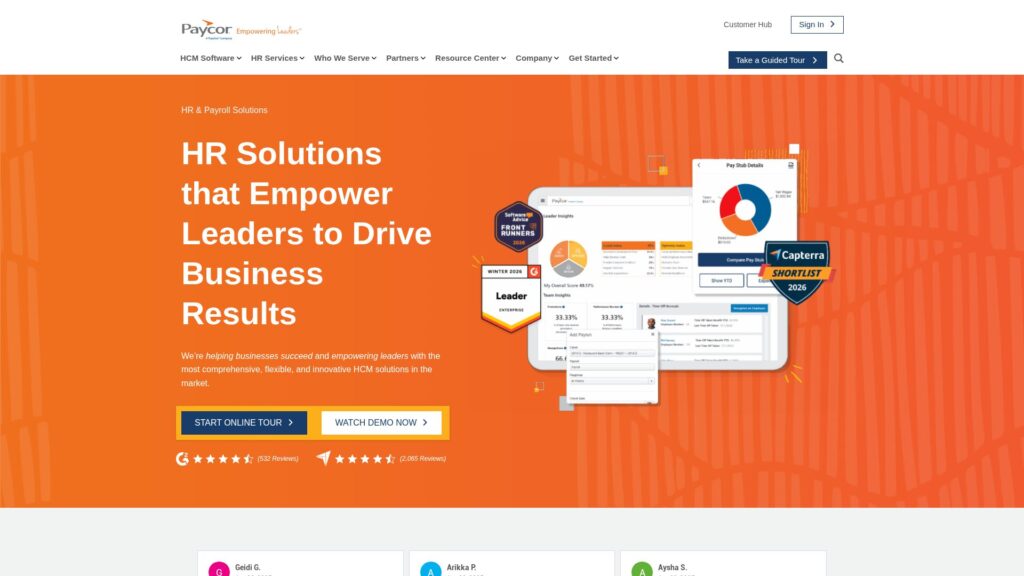
Features of Paycor
- Core HR database
- Payroll processing
- Time and attendance tracking
- Employee scheduling
- Benefits administration and enrollment
- Talent acquisition and applicant tracking
- Onboarding workflows
- Performance and talent management
- Employee self-service portal
- Manager self-service
- Mobile app
- Analytics and reporting
- Open API
- Third-party integrations marketplace
- Background check integrations
- Point of sale integrations
- Global payroll partner integrations
- Document storage for employee records
- Configurable workflows and approvals
- Role-based access controls
- Multi-location support
- Compliance and tax filing support
- Learning management system
- On-premise deployment
Unified HR and Payroll for a Single Source of Truth
Paycor’s core is a combined HR and payroll system where employee records, job data, compensation, and tax information live side by side. When HR updates a role, rate, or location, that change automatically flows into payroll, reducing the need to re-enter data in multiple systems. This unified approach minimizes errors, simplifies audits, and helps ensure compliance with wage and hour regulations compared with running separate HRIS and payroll products.
For growing organizations, consolidating into a single HR and payroll platform also streamlines processes like onboarding, terminations, and year-end reporting. Paycor’s capabilities in this area are broadly in line with other mid-market HCM suites, but its design tends to be more approachable for teams upgrading from entry-level payroll services.
Hiring and Talent Acquisition Workflows
Paycor offers talent acquisition tools that cover job postings, candidate tracking, and communication, aiming to simplify hiring for both HR and hiring managers. Applicants can be sourced, screened, and progressed through configurable workflows, with data carried forward into onboarding once a hire is made. This reduces manual data entry and the risk of missing steps between offer acceptance and day-one readiness.
While the depth of sourcing and employer branding options may not match top-tier, standalone ATS products, Paycor’s talent acquisition is generally sufficient for small and mid-sized employers that want integrated rather than best-of-breed recruiting. Its tight connection with HR and payroll data is the main advantage over point solutions.
Employee Engagement and Talent Management
On the talent management front, Paycor focuses on performance conversations, engagement, and retention rather than heavy, complex HR processes. Managers and HR leaders can use built-in tools to gather feedback, track goals, and run performance reviews so that development conversations are documented and repeatable. This is particularly helpful for companies formalizing their review cycles for the first time.
Compared with specialized performance management and engagement suites, Paycor’s talent capabilities are more streamlined and less configurable. However, for many organizations that simply need structured check-ins, goal tracking, and basic engagement measures, Paycor delivers enough functionality within the same system where payroll and HR records already reside.
Workforce Management, Scheduling, and Time
Paycor’s workforce management tools focus on scheduling, time tracking, and labor cost control. Managers can build, publish, and adjust schedules, while employees can clock in and out through supported devices or mobile. These time records then feed directly into payroll calculations, which helps reduce discrepancies and manual adjustments that often plague separate timeclock and payroll systems.
For industries with complex shifts such as healthcare, manufacturing, and restaurants, Paycor’s scheduling flexibility and labor analytics can highlight coverage gaps, overtime trends, and compliance risks. This level of integration between time, scheduling, and payroll is a clear advantage over standalone scheduling apps that require exports and imports.
Benefits Administration and Open Enrollment
Benefits administration in Paycor covers plan setup, eligibility, and employee self-service enrollment. During open enrollment, employees can review plan options, compare costs, and submit their selections online, significantly cutting down on paper forms and manual data entry for HR. Those elections then flow into payroll and reporting, which helps maintain alignment between deductions and carrier requirements.
Paycor also positions its benefits tools as a way to help leaders find savings opportunities while maintaining quality coverage, though the sophistication of those insights will vary by employer. Still, moving benefits into the same platform as HR and payroll reduces reconciliation issues and improves the overall employee experience compared with disconnected benefits portals.
Mobile Access and Self-Service for Employees and Managers
Paycor offers a mobile app and mobile-optimized experience that allows employees to view pay information, access schedules, request time off, and manage basic HR tasks from their phones. Frontline workers in restaurants, healthcare, or manufacturing especially benefit from on-the-go access given they are rarely at a desk. Manager self-service features allow supervisors to approve time, review team data, and handle simple HR actions without routing everything through corporate HR.
This mobile and self-service focus reduces administrative overhead, speeds up routine approvals, and improves transparency for employees. Within the HR software category, Paycor’s mobile experience is competitive and often a deciding factor for organizations with large hourly or distributed workforces.
Analytics and Reporting for Leaders
Analytics is an important part of Paycor’s positioning as a platform that “empowers leaders.” Users can generate reports on headcount, turnover, labor spend, overtime, benefits participation, and other HR metrics from the centralized dataset. Dashboards can help leaders identify trends, compliance risks, and opportunities to optimize scheduling or staffing.
While its analytics may not rival dedicated BI platforms or high-end workforce planning tools, Paycor provides HR and operations leaders with enough insight to make more data-informed decisions than they could with spreadsheets and disconnected systems. This level of built-in reporting is aligned with other mid-market HCM platforms.
Implementation with Paycor is a structured project rather than a quick sign-up, especially if you are rolling out multiple modules like payroll, time, and benefits together. Expect data migration, configuration of pay rules and schedules, and training for HR, managers, and employees. For organizations moving from manual processes or separate systems, this investment usually pays off in reduced ongoing administration, but it does require planning and executive sponsorship.
Day-to-day usability is generally strong for both HR admins and frontline managers. Workflows for payroll runs, time approvals, and basic HR changes are designed to be logical once configured, and the mobile experience makes routine tasks accessible. Users coming from very simple payroll tools may encounter a learning curve as they adopt broader HCM capabilities, but compared to enterprise suites, Paycor remains relatively approachable.
Paycor supports a wide integration ecosystem that spans pay solutions, point of sale systems, benefits platforms, global payroll partners, advanced scheduling tools, and background screening providers. For retailers, restaurants, and other transactional businesses, POS and payroll integration can be critical for accurate labor tracking and reporting. Benefits and global payroll integrations help organizations extend Paycor’s reach while keeping it as the core HR system of record.
There are also broader app and tech partnerships that allow data to sync between Paycor and other operational systems, reducing manual file transfers. Buyers with more complex or custom integration needs should confirm availability of APIs, data export options, and prebuilt connectors as part of the evaluation process, but for many small and mid-sized organizations, the existing ecosystem covers most essential use cases.
Paycor Overview
Pros
- Broad HCM suite covering HR, payroll, time, talent, and benefits in one platform
- Single source of truth for employee data reduces manual updates and errors
- Strong support for frontline managers with mobile-first access and workflows
- Industry-focused features for healthcare, manufacturing, restaurants, and services
- Hundreds of integrations across pay, POS, benefits, global payroll, and more
- Well-established vendor with large customer base and strong third-party ratings
- Workforce management tools help control labor costs and scheduling complexity
Cons
- Some modules are less feature-rich than best-of-breed specialist tools
- Implementation and configuration require meaningful time and change management
- May be more system than very small, payroll-only businesses actually need
- Highly complex global or unionized organizations may outgrow its capabilities
Paycor: Frequently Asked Questions
What is Paycor best used for?
Paycor is best for organizations that want a unified HR and payroll platform covering core HR, payroll, time, scheduling, benefits, and basic talent management in one system.
What size companies does Paycor serve best?
It is particularly well suited to small and mid-sized businesses and multi-location employers that have outgrown basic payroll tools but do not need a heavyweight enterprise HCM suite.
Does Paycor support hourly and shift-based workforces?
Yes, Paycor includes workforce management features for scheduling, time tracking, and labor cost control, which are especially useful in industries like healthcare, manufacturing, and restaurants.
Can Paycor integrate with our existing systems?
Paycor offers integrations across pay solutions, point of sale, benefits providers, global payroll partners, advanced scheduling tools, and background screening, plus broader app and tech partnerships.
Is Paycor easy for managers and employees to use?
The platform is designed with mobile-first, self-service access so employees and frontline managers can handle routine tasks like viewing pay, managing schedules, and approving time without relying solely on HR.
Is Paycor suitable for global organizations?
Paycor can support some international scenarios through global payroll partners, but organizations with very complex global HR structures may prefer more globally focused enterprise HCM suites.
