
Paylocity Review: Unified HR, Payroll & Finance Platform for 2026
 Mar 27,2026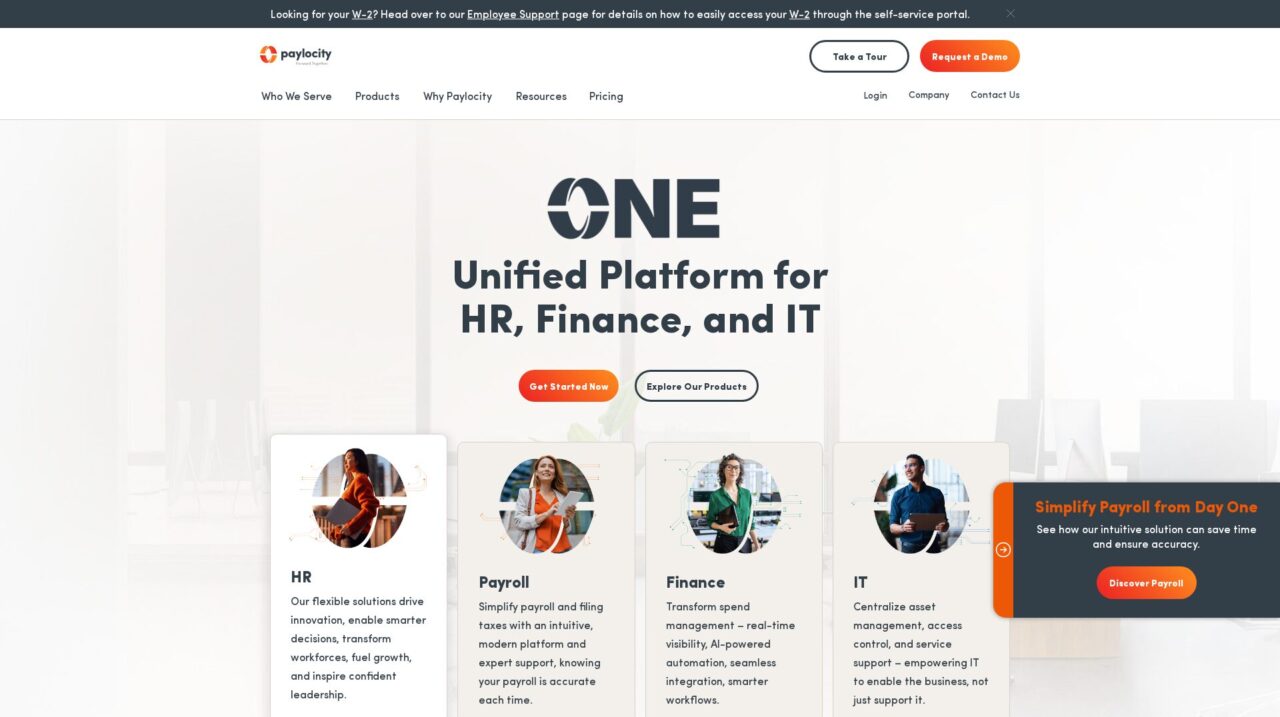

Paylocity is a unified, cloud-based HR and payroll platform that brings HR, finance, and IT together for small to enterprise businesses. It streamlines core HR, payroll, time, talent, and spend management in a single system.
After analyzing Paylocity across real-world implementations and feature depth, this review breaks down how the platform actually performs as a unified HR and payroll system. The goal is to help you decide if it is the right fit for your HR, finance, and IT teams, not just to restate marketing claims.
If you are still exploring the broader landscape of HR tools, start with our comparison of leading HR and payroll software on CX Everywhere so you can see where Paylocity sits in the category. Once you understand the category benchmarks, it becomes much easier to judge whether its capabilities match your needs.
Paylocity is a well-known name in the mid-market HCM space, used by thousands of US businesses that have moved beyond basic payroll. Many buyers arrive with positive word of mouth but still need clarity on strengths, weaknesses, and how it compares to rivals like Paycom, ADP, and UKG.
This review focuses on what Paylocity does well, where it falls short, and which company sizes and industries will benefit most. It is aimed at HR leaders, finance executives, and IT stakeholders in organizations from roughly 50 to several thousand employees who are considering a consolidated platform for payroll, HR, and workforce management.
Paylocity Review Summary
Paylocity is a strong choice for organizations that want a unified, modern HCM platform without the overhead of a full enterprise suite. It combines solid payroll and compliance with employee-centric features like social-style communication, surveys, and a polished mobile app, which drives adoption far beyond simple pay stub access.
At the same time, it remains primarily a US-focused solution with quote-based pricing and an implementation project that requires dedicated effort from HR and finance teams. Companies that can invest in that rollout and primarily operate in North America will find that Paylocity significantly reduces manual work and improves visibility into workforce costs and trends.
How We Review Tools and Assign the CX Score
We've developed a comprehensive scoring system to evaluate software tools objectively. Our CX Score (1.0–5.0) reflects how strong a product is within its category, based on hands-on testing and analysis across multiple criteria.
Core Functionality
Does the tool deliver the essential features users expect? We assess whether core capabilities meet category standards and if key features are accessible across pricing tiers.
Standout Features
We evaluate unique capabilities that go beyond the basics—features that make the product faster, more efficient, or offer additional value compared to competitors.
Ease of Use
How intuitive is the interface? We consider design quality, mobile apps, templates, and whether complex tasks feel simple to execute.
Onboarding
We measure how quickly new users can get productive with minimal training. High-scoring tools require little to no external support to get started.
Integrations
We assess native integrations, third-party connections, and API access. Tools that connect easily with common tech stacks score higher.
Customer Support
How easy is it to get help? We evaluate support channels, response times, and quality of documentation. Real-time human support scores best.
Value for Money
We compare pricing against features delivered. Software that offers more functionality at competitive prices receives higher marks.
Features of Paylocity
- Cloud-based deployment
- Payroll processing
- Payroll tax services
- Core HRIS/employee database
- Time and attendance
- Scheduling
- Benefits administration
- Applicant tracking system (ATS)
- Digital onboarding
- Performance management
- Learning management
- Employee engagement tools (surveys, feed)
- Expense and spend management
- IT asset management
- Access control and provisioning
- Mobile app (iOS and Android)
- Employee self-service portal
- Manager self-service
- Reporting and analytics
- Open API
- SSO support
- Third-party integrations
- Global payroll support
- On-premise deployment
- Built-in CRM
Unified HR and Payroll Management
Paylocity’s core strength is providing a single system of record for employee data, payroll, and HR processes. Employee profiles, job data, compensation, and tax information live in one HRIS, which feeds directly into payroll runs. This reduces the manual reconciliation and duplicate data entry that plague organizations using separate systems for HR and payroll.
The payroll engine supports common US compliance requirements, including multi-state taxation, garnishments, and standard reporting. Integration with benefits, time and attendance, and general ledger exports ensures that payroll is not a silo but a connected workflow across your back office.
Time and Attendance With Built-In Compliance Controls
Time and labor features let employees clock in and out via web, mobile, or physical devices, with schedules and work rules determining how hours flow into payroll. You can configure overtime rules, shift differentials, and rounding settings to match your policies while maintaining audit trails for compliance.
For industries with hourly or shift-based work, this tight integration between time tracking and payroll reduces pay errors and saves HR time every pay period. Compared with standalone time tools, Paylocity’s approach minimizes the risk of missing imports or mismatched data when payroll deadlines hit.
Benefits Administration and Employee Self-Service
Benefits administration modules handle eligibility rules, open enrollment, and ongoing life events. Employees can review plan options, make elections, and view coverage details through the portal or mobile app, significantly cutting down on HR’s administrative burden and questions.
Because benefits, payroll, and HR data are unified, deductions and employer contributions automatically sync with payroll. This is a clear improvement over older models where HR has to manually update deductions or maintain separate spreadsheets when employees change plans.
Talent Acquisition and Onboarding
Paylocity includes an applicant tracking system that manages job postings, applications, candidate communication, and interview workflows. Once a candidate is hired, their data flows directly into onboarding, eliminating duplicate entry and speeding up the move from offer to productive employee.
Digital onboarding lets new hires complete forms, review policies, and get acquainted with the company before their first day. This is especially valuable for distributed or remote teams, where traditional paper-heavy onboarding is cumbersome and error-prone.
Performance, Learning, and Employee Engagement
Beyond core HR, Paylocity offers tools for performance management, learning, and engagement. HR teams can run performance reviews, set goals, and track progress within the system, while learning modules enable delivery of training content and tracking of completion.
Engagement features like surveys, recognition, and a social-style communication feed help HR foster culture and keep employees informed. Compared with traditional payroll systems that employees rarely log into, Paylocity aims to be a daily destination where people check schedules, interact with colleagues, and stay up to date.
Spend Management and Financial Visibility
Paylocity’s finance capabilities center on spend management, giving organizations real-time visibility into expenses across teams and departments. Expense submissions, approvals, and policies are all handled in the platform, and can be aligned with HR data like departments, locations, and managers.
This linkage lets finance and HR collaborate on controlling workforce-related costs without constantly moving data between separate tools. For growing organizations, this can be a meaningful step toward better budgeting and more accurate forecasting.
IT Asset Management and Access Control
On the IT side, Paylocity extends the employee record to include hardware, software, and access rights. When employees join, move roles, or leave, IT can manage provisioning and deprovisioning based on HR events, reducing security risk and manual ticket work.
Centralizing asset management and access control around the HRIS helps IT act as an enabler rather than just a support function. It also ensures that devices and permissions are aligned with actual employment status, which is a gap in many organizations running disconnected systems.
Implementing Paylocity requires a structured project, especially if you are migrating from multiple systems. You will need to configure pay codes, time rules, benefits plans, and approval workflows, and complete data migration for employees and historical payroll where needed. Paylocity’s implementation teams and partners typically guide this process, but you should expect several weeks to a few months depending on company size and complexity.
Once live, everyday usability is generally strong. Admins have a powerful but configurable dashboard, and many routine tasks like onboarding tasks, time-off approvals, and reminders can be automated. There is a learning curve for HR and payroll administrators because of the platform’s breadth, but it is not as steep as full enterprise HCM suites. Employees benefit from an intuitive mobile app and portal where they can access pay, benefits, schedules, and communication without HR handholding.
Paylocity offers a range of integrations to connect HR and payroll data with your broader application stack. Common scenarios include feeding payroll and expense data into accounting or ERP systems, syncing employee information with benefits carriers, and connecting to third-party tools for background checks or learning content. An API and prebuilt connectors are available for many popular systems, although the depth of each integration can vary.
Because the publicly visible information does not list every integration, buyers should ask detailed questions about their specific ecosystem, such as which ERPs, time devices, and benefits carriers are supported natively versus through custom work. For larger or more complex environments, it is also worth clarifying how Paylocity handles SSO, data exports, and any middleware needed to keep systems in sync.
Paylocity Overview
Pros
- Modern, employee-friendly mobile app that drives daily engagement
- Robust unified HR and payroll functionality for small to enterprise organizations
- Strong automation across payroll, time, and HR workflows reduces manual work
- Expanding platform that now connects HR, finance, and IT around one system
- Good fit for US-based mid-market companies needing advanced HR features
- Reputation for responsive, award-winning customer service and support
- Digital onboarding and ATS streamline hiring and new hire setup
- Employee self-service for pay, benefits, and time off reduces HR inquiries
Cons
- Quote-based pricing makes it harder to benchmark costs quickly
- Implementation requires a dedicated rollout project and internal resources
- Primarily optimized for US payroll, less suited for complex global operations
- Feature breadth can create an initial learning curve for HR admins
- May be more platform than needed for very small, cost-sensitive businesses
Paylocity: Frequently Asked Questions
What type of companies is Paylocity best suited for?
Paylocity is best for US-based organizations from about 50 to several thousand employees that want a unified platform for HR, payroll, time, and employee experience.
Can very small businesses use Paylocity?
Yes, small businesses can use Paylocity, but the breadth of features and quote-based pricing often make it most compelling once you reach roughly 50 or more employees.
Does Paylocity support global payroll?
Paylocity is primarily optimized for US payroll and compliance; organizations with complex multi-country payroll needs may require additional solutions or a global payroll provider.
How long does it take to implement Paylocity?
Implementation timelines vary by size and complexity, but you should budget several weeks to a few months to configure payroll, time, and benefits and migrate data.
Does Paylocity offer a mobile app for employees?
Yes, Paylocity provides a mobile app that lets employees access pay, time off, schedules, documents, and communication on their phones.
How does Paylocity help finance and IT teams?
Beyond HR and payroll, Paylocity includes spend management for finance and asset and access management for IT, connecting workforce data with expenses and provisioning.
Can Paylocity integrate with our accounting or ERP system?
Paylocity supports integrations and data exports to common accounting and ERP systems; buyers should confirm specific connectors and API options with sales and implementation teams.
Is pricing for Paylocity publicly listed?
Pricing is typically provided through a custom quote based on employee count and selected modules, so you will need to speak with sales to get exact costs.
