
Phenom Review: AI Talent Experience Platform for Enterprises 2026
 Jan 26,2026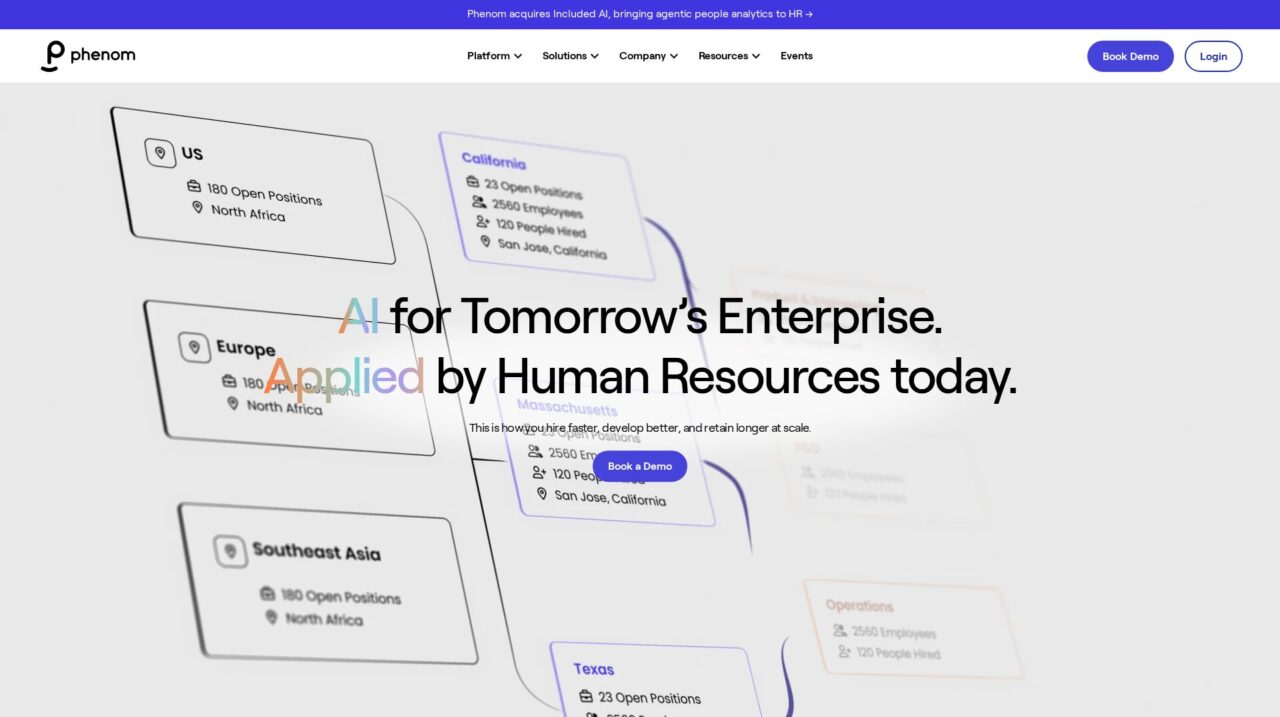

Phenom is an enterprise AI talent experience platform that unifies recruiting, talent management, and employee experience to help large organizations hire faster, develop better, and retain longer.
We have taken a close look at Phenom as an AI-driven talent experience platform, focusing on how it performs across real-world recruiting, talent management, and employee experience workflows. This review distills that evaluation into a practical guide for HR and talent leaders considering Phenom for their stack.
If you are still exploring the market broadly, it can help to compare Phenom against other options in the wider HR and payroll software landscape before making a shortlist. From there, understanding Phenom’s specific strengths and tradeoffs will be much easier.
Phenom is widely recognized among enterprise HR teams for its AI-first approach to candidate and employee experience, but many buyers still struggle to understand where it stops, where their ATS or HRIS begins, and what it really takes to implement. That is exactly what this review aims to clarify.
By the end, you will have a grounded view of Phenom’s pros and cons, its key features across candidate, recruiter, and employee journeys, and the types of organizations and use cases where it tends to be a strong fit. The focus is on mid-market and large enterprises with dedicated talent acquisition and HR functions, complex hiring needs, and a strategic interest in internal mobility and retention. For those teams, Phenom promises to help turn unorganized talent data into insights, automate repetitive work, and deliver more personalized experiences across the talent lifecycle.
Phenom Review Summary
Overall, Phenom is one of the stronger options in the AI talent experience category for enterprises that want a single platform spanning candidate attraction, recruiter productivity, hiring manager collaboration, and employee development. Its applied AI infrastructure and HR agents are designed to automate manual work and personalize experiences at scale, and the customer base of hundreds of global brands signals both maturity and scalability.
That said, this is not a simple plug-and-play point solution. The breadth of functionality, reliance on quality data, and typical enterprise implementation model mean buyers should treat Phenom as a strategic platform investment. If you have the scale, complexity, and internal resources to support that, Phenom can deliver meaningful improvements in time-to-fill, internal mobility, and recruiter efficiency. If not, a smaller, more focused tool may be the better fit.
How We Review Tools and Assign the CX Score
We've developed a comprehensive scoring system to evaluate software tools objectively. Our CX Score (1.0–5.0) reflects how strong a product is within its category, based on hands-on testing and analysis across multiple criteria.
Core Functionality
Does the tool deliver the essential features users expect? We assess whether core capabilities meet category standards and if key features are accessible across pricing tiers.
Standout Features
We evaluate unique capabilities that go beyond the basics—features that make the product faster, more efficient, or offer additional value compared to competitors.
Ease of Use
How intuitive is the interface? We consider design quality, mobile apps, templates, and whether complex tasks feel simple to execute.
Onboarding
We measure how quickly new users can get productive with minimal training. High-scoring tools require little to no external support to get started.
Integrations
We assess native integrations, third-party connections, and API access. Tools that connect easily with common tech stacks score higher.
Customer Support
How easy is it to get help? We evaluate support channels, response times, and quality of documentation. Real-time human support scores best.
Value for Money
We compare pricing against features delivered. Software that offers more functionality at competitive prices receives higher marks.
Features of Phenom
- AI-powered job recommendations
- Career site and landing page builder
- Candidate relationship management (CRM)
- Chatbot and conversational recruiting
- Automated interview scheduling
- Internal mobility and employee career paths
- Skills ontology and matching
- Recruiting analytics and dashboards
- Talent marketing and campaigns
- Hiring manager collaboration tools
- Integration with major ATS platforms
- Integration with HRIS / HCM systems
- Configurable workflows and automation
- GDPR and enterprise-grade security
- Open API access
- Mobile-friendly candidate experience
- Multi-language and global support
- On-premise deployment
Personalized Candidate Journeys from First Touch to Application
Phenom provides a modern, AI-powered candidate experience that includes dynamic career sites, personalized job recommendations, and relevant content tailored to each visitor. Instead of static job listings, candidates see roles and resources that match their skills, interests, and behavior, which helps them find and choose the right opportunities faster.
This level of personalization goes beyond what most traditional ATS career pages offer. For organizations competing in tight talent markets, it can significantly improve conversion rates, reduce drop-off, and enhance employer brand perception, all while capturing richer data on candidate interests and intent.
Recruiter and Talent Marketer Productivity with AI Co-pilots
On the recruiter and talent marketing side, Phenom equips teams with AI co-pilots that help with sourcing, candidate matching, outreach, and pipeline management. Recruiters can quickly identify top candidates, automate follow-ups, and manage campaigns targeted at specific segments, freeing up time for higher-value conversations and stakeholder management.
Compared to standard ATS workflows that rely heavily on manual searching and emailing, these capabilities can reclaim hours per recruiter each week. Talent marketers also benefit from data-backed insights into which campaigns, channels, and content are actually driving quality applicants.
Skills-based Internal Mobility and Employee Development
Phenom extends its AI capabilities into the employee experience with internal mobility and career development features. Employees can discover internal roles, projects, and learning opportunities based on their skills, interests, and career goals, rather than relying on informal networks or manual searches.
This skills-centric view helps organizations increase internal hires and retain high-potential employees by making career paths more transparent. It also gives HR and business leaders visibility into skill gaps and succession pipelines, something many legacy HR systems struggle to provide effectively.
AI Agents for HR to Automate Manual Work
A distinctive feature of Phenom is its set of AI agents purpose-built for HR roles, such as recruiters and talent marketers. These agents can automate repetitive tasks like screening, scheduling, drafting communications, and surfacing insights, effectively acting as digital co-workers that augment human teams.
In contrast to generic automation rules, these agents are designed around HR-specific workflows and objectives. For organizations looking to move HR teams away from administrative work and toward strategic initiatives, this targeted automation can be a significant operational advantage.
Centralized Applied AI Infrastructure Connecting HR Systems
Underneath the experiences, Phenom runs on an applied AI infrastructure that connects with existing HR systems, synchronizes data, and powers machine learning models across the platform. This architecture is critical for large enterprises that have multiple HR tools, regions, and business units with different processes and data standards.
By consolidating and interpreting data across systems, Phenom can generate strategic insights, such as talent gaps and potential flight risks, that are hard to surface from siloed tools. It also enables consistent experiences for candidates and employees, regardless of which backend systems are in use.
Analytics and Outcomes-focused Talent Experience Reporting
Phenom emphasizes measurable outcomes like reduced time to fill, increased internal mobility, more efficient talent acquisition spend, and recruiter hours saved. The platform provides reporting and analytics that help leaders track these metrics and understand the drivers behind them, such as campaign performance, funnel conversion, and source effectiveness.
Compared to basic ATS reports limited to requisition counts and time in stage, Phenom’s analytics are more aligned with strategic questions about talent experience, workforce planning, and ROI on employer branding investments. That makes it especially valuable for CHROs and TA leaders who need to communicate impact to the C-suite.
Phenom’s everyday interface is modern and generally intuitive for users familiar with contemporary SaaS platforms, but the breadth of functionality means there is still a learning curve. Recruiters, talent marketers, and HR business partners will need structured onboarding to learn how to use AI recommendations, set up campaigns, and interpret insights, especially if they are coming from a more transactional ATS environment.
From an admin and implementation perspective, Phenom is not a lightweight tool. Configuration of journeys, data mappings, permission models, and branding requires careful planning and collaboration across HR, IT, and sometimes marketing. Once live, many workflows can be automated and simplified, but organizations should plan for ongoing governance and optimization to keep automations, content, and models aligned with evolving business needs.
Phenom is designed to integrate with existing HR systems, particularly applicant tracking systems and core HRIS platforms, using APIs and prebuilt connectors where available. This connectivity allows it to sync candidate and employee data, requisitions, and status changes so that the AI models have a complete view of the talent lifecycle and users are not forced into duplicative data entry.
However, the precise depth of integration can vary by system and deployment. Buyers should validate how Phenom connects with their specific ATS, HRIS, identity provider, and communication tools, and clarify the supported data flows and latency. For complex global environments, it is important to involve internal IT early, confirm data governance and security requirements, and understand whether any custom integration work or middleware will be needed to achieve the desired level of synchronization.
Phenom Overview
Pros
- End-to-end platform spanning candidate, recruiter, hiring manager, and employee experiences
- AI-first architecture powering personalization, matching, and automation at scale
- Strong fit for large enterprises with complex, multi-region hiring needs
- Demonstrated outcomes in time-to-fill reduction and internal mobility improvements
- AI agents for HR roles that meaningfully reduce manual administrative work
- Robust analytics for talent experience, pipeline health, and campaign performance
- Unified experience layer that complements existing ATS and HRIS systems
Cons
- Best suited to enterprises; overkill for small or simple hiring organizations
- Implementation can be complex and resource-intensive with change management needs
- Learning curve for recruiters and HR teams new to AI-driven workflows
- Value depends heavily on quality integrations with existing HR systems
- Custom, opaque pricing makes budgeting and comparisons more difficult
Phenom: Frequently Asked Questions
What type of companies is Phenom best suited for?
Phenom is primarily designed for mid-sized and large enterprises with complex recruiting needs, multiple regions, and a strategic focus on internal mobility and talent experience.
Can Phenom replace my existing ATS?
Phenom is typically deployed as an experience and AI layer that complements an existing ATS, although it can take over many candidate-facing and CRM-style functions that traditional ATS tools do not handle well.
How difficult is it to implement Phenom?
Implementation is a significant project involving HR, TA, IT, and often marketing, including system integrations, data mapping, and journey design, so buyers should plan for a structured rollout rather than expecting a quick setup.
Does Phenom support internal mobility and employee development?
Yes, Phenom includes features for internal job discovery, skills-based career paths, and development recommendations, helping organizations increase internal hires and retain key talent.
How does Phenom use AI in HR workflows?
Phenom applies AI to job and content recommendations, candidate matching, campaign targeting, automation of tasks like screening and scheduling, and analytics that identify talent gaps and potential flight risks.
Will Phenom work with our existing HR systems?
Phenom is built to integrate with leading ATS and HRIS platforms through APIs and connectors, but you should confirm the specific level of integration available for your systems and any custom work required.
Is Phenom suitable for small businesses?
In most cases Phenom is more than small organizations need, due to its breadth and implementation requirements; smaller companies may find simpler ATS or recruiting tools more appropriate.
How does Phenom address AI fairness and ethics?
Phenom emphasizes maintaining the validity and reliability of its AI models and positions its platform as safe, fair, and ethical, though buyers should still review governance practices and compliance requirements for their organization.
