
Yello Review: Early Talent Recruiting & Campus Hiring Software
 Mar 16,2026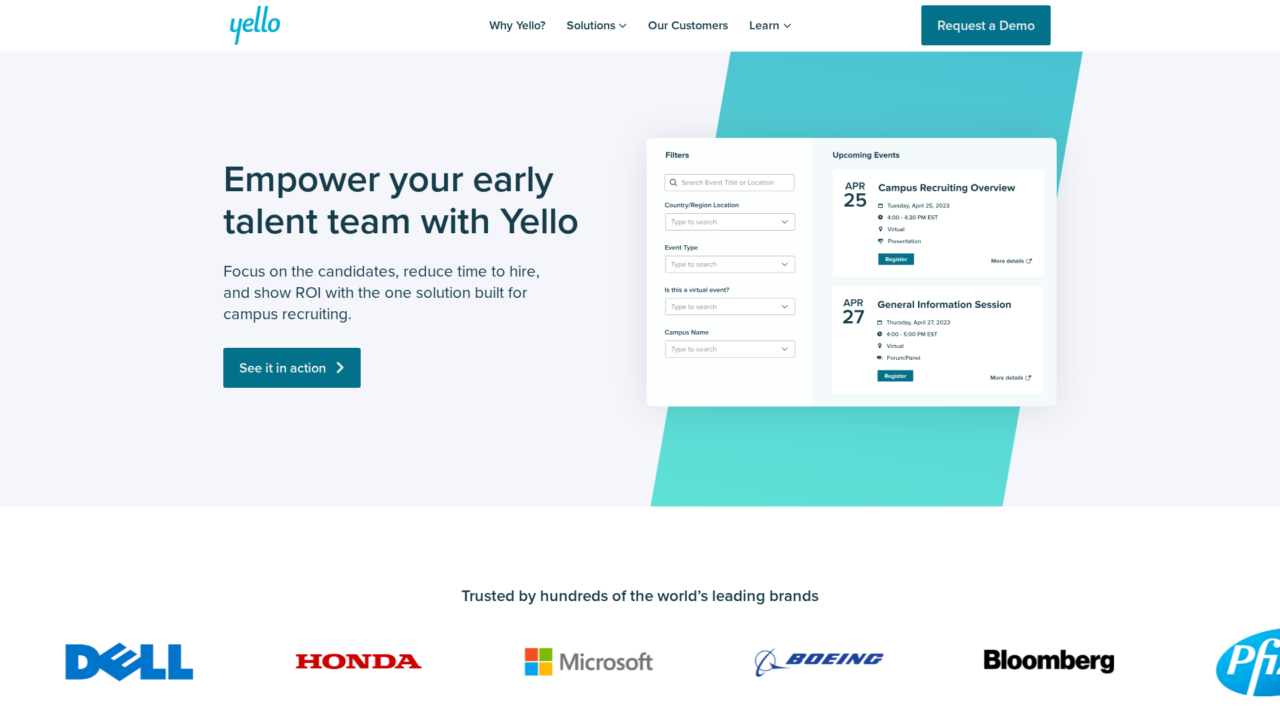

Yello is an early talent and campus recruiting platform for large enterprises and high-growth organizations that need to plan events, source students, and manage candidates from hello to hire.
After analyzing Yello in depth, this review walks through how the platform actually performs for early talent and campus recruiting teams. The goal is to help you decide whether Yello is the right foundation for your university relations and early-career hiring strategy.
If you are still surveying the broader landscape, you may also want to compare options in our campus recruiting software and applicant tracking coverage before deciding on a single vendor. Yello is widely recognized among Fortune 500 and high-growth companies that run structured campus programs, but the nuances of your hiring mix and tech stack still matter a lot.
Yello has built a strong reputation as a campus-first solution, especially for organizations that need to coordinate large volumes of events, student touchpoints, and stakeholders. That said, buyers often need more than marketing headlines to judge fit: how focused is it on early talent, how well does it integrate, and what does working with Yello feel like over time?
In this review, you will learn where Yello excels, where it is more limited, and which types of teams and hiring strategies get the most from it. We will focus on real-world use cases such as campus event workflows, student sourcing, early-career nurturing, and government recruiting, so you can quickly see whether it aligns with your own priorities.
Yello Review Summary
Overall, Yello is one of the strongest purpose-built platforms for early talent and campus recruiting, offering a rich set of tools for event management, student sourcing, and long-lead candidate nurturing. Its integration with the WayUp candidate database and FedRAMP authorization position it well for large enterprises and government organizations that hire early-career talent at scale.
The tradeoff is that Yello is deliberately specialized rather than a full ATS for every role, so it typically runs alongside your core recruiting system and demands thoughtful implementation. If early talent is a strategic channel and you need to move beyond ad hoc campus processes, Yello is well worth serious consideration; if not, a more generalist recruiting platform with light campus features may suffice.
How We Review Tools and Assign the CX Score
We've developed a comprehensive scoring system to evaluate software tools objectively. Our CX Score (1.0–5.0) reflects how strong a product is within its category, based on hands-on testing and analysis across multiple criteria.
Core Functionality
Does the tool deliver the essential features users expect? We assess whether core capabilities meet category standards and if key features are accessible across pricing tiers.
Standout Features
We evaluate unique capabilities that go beyond the basics—features that make the product faster, more efficient, or offer additional value compared to competitors.
Ease of Use
How intuitive is the interface? We consider design quality, mobile apps, templates, and whether complex tasks feel simple to execute.
Onboarding
We measure how quickly new users can get productive with minimal training. High-scoring tools require little to no external support to get started.
Integrations
We assess native integrations, third-party connections, and API access. Tools that connect easily with common tech stacks score higher.
Customer Support
How easy is it to get help? We evaluate support channels, response times, and quality of documentation. Real-time human support scores best.
Value for Money
We compare pricing against features delivered. Software that offers more functionality at competitive prices receives higher marks.
Features of Yello
- Early talent recruiting focus
- Campus event management
- Recruitment CRM
- WayUp candidate database integration
- Government and public sector support
- FedRAMP authorization
- Candidate relationship nurturing
- Analytics and ROI reporting
- ATS integrations
- Mobile-friendly candidate experience
- Diversity recruiting support
- Open API
- On-premise deployment
- Enterprise security and compliance
- Interview scheduling
End-to-End Early Talent Recruiting Workflows
Yello delivers a workflow engine specifically designed for early talent recruiting, from the first campus touchpoint to final hire. Recruiters can structure the full journey: initial interest capture at events or online, follow-up campaigns, interviews, and offers, all within one platform rather than multiple disconnected tools. This specialization helps teams handle the seasonal spikes and high-volume interactions that define university hiring.
Compared with generic ATS workflows, Yello’s early talent focus reduces the need for one-off workarounds and custom objects. It allows early-career programs to be modeled as first-class citizens in the system, supporting segmentation by school, graduation year, major, and other student-specific attributes that matter far less in experienced-hire recruiting.
Campus Event Planning and Optimization
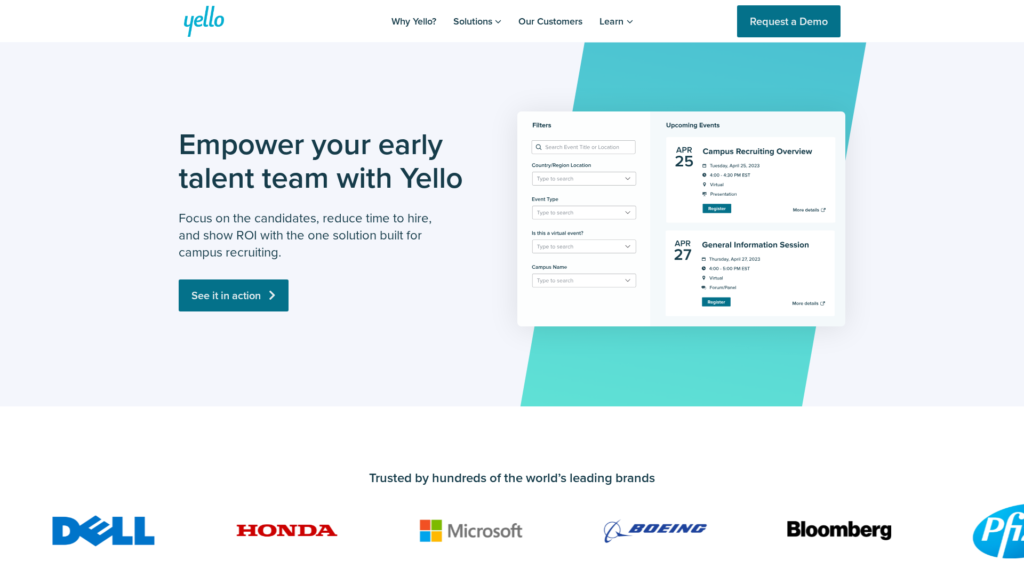
One of Yello’s core strengths is its focus on planning and optimizing campus events, which are often the most expensive part of early talent recruiting. The platform supports creating event calendars, managing registrations, handling check-ins, and centralizing data from both in-person and virtual experiences. Recruiters can quickly see which events generate the most engaged candidates and adjust their strategy accordingly.
Unlike basic event tools or spreadsheet trackers, Yello ties event activity directly to candidate records and downstream outcomes. This makes it possible to report on which campuses, events, and activities actually convert to hires, rather than just tracking attendance. For leaders scrutinizing travel and sponsorship budgets, this level of visibility is critical.
Candidate Relationship Management for Students and Graduates
Yello functions as a recruitment CRM tailored to students and new graduates, enabling teams to nurture relationships long before a formal job application. Recruiters can segment talent pools, send targeted communications, and keep detailed histories of interactions across events, emails, and interviews. This is vital in early-career hiring where timing and relationship-building can matter more than immediate requisitions.
Compared to generic CRM or marketing tools, Yello’s candidate profiles and communication features are tuned to recruiting workflows and compliance needs. It helps ensure that candidate data is used responsibly while still enabling personalized, Gen Z-friendly experiences that stand out from mass, generic outreach.
Integrated Sourcing Through the WayUp Candidate Database
Yello’s integration with the WayUp candidate database adds a powerful sourcing dimension, giving recruiters access to a large pool of early-career candidates. This allows employers to augment their campus footprints with virtual outreach, identify students who match diversity and skills goals, and quickly populate pipelines ahead of key recruiting seasons.
Because the candidate database is woven into Yello’s workflows, sourced profiles can be routed directly into events, campaigns, and interview processes without manual data transfers. For teams that have relied on external job boards or manually importing student lists, this represents a significant efficiency and data quality upgrade.
Security and Compliance for Government Recruiting
For government agencies and contractors, Yello’s FedRAMP authorization is a critical feature that signals strong security and compliance practices. It simplifies security assessments and procurement, enabling these organizations to adopt modern recruiting tools without compromising regulatory requirements.
Yello’s support for government recruiting means that public sector teams can leverage the same early talent workflows and event capabilities as corporate employers, but within an environment that respects stringent privacy and data protection rules. This is relatively rare in campus-focused tools, many of which are aimed primarily at private sector needs.
Analytics and ROI Measurement for Campus Programs
Yello is built to help teams “show ROI” on campus recruiting, which is notoriously hard to quantify. By centralizing event data, candidate journeys, and hiring outcomes, the platform supports analytics that tie activities to hires and offer acceptances. This makes it easier for TA leaders to make data-backed decisions about which schools, events, and initiatives are worth continued investment.
Compared with teams running campus programs out of spreadsheets and disjointed tools, this level of analytics maturity can be transformative. It enables continuous optimization rather than relying on anecdotal feedback, and helps TA secure executive support and budget for early talent initiatives.
Flexible Processes Without Forced Workflows
Yello emphasizes that customers “dictate process,” not the vendor, which is reflected in its flexible workflow design. Teams can configure processes that match their own policies, branding, and candidate communication standards rather than being forced into rigid, one-size-fits-all sequences.
This flexibility is particularly important in global organizations and regulated sectors, where local practices and legal requirements may differ substantially. While any configurable system introduces some complexity, the ability to tailor workflows can help ensure that campus recruiting feels consistent, compliant, and aligned with the broader employer brand.
Yello is built for recruiting teams rather than technical users, so the day-to-day interface is oriented around events, candidates, and simple workflows that most campus recruiters can grasp quickly. Common tasks like setting up an event, importing attendee lists, or sending follow-up campaigns can typically be managed by non-technical coordinators once the system is configured.
The main learning curve comes from the breadth of functionality and the need to align Yello with your existing ATS and processes. Implementation usually involves defining data structures, event workflows, and integration points, which may require collaboration between TA operations, IT, and vendor implementation teams. Once that foundation is in place, however, front-line recruiters generally find the tool significantly easier than juggling multiple spreadsheets and ad hoc tools.
Yello is commonly deployed alongside a core ATS, which means integrations are an important part of any implementation. While specifics vary by customer, Yello typically supports data exchange with major ATS platforms, HR systems, and calendar or communication tools, ensuring that early talent pipelines do not become a data silo. Event and candidate data can be synchronized so that hires flow back into central systems of record.
Because public information on integration coverage is relatively high level, prospective buyers should ask detailed questions during evaluation: which ATS and HRIS integrations are prebuilt versus custom, how candidate and requisition data are mapped, and what APIs or data export options exist. For government and highly regulated organizations, confirming how integrations interact with security authorizations such as FedRAMP is also essential.
Yello Overview
Pros
- Purpose-built for early talent and campus recruiting workflows
- Strong campus event planning, management, and ROI tracking capabilities
- Deep sourcing support through integration with the WayUp candidate database
- FedRAMP authorization makes it suitable for federal and high-security environments
- Recruitment CRM features tailored to student and graduate relationships
- Customer-centric Yello Pledge around renewal pricing and candidate access
- Helps prove the value of campus programs through structured analytics
- Flexible workflows that can be aligned with existing recruiting processes
Cons
- Primarily focused on early talent, not a full ATS replacement
- Best suited to larger enterprises and high-growth organizations with significant campus hiring
- Typically requires integration with an existing ATS, adding implementation complexity
- May feel heavy for small teams running only a few campus events per year
- Limited public detail on integrations and pricing requires deeper sales conversations
Yello: Frequently Asked Questions
What type of companies is Yello best for?
Yello is best suited for large enterprises, high-growth employers, and government organizations that run structured campus or early talent hiring programs at scale.
Does Yello replace an ATS for all hiring?
No, Yello focuses on early talent and campus recruiting and is usually paired with a core ATS that manages requisitions and experienced hires.
Is Yello suitable for government and regulated environments?
Yes, Yello is FedRAMP authorized, making it appropriate for many federal and public sector recruiting use cases where strong security and compliance are mandatory.
How does Yello help with campus event management?
Yello supports planning, promoting, and running campus events, capturing attendee data, and tying event activity to downstream hiring outcomes so you can measure ROI.
Can Yello help us source more diverse early talent?
Yello integrates with the WayUp early-career candidate database and supports targeted outreach, which can help organizations build more diverse pipelines from universities and related channels.
What should we know about implementing Yello?
Implementation typically involves designing workflows, integrating with your ATS or HR systems, and training recruiters; organizations with clear campus strategies and TA operations support tend to see the fastest value.
Is Yello a good fit for small companies with limited campus hiring?
For small teams hiring only a handful of interns or graduates, Yello may be more system than necessary; a lighter-weight tool or ATS module can sometimes be sufficient.
How does Yello support candidate engagement over time?
Yello acts as a recruitment CRM where you can segment student talent pools, run targeted communications, and track engagement across events and interactions until candidates are ready to apply.
