
ZipRecruiter Review: Job Board and Recruiting Platform Explained 2026
 Feb 01,2026

ZipRecruiter is a job board and recruiting platform that connects employers with job seekers through AI-driven matching, distribution to multiple job sites, and candidate management tools.
I have evaluated ZipRecruiter as both a job board for candidates and a recruiting channel for employers, with a focus on how it performs in real-world hiring workflows. This review is my practical assessment of where it fits in the modern recruiting toolkit and how it compares with other sourcing and hiring tools.
If you are still exploring the broader landscape of hiring platforms, it is worth looking at our comparison of leading applicant tracking and recruiting tools in our talent acquisition software guides on CX Everywhere. That context will help you understand whether you need a full ATS, a job board, or a combination of both.
ZipRecruiter is a widely known brand in the U.S. job market, often advertised as a fast way to connect employers and job seekers. Yet popularity does not automatically mean it is the right fit for every hiring strategy, especially if you have niche roles, complex processes, or global hiring needs. Many teams want a clear-eyed view of its strengths and weaknesses before committing budget and time.
In this review, you will learn what ZipRecruiter does well, where it falls short, and what types of companies and roles it serves best. The focus is on practical use cases: small businesses posting their first jobs, growing companies that need predictable applicant flow, and larger organizations that treat ZipRecruiter as one of several sourcing channels.
At its core, ZipRecruiter helps employers get job ads in front of relevant candidates quickly, and helps job seekers find and apply to roles with minimal friction. Hiring managers, small business owners, recruiters, and active job seekers are the primary audiences. If you are looking for a way to boost inbound candidates without the complexity of full enterprise recruiting software, ZipRecruiter is a serious contender worth understanding in detail.
ZipRecruiter Review Summary
Overall, ZipRecruiter is a strong option for organizations that prioritize speed and reach in their hiring efforts, especially for common or high-volume roles in the United States. It simplifies job posting, leverages a large network and matching engine to surface candidates quickly, and offers a low-friction experience for both employers and job seekers.
Its main limitations stem from what it is not trying to be: it is not a full-featured applicant tracking system, and it is not a specialized sourcing tool for very niche positions. Companies that succeed with ZipRecruiter typically integrate it into a broader recruiting stack, using it as an efficient candidate source rather than as their single system of record for hiring.
How We Review Tools and Assign the CX Score
We've developed a comprehensive scoring system to evaluate software tools objectively. Our CX Score (1.0–5.0) reflects how strong a product is within its category, based on hands-on testing and analysis across multiple criteria.
Core Functionality
Does the tool deliver the essential features users expect? We assess whether core capabilities meet category standards and if key features are accessible across pricing tiers.
Standout Features
We evaluate unique capabilities that go beyond the basics—features that make the product faster, more efficient, or offer additional value compared to competitors.
Ease of Use
How intuitive is the interface? We consider design quality, mobile apps, templates, and whether complex tasks feel simple to execute.
Onboarding
We measure how quickly new users can get productive with minimal training. High-scoring tools require little to no external support to get started.
Integrations
We assess native integrations, third-party connections, and API access. Tools that connect easily with common tech stacks score higher.
Customer Support
How easy is it to get help? We evaluate support channels, response times, and quality of documentation. Real-time human support scores best.
Value for Money
We compare pricing against features delivered. Software that offers more functionality at competitive prices receives higher marks.
Features of ZipRecruiter
- Job posting and distribution
- AI-driven candidate matching
- Candidate inbox and messaging
- 1-click apply for candidates
- Employer dashboard and basic analytics
- Resume upload and candidate profiles
- Automated job alerts to candidates
- Multi-board job distribution network
- Full applicant tracking workflows
- Advanced interview scheduling
- Custom hiring pipelines
- Open API for custom integrations
- Native integrations with major ATS
- Mobile-friendly candidate experience
- Support for complex enterprise permissioning
Broad Job Distribution to a Large Candidate Network
ZipRecruiter allows employers to publish a job once and have it distributed across its own marketplace and a network of partner job sites. This significantly reduces the administrative work of posting to multiple boards individually and helps smaller companies tap into audience scale that would otherwise be out of reach. In practice, this translates into faster visibility and a higher likelihood of receiving applicants quickly after a posting goes live.
Compared with single-site job boards, this hub-and-spoke approach delivers better coverage and more consistent applicant flow, especially for roles that are in high demand. It is particularly valuable for employers who do not have dedicated recruitment marketing resources but still need exposure across multiple channels.
AI-Driven Job Matching and Candidate Recommendations
ZipRecruiter leans heavily on AI-style matching to connect job seekers with relevant roles. As candidates build their profiles and upload resumes, the system learns their skills, experience, and preferences. Phil, the career advisor persona, embodies this matching capability by guiding users to openings that align with their background and interests, and by nudging them with alerts when new roles appear.
For employers, this means that their postings are proactively surfaced to job seekers who are algorithmically judged to be a good fit. This reduces the reliance on manual searching by candidates and can improve the proportion of relevant applications compared with a purely search-based job board experience.
Streamlined Job Posting and Management for Employers
Posting a job on ZipRecruiter is designed to be straightforward for non-technical users. Guided forms prompt you for essential details such as job title, location, pay information, and description, and help you create a clear, structured posting. Once live, employers can manage postings from a central dashboard, pause or close jobs as needed, and track how many views and applications each listing attracts.
While the management features do not match the depth of a full ATS, they are more than adequate for many small and midsize employers who need a simple way to post, monitor performance, and make quick adjustments. This simplicity is one of the reasons ZipRecruiter is often adopted by line managers and owners, not just HR professionals.
Candidate Inbox, Screening, and Communication Tools
ZipRecruiter provides a consolidated candidate inbox where employers can review applications, filter by basic criteria, and communicate with candidates. Employers can view resumes, send messages, and take simple actions like bookmarking or rejecting applicants from within the platform. This centralization is a clear upgrade over managing responses through email, and it helps teams stay organized during active hiring periods.
However, these tools are intentionally lightweight. There are no deeply customizable pipelines or structured evaluation workflows, so more complex organizations will typically export candidates or sync them into a dedicated ATS. For many small businesses, though, the built-in flow is sufficient to move a candidate from application to interview scheduling.
1-Click Apply and Frictionless Candidate Experience
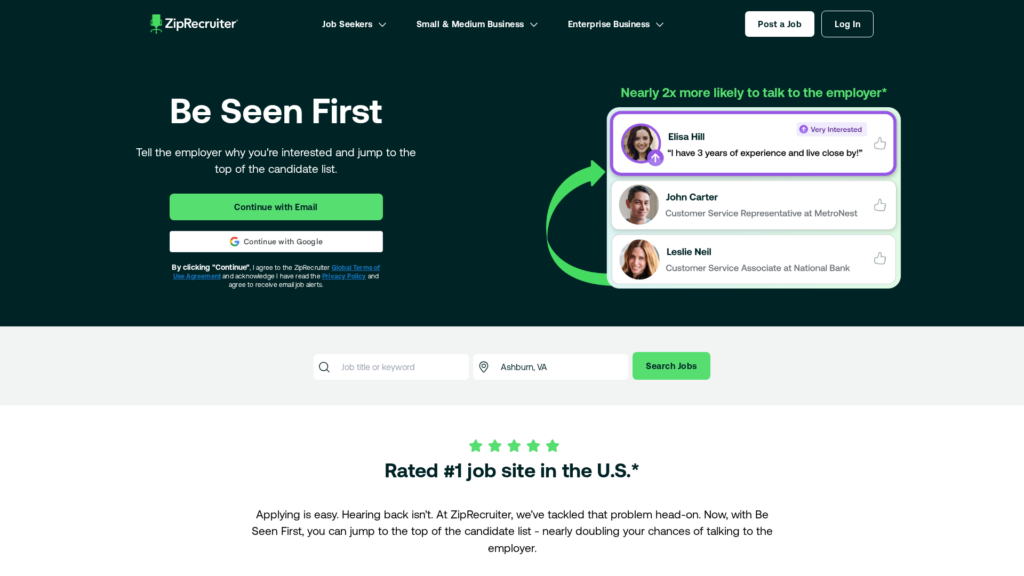
For job seekers, ZipRecruiter emphasizes speed and convenience. After an initial profile setup, many roles support 1-click apply, allowing candidates to submit applications without repeatedly filling out the same information. Phil and the surrounding interface highlight jobs that match the candidate’s skills and preferences, encouraging them to apply quickly and often.
This frictionless experience boosts apply rates and helps employers generate applicant volume, especially for roles that do not require long, complex applications. It also makes ZipRecruiter an attractive starting point for active job seekers who want to cast a wide net without investing time in each individual application.
Analytics and Insights on Job Performance
ZipRecruiter provides basic but useful analytics on job performance, including views, applications, and timing trends. These metrics enable employers to see which postings are resonating, when applicant flow slows down, and whether changes to job titles or descriptions have an impact. For organizations new to structured hiring metrics, this visibility alone can be a step forward.
Compared with analytics capabilities in advanced ATS or recruitment marketing platforms, the reporting is limited and not designed for deep optimization across many channels. Still, for most small to midsize employers, the built-in insights are enough to make informed decisions about reposting, adjusting requirements, or improving job descriptions.
ZipRecruiter is intentionally designed for quick adoption, with minimal setup required for both employers and job seekers. Employers can create an account, draft a job posting using guided forms, and publish it within a short time, all without needing IT involvement or extensive training. The interface focuses on clear calls to action, such as creating a new job, reviewing candidates, or adjusting an existing posting.
The learning curve is therefore shallow for typical users like hiring managers, small business owners, or HR generalists. Daily use largely revolves around logging in, scanning the candidate inbox, and sending messages or invitations to interview. More advanced recruitment operations may find the system lacks the depth and configurability they are used to, but that is a tradeoff in favor of simplicity. For job seekers, the experience is equally straightforward: sign up or log in, let Phil guide them to relevant roles, and then apply, often with a single click after initial profile setup.
ZipRecruiter primarily operates as a standalone job distribution and candidate sourcing platform, but it can also fit into a broader recruiting ecosystem. Many modern applicant tracking systems and HR suites offer some level of integration with major job boards, ZipRecruiter included, enabling automatic posting from the ATS and candidate data flowing back into the system of record. The details of which ATS and HRIS platforms are supported, and to what depth, will vary by vendor and region.
Because public documentation around integrations is not prominently shown in the content available here, potential buyers should confirm the current list of native integrations directly with ZipRecruiter or their ATS provider. It is also prudent to ask whether there are APIs or standardized export options if you plan to move applicant data into internal systems. For small employers that do not yet have an ATS, operating ZipRecruiter on its own is common, but larger organizations typically integrate it to avoid duplicate data entry and manual tracking.
ZipRecruiter Overview
Pros
- Extremely easy for small businesses to post jobs and start receiving applicants quickly
- Broad reach through distribution across ZipRecruiter’s own marketplace and partner job sites
- AI-driven matching via Phil helps surface relevant jobs to candidates automatically
- Streamlined candidate inbox and messaging reduce reliance on unstructured email
- 1-click apply and guided flows improve application rates for many roles
- Strong brand recognition and candidate awareness in the U.S. market
- Simple interface and low learning curve for non-technical hiring managers
- Basic analytics give employers visibility into job performance without complexity
Cons
- Not a full applicant tracking system, with limited pipeline and workflow features
- Candidate quality can be mixed for highly specialized or senior roles
- Reporting and analytics are lighter than dedicated recruiting analytics tools
- Works best as a sourcing channel, requiring other systems for structured hiring
- Integration details and compatibility with specific ATS platforms may require extra verification
ZipRecruiter: Frequently Asked Questions
Is ZipRecruiter a full applicant tracking system?
No, ZipRecruiter is primarily a job board and sourcing platform with basic candidate management, not a full ATS with deep workflows and approvals.
What types of roles does ZipRecruiter work best for?
It performs best for common or high-volume roles such as hourly, entry-level, and many mid-level professional jobs, especially in the U.S.
Can larger companies use ZipRecruiter effectively?
Yes, larger organizations often use ZipRecruiter as a top-of-funnel sourcing channel and integrate it with an ATS for full hiring workflows.
How easy is it for small businesses to start using ZipRecruiter?
Very easy; small businesses can sign up, create a job posting using guided forms, and start receiving applicants with minimal setup or training.
Does ZipRecruiter support rapid applications for candidates?
Yes, many jobs support 1-click apply, allowing candidates to submit quickly after an initial profile is created.
Can ZipRecruiter integrate with my existing ATS?
Many ATS platforms offer job board integrations, but you should confirm current ZipRecruiter integration support with your specific ATS vendor or ZipRecruiter sales.
Is ZipRecruiter suitable for hiring very niche or senior roles?
It can be used, but for highly specialized or senior positions, it is often supplemented with targeted sourcing tools or niche job boards.
What data can employers see about job performance?
Employers can view metrics like job views and application counts, helping them assess how postings are performing over time.
