
Mooncamp Review: Strategy Execution & OKR Software Explained 2026
 Mar 01,2026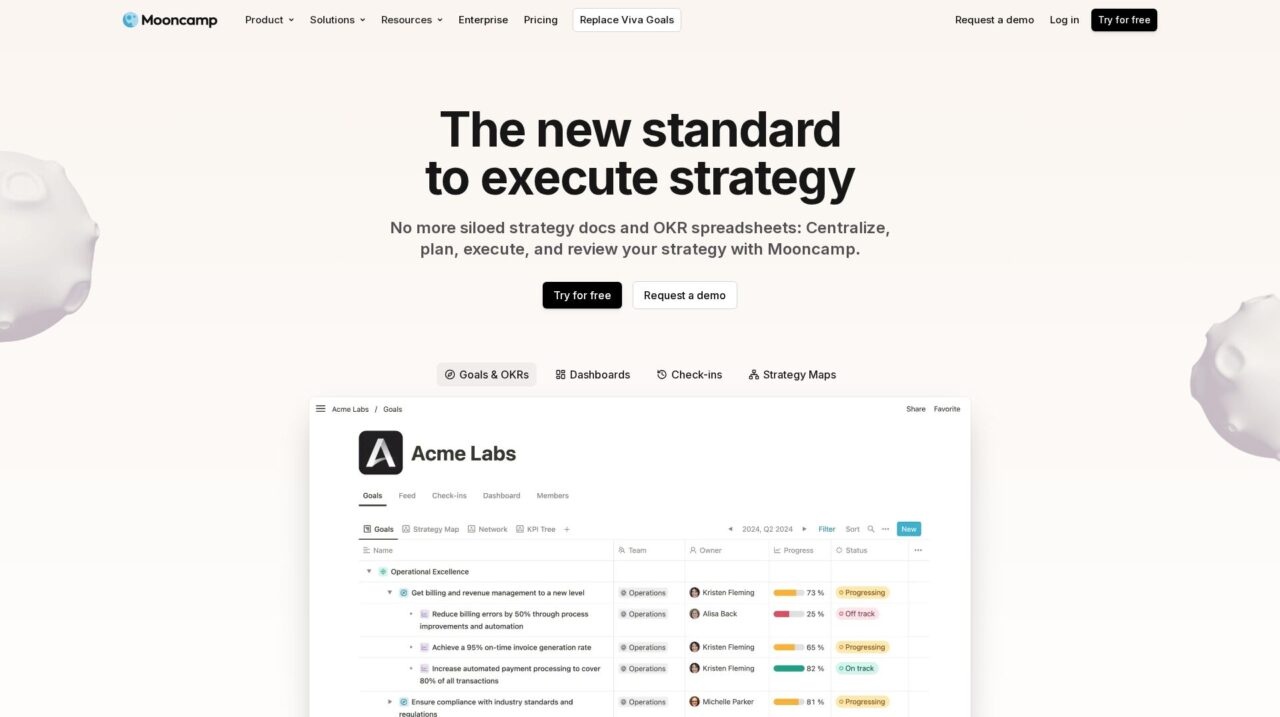

Mooncamp is an OKR and strategy execution platform that helps companies plan, execute, and review strategy in a single, closed-loop system.
We have taken a close look at Mooncamp to understand how it performs as a modern OKR and strategy execution platform. This review distills that analysis into a practical guide for buyers who need more than marketing claims.
If you are still exploring the broader landscape, you may also want to compare it with other options in our coverage of OKR and strategy execution tools within our wider catalog of project and work management platforms. That will help you see where Mooncamp sits in the ecosystem before committing.
Mooncamp has become a recognizable name among companies that take OKRs seriously and want a structured way to execute strategy. Many teams adopt it after outgrowing spreadsheets or generic project management apps, but it is not obvious from a distance whether it is the right fit for every organization.
In this review, you will learn how Mooncamp approaches strategy planning, execution, and review, where it excels, where its limitations show up, and what kinds of companies get the most value from it. The analysis is geared toward executives, chiefs of staff, PMOs, and strategy or operations leaders at mid-sized and larger organizations who are considering a dedicated system for OKRs and strategic alignment.
At its core, Mooncamp is designed to solve the problem of scattered, static strategy. It brings objectives, key results, and strategic initiatives into a single closed-loop system so leadership teams can plan, monitor, and iterate on strategy in a consistent way across departments.
Mooncamp Review Summary
Overall, Mooncamp is a mature, strategically focused OKR and execution platform that goes well beyond simple goal tracking. Its closed-loop design, spanning strategic planning, execution, and review, provides a solid backbone for organizations that want strategy to be a continuous operating rhythm rather than an annual exercise.
It is especially compelling for mid-market and enterprise customers that need alignment across multiple units and value a partner to help with rollout. The main caveats are that it is not a task-level project management tool and may feel heavier than lean startups or early-stage teams require. If your primary pain point is inconsistent strategy execution rather than basic collaboration, Mooncamp is a strong contender.
How We Review Tools and Assign the CX Score
We've developed a comprehensive scoring system to evaluate software tools objectively. Our CX Score (1.0–5.0) reflects how strong a product is within its category, based on hands-on testing and analysis across multiple criteria.
Core Functionality
Does the tool deliver the essential features users expect? We assess whether core capabilities meet category standards and if key features are accessible across pricing tiers.
Standout Features
We evaluate unique capabilities that go beyond the basics—features that make the product faster, more efficient, or offer additional value compared to competitors.
Ease of Use
How intuitive is the interface? We consider design quality, mobile apps, templates, and whether complex tasks feel simple to execute.
Onboarding
We measure how quickly new users can get productive with minimal training. High-scoring tools require little to no external support to get started.
Integrations
We assess native integrations, third-party connections, and API access. Tools that connect easily with common tech stacks score higher.
Customer Support
How easy is it to get help? We evaluate support channels, response times, and quality of documentation. Real-time human support scores best.
Value for Money
We compare pricing against features delivered. Software that offers more functionality at competitive prices receives higher marks.
Features of Mooncamp
- OKR Management
- Strategic Planning Frameworks
- Goal Cascading and Alignment
- Progress Tracking and Check-ins
- Executive Dashboards
- Quarterly Review Workflows
- Multi-level Organization Structure
- Enterprise User Management
- Single Sign-On (SSO)
- Public API
- Project Management Integrations
- Slack or Chat Integrations
- Role-based Permissions
- Custom Fields and Structures
- Reporting and Analytics
- Email Notifications
- Mobile Access via Browser
- On-premise Deployment
- Built-in Task Management
Centralized Strategic Planning for the Entire Organization
Mooncamp lets leadership teams capture vision, strategic themes, and top-level objectives in one structured environment. Company-wide OKRs can then be defined against that strategy, creating a single source of truth for what the business is trying to achieve and why. Compared to ad hoc documents and slide decks, this structure makes it easier to maintain continuity across planning cycles.
Because strategy, not tasks, is the primary object, Mooncamp is particularly effective in organizations where multiple units must align on a few critical priorities. It helps avoid the fragmentation that occurs when each department manages its own goals in isolation.
Cascading OKRs for Alignment Across Teams
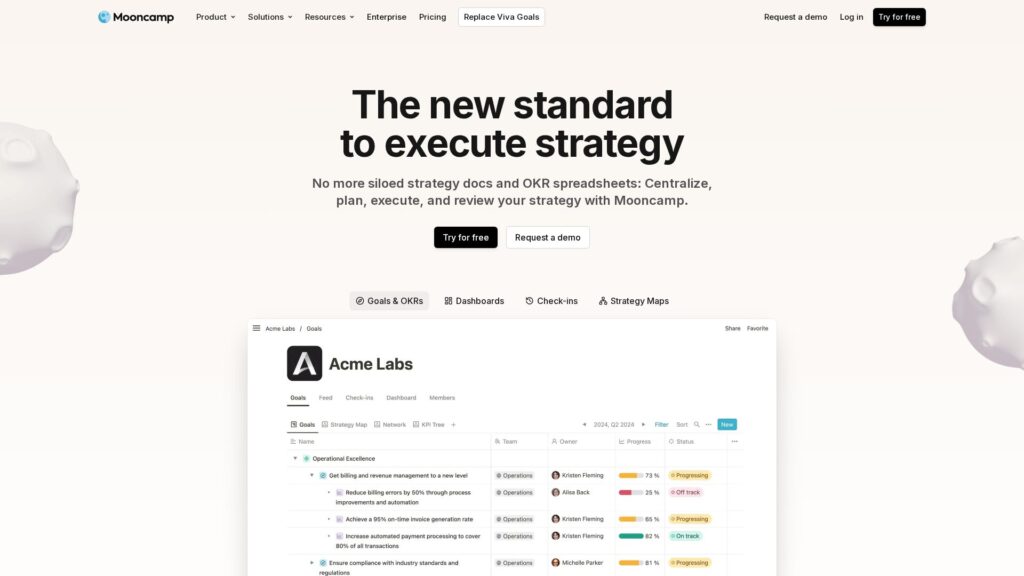
Objectives and key results in Mooncamp can be cascaded from the top level down to business units, departments, and teams. This enables a clear line of sight between strategic objectives and the measurable outcomes owned by specific groups. Teams can see how their OKRs contribute to company-level goals, which improves focus and buy-in.
Compared with more basic OKR tools that simply list goals at a single level, Mooncamp’s cascading model supports more complex organizational structures and reduces ambiguity about ownership and alignment.
Execution Tracking to Keep Objectives on Course
During the execution phase, Mooncamp allows owners to update progress on key results, track initiatives linked to those results, and flag risks or blockers. Leadership can quickly see which objectives are on track, at risk, or off track, without stitching together multiple reports. This helps shift conversations from status collection to problem solving.
While it does not aim to replace detailed issue tracking or task management tools, Mooncamp’s execution tracking provides enough structure to run focused check-ins and OKR reviews, which many teams struggle to do consistently with generic project software.
Review Workflows and Strategic Insight at a Glance
Mooncamp includes views and workflows designed for regular strategy and OKR review, such as quarterly or monthly business reviews. Progress can be summarized across objectives and time periods, giving leaders a high-level understanding of where the strategy is succeeding and where it needs adjustment. This makes it easier to run data-informed retrospectives instead of relying purely on anecdotes.
In contrast to tools that simply store OKRs, Mooncamp’s review capabilities reinforce a healthy cadence of reflection and learning, which is critical for making strategy execution a continuous loop.
Support for Enterprise Governance and Scale
For larger organizations, Mooncamp supports the governance needed to run strategy and OKRs at scale. Administrators can define structures, permissions, and standards for how objectives are set and maintained, which reduces chaos as adoption grows. This enterprise-ready posture is a step beyond lightweight tools that work for a single team but struggle with hundreds or thousands of users.
Because the platform is built with enterprise in mind, it fits better into formal planning and review rhythms, including executive steering committees and PMO-led processes, than tools designed solely for small startups.
Partner-Like Onboarding and Strategy Support
Mooncamp positions its team not just as software vendors but as partners that help customers design and run their OKR and strategy execution programs. This often includes guidance on configuring the framework, setting realistic objectives, and establishing review cadences that fit the organization’s culture.
For companies that have tried and failed to implement OKRs in the past, this kind of support can be the difference between another abandoned initiative and a sustainable operating system.
Mooncamp is designed with a modern, web-based interface that most business users can adapt to quickly, especially if they have prior exposure to goal or project tools. The core concepts of objectives, key results, and initiatives are presented in a structured but not overly technical way, which helps reduce the learning curve for non-technical stakeholders.
Implementation effort will vary by company size and process maturity. For small teams, configuration can be relatively quick, but the product shows its full value when paired with a deliberate rollout: defining your OKR framework, training managers, and setting a regular cadence for updates and reviews. In larger organizations, expect to allocate time for change management and governance, though Mooncamp’s partner-like approach can ease that load. Day-to-day usability is straightforward once the program is established, with most users interacting through periodic updates, check-ins, and review meetings.
Mooncamp sits in the strategy and OKR layer of a company’s tooling stack, which typically means it needs to coexist with project management, communication, and analytics platforms. While details on specific native integrations are not fully visible here, buyers should expect at least basic connectivity options such as user provisioning via identity providers and potential data exchange with work tools for progress updates.
Before committing, it is important to verify how Mooncamp will integrate with your existing systems: for example, whether it offers a public API, SSO support, and direct integrations with tools like Jira, Asana, or Slack, as well as your HRIS. For enterprise buyers, understanding how it fits into existing authentication, data governance, and reporting infrastructure is key to ensuring that strategy data can flow where it needs to without excessive manual work.
Mooncamp Overview
Pros
- Closed-loop approach covering planning, execution, and strategic review
- Strong fit for mid-market and enterprise OKR programs
- Cascading OKRs create clear alignment across teams and units
- Designed around strategy, not just tasks or projects
- Partner-like onboarding and support for implementation
- Good structure for recurring OKR and business reviews
- Helps move strategy from static documents into a live system
Cons
- Less suitable for very small teams or casual OKR use
- Does not replace detailed project or task management tools
- Implementation requires deliberate rollout and change management
- Buyers must validate integrations and API capabilities for their stack
Mooncamp: Frequently Asked Questions
What type of companies is Mooncamp best suited for?
Mooncamp is best for mid-sized and enterprise organizations that want a dedicated system for OKRs and strategy execution across multiple teams or business units.
Is Mooncamp a full project management or task tracking tool?
No, Mooncamp focuses on strategy and OKRs; you will typically pair it with project or issue tracking tools for day-to-day task management.
Can small startups use Mooncamp effectively?
Smaller teams can use it, but the platform and rollout effort are better justified when you have multiple teams or departments to align.
How difficult is it to implement Mooncamp?
The interface is straightforward, but a successful implementation requires upfront work to define your OKR framework, train managers, and establish review cadences, especially in larger organizations.
Does Mooncamp integrate with existing tools like Jira or Slack?
Mooncamp is designed to sit alongside existing work tools, but buyers should confirm specific native integrations and API options with the vendor before purchase.
Is there on-premise deployment available for Mooncamp?
Mooncamp is offered as a cloud-based platform and does not provide on-premise deployment, so organizations with strict on-premise requirements should verify fit with their security policies.
