
Oyster Review: Global Payroll and Employer of Record Platform
 Apr 13,2026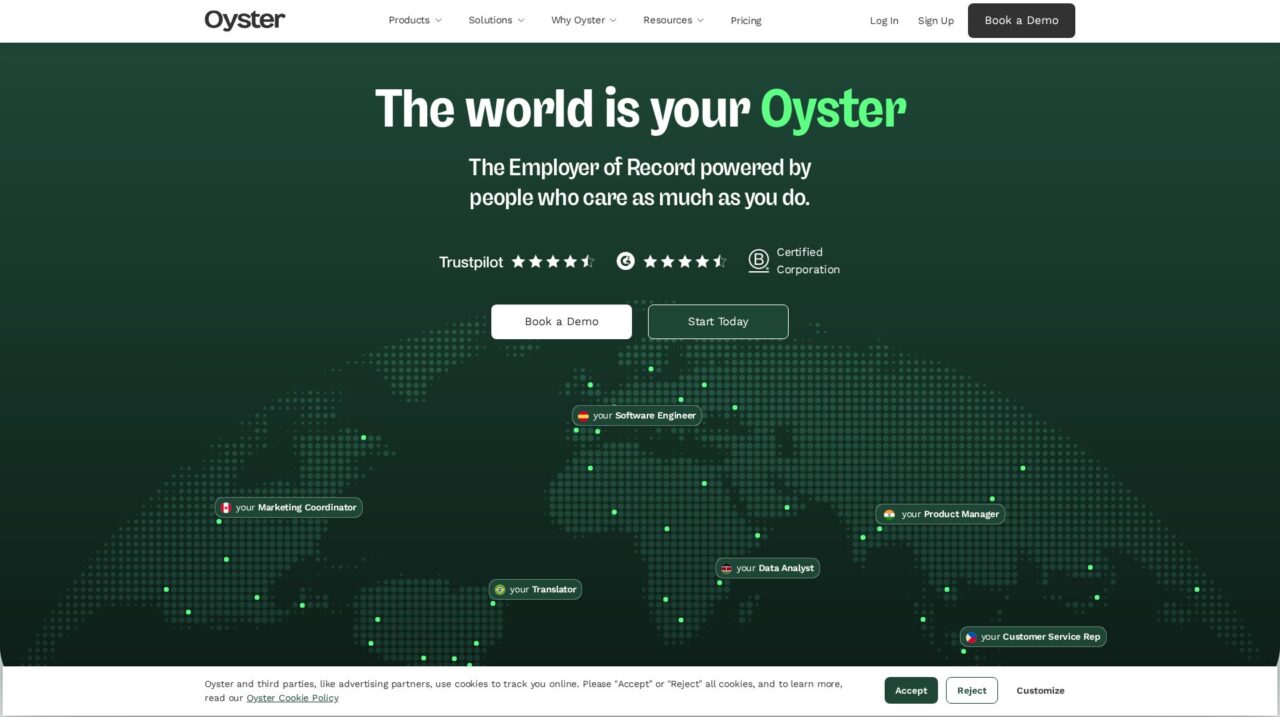

Oyster is a global payroll and employer of record platform that helps companies hire, pay, and manage employees and contractors compliantly in 180+ countries. It is built for distributed and scaling teams that want to expand globally without setting up local entities.
After evaluating Oyster across real-world global hiring and payroll scenarios, this review breaks down how the platform actually performs for modern distributed teams. If you are still exploring the landscape generally, start with broader guides to global payroll and employer of record tools in our global HR and payroll software comparisons, then come back here for a closer look at Oyster.
Oyster has become a well-known name among remote-first and international companies that want to hire in many countries without setting up local entities. Despite that visibility, many buyers still struggle to understand where it fits alongside their existing HR systems, how it compares to other EORs, and what tradeoffs come with the model.
In this review, you will get a clear picture of Oyster’s pros and cons, its core features, the quality of its support, and which types of organizations are likely to see the most value. The goal is to give founders, people leaders, and finance teams enough context to decide whether Oyster is the right backbone for their global employment strategy.
Oyster is most relevant for startups and mid-market companies hiring full-time employees and contractors in multiple countries, especially those that do not have in-house legal and payroll teams in every market. It focuses on solving the complex problems of compliant hiring, localized contracts and benefits, and ongoing international payroll rather than trying to be an all-in-one HR suite.
Oyster Review Summary
Overall, Oyster delivers a strong balance of software and service for companies that want to hire, pay, and support people in many countries without building heavy in-house infrastructure. Its EOR and contractor capabilities are competitive on coverage and ease of use, and the emphasis on a human, guided experience differentiates it from some more transactional alternatives.
The main limitations are structural to the category: EOR can become costly at high headcounts in specific countries, and Oyster is not a full replacement for a robust HRIS or talent suite. For most growing, globally distributed teams, however, those tradeoffs are acceptable, and Oyster stands out as a reliable, user-friendly choice for global employment.
How We Review Tools and Assign the CX Score
We've developed a comprehensive scoring system to evaluate software tools objectively. Our CX Score (1.0–5.0) reflects how strong a product is within its category, based on hands-on testing and analysis across multiple criteria.
Core Functionality
Does the tool deliver the essential features users expect? We assess whether core capabilities meet category standards and if key features are accessible across pricing tiers.
Standout Features
We evaluate unique capabilities that go beyond the basics—features that make the product faster, more efficient, or offer additional value compared to competitors.
Ease of Use
How intuitive is the interface? We consider design quality, mobile apps, templates, and whether complex tasks feel simple to execute.
Onboarding
We measure how quickly new users can get productive with minimal training. High-scoring tools require little to no external support to get started.
Integrations
We assess native integrations, third-party connections, and API access. Tools that connect easily with common tech stacks score higher.
Customer Support
How easy is it to get help? We evaluate support channels, response times, and quality of documentation. Real-time human support scores best.
Value for Money
We compare pricing against features delivered. Software that offers more functionality at competitive prices receives higher marks.
Features of Oyster
- Employer of Record (EOR)
- Global Payroll
- Contractor Management
- Multi-country Coverage (100+ countries)
- Local Entity Infrastructure
- Automated Compliance Updates
- Localized Employment Contracts
- Localized Benefits Administration
- Employee Self-service Portal
- Contractor Self-service Portal
- HRIS Integrations
- ATS Integrations
- Accounting/ERP Integrations
- Open API
- Time and Attendance Tracking
- Performance Management
- Learning Management
- Expense Management
- Equity Management Tools
- Custom Reporting and Analytics
- Role-based Access Controls
- Single Sign-On (SSO)
- GDPR Compliance
- Data Encryption in Transit and At Rest
- Dedicated Customer Success Manager
- Phone and Email Support
- In-app Support and Knowledge Base
- On-premise Deployment
- Mobile App
Hire Full-time Employees Globally Without Local Entities
Oyster’s core offering is employer of record support, which lets you hire full-time employees in 180+ countries using Oyster’s local entities instead of forming your own. The platform generates country-specific, compliant employment contracts, manages onboarding workflows, and configures salaries, taxes, and statutory benefits according to local law. Compared to typical payroll providers that expect you to already have local entities, this dramatically shortens the time from identifying talent to making a compliant offer.
Because Oyster assumes the role of legal employer, it also helps you manage risk in areas where local labor laws are complex or unfamiliar. HR teams can rely on embedded guardrails and expert guidance for topics like probation periods, termination notice, and mandatory leave, reducing the chances of costly mistakes that are common with more generic tools.
Engage and Pay International Contractors in One Place
In addition to employees, Oyster supports global contractor engagements at a per-contractor monthly fee. You can onboard contractors through standardized agreements, collect payment and tax information, and schedule payments across currencies from a single dashboard. This consolidates what many companies currently do through a patchwork of local vendors, bank transfers, and manual spreadsheets.
While contractor management is a common feature in global payroll tools, Oyster integrates it tightly with its EOR workflows. That means you can maintain a consistent view of your global talent, whether they are engaged as employees or contractors, and transition people between models as business and compliance needs evolve.
Automated Multi-country Payroll and Disbursements
Once hires are in place, Oyster calculates payroll across countries, handling gross-to-net, statutory deductions, employer contributions, and local reporting. Payroll runs are centralized so finance and HR teams can review totals, approve payouts, and reconcile spending across the entire distributed workforce without logging into multiple local systems. This is more advanced than standard single-country payroll software, which typically does not attempt to unify operations across borders.
Oyster also takes care of the payment execution layer, ensuring employees and contractors are paid accurately and on time in their local currencies. This eliminates the need for your finance team to manage international payment rails or juggle multiple banking relationships, an area that often creates hidden friction in global employment.
Compliance, Contracts, and Localized Benefits
Compliance is a central pillar of Oyster. The platform provides pre-vetted, localized employment contracts that reflect current legal requirements, recommended notice periods, working time rules, and other protections. Oyster’s team monitors regulatory changes and adapts templates accordingly, so you are not relying on static documentation or ad hoc legal advice every time you make a hire in a new country.
Beyond contracts, Oyster structures benefits packages that meet or exceed statutory minimums, from health coverage to leave entitlements, depending on the market. Compared to traditional payroll providers that leave benefit design up to you, this approach offers a more opinionated, safer baseline for companies without deep local expertise.
Employee and Contractor Self-service Experience
Oyster includes a self-service portal where employees and contractors can access their employment or contractor agreements, complete onboarding, and retrieve payslips and basic employment information. This reduces inbound questions to HR and gives international hires a clear, modern experience that matches how they use other workplace tools. Many legacy payroll systems offer only limited or clunky self-service, particularly in cross-border contexts.
The portal also plays a role in reinforcing trust around the EOR model. By giving people a transparent view of their pay, benefits, and employment status and backing it with responsive support, Oyster helps ensure that being employed through an EOR does not feel second-class compared to being hired directly by the client company.
Integrations With HRIS, ATS, and Accounting Systems
To avoid becoming an isolated data silo, Oyster integrates with popular HRIS, applicant tracking, and accounting tools. This allows new hires created in your ATS to flow into Oyster for onboarding, and finalized payroll data to sync back into your finance systems for reporting and reconciliation. For distributed teams that already rely on platforms like Workday, BambooHR, Greenhouse, or Xero, this integration-first approach is critical to keeping processes streamlined.
While the exact depth of each integration varies, the intent is that Oyster becomes the global employment execution layer while your HRIS remains the primary system of record. Compared to standalone EORs that operate in isolation, this makes it easier to maintain accurate headcount and cost data across your stack.
Guided Support and Local HR Expertise
Oyster’s support model is designed around a dedicated point of contact plus a network of local HR and legal specialists. You can lean on them for high-stakes situations such as terminations, restructuring, complex leave scenarios, or compensation changes in countries you do not fully understand. This is more comprehensive than many tools that limit support to ticket-based technical questions.
For HR teams that are new to global employment, this guidance can be the difference between confidently expanding into new regions and avoiding them altogether. It also means you are not continuously sourcing and managing separate external counsel or consultants in every country where you employ people.
Oyster is built to be approachable for HR and finance teams that may be running global employment for the first time. Onboarding tends to follow structured workflows: you select a country, input role and compensation details, and the system presents localized contract and benefits options with clear explanations. This guided pattern minimizes free-form configuration and the likelihood of inadvertently setting up a non-compliant arrangement.
Implementation is comparatively light for a payroll product, because you are not configuring country-specific tax rules yourself. Instead, you connect your existing HRIS or ATS if desired, set company-level preferences, and work with Oyster’s team to validate your first few hires and payroll runs. From there, ongoing administration is largely routine: approve offers, review payroll drafts, and handle occasional exceptions with support. For end users, the employee and contractor portal is straightforward, focusing on essential tasks without clutter.
Oyster integrates with common HR and finance systems so it can slot into an existing stack rather than standing alone. Out-of-the-box connectors are available for selected HRIS platforms, applicant tracking systems, and accounting tools, enabling data to move between recruiting, core HR, and payroll with minimal manual effort. For example, new hires created in your ATS can be pushed into Oyster for contract generation and onboarding, and finalized payroll figures can be shared with your accounting software for journal entries and reporting.
There is also an API layer that allows more advanced teams to build custom workflows or connect Oyster to less common systems. However, prospective customers should verify specific integrations and capabilities during evaluation, especially if they rely on niche HRIS or have complex finance processes. As with most tools in this category, successful integration depends as much on process design as on technical connectors, so it is worth investing time up front to design how data should flow between Oyster and your core systems.
Oyster Overview
Pros
- Broad country coverage supporting hires in 180+ countries
- Strong compliance posture with localized contracts and benefits guidance
- Human-centric support model with dedicated point of contact and local experts
- Competitive, transparent pricing structure for employees and contractors
- Fast implementation and quick time to first hire in new countries
- Intuitive interface that non-specialist HR and finance users can navigate easily
- Integrated EOR and contractor management in a single platform
- Integrations with HRIS, ATS, and accounting systems to reduce manual work
- Employee self-service portal improves experience for international hires
- Certified B Corp positioning appeals to companies focused on responsible growth
Cons
- Not a full HRIS, so you still need separate systems for core HR functions
- EOR model can become costly in specific countries at higher headcounts
- Depth and availability of integrations vary and may require validation
- Less suitable for enterprises with mature in-house global payroll operations
- Limited native capabilities around advanced HR modules like performance or learning
Oyster: Frequently Asked Questions
What type of companies is Oyster best suited for?
Oyster is best for startups and mid-market companies hiring employees and contractors in multiple countries without local entities, especially remote-first or distributed teams.
Does Oyster replace my existing HRIS?
No, Oyster focuses on global employment, payroll, and compliance and usually sits alongside a core HRIS, which remains your primary system of record for HR data.
Can Oyster help us hire in countries where we do not have a legal entity?
Yes, that is the core value of Oyster’s employer of record model; you can employ people compliantly through Oyster’s local entities in 180+ countries.
How does Oyster handle payroll compliance across different countries?
Oyster maintains localized tax, labor, and benefits rules for each supported country, applies them automatically in payroll calculations, and updates them as regulations change, with oversight from local experts.
Is Oyster suitable for large enterprises with existing global entities?
Enterprises can use Oyster tactically for specific regions or for contractor management, but those with mature in-house global payroll may find it more complementary than foundational.
What integrations does Oyster offer?
Oyster connects with selected HRIS, ATS, and accounting platforms and provides APIs for custom connections, but buyers should verify specific systems and use cases during evaluation.
How quickly can we start hiring through Oyster in a new country?
In many cases, companies can make their first hire in a new country within days, since Oyster’s local entities and standardized workflows remove the need to set up local infrastructure.
Does Oyster support contractor payments as well as employees?
Yes, Oyster manages both full-time employees via EOR and international contractors, allowing you to consolidate engagement and payment workflows for global talent.
How does the EOR relationship work with our employees?
Legally, Oyster is the employer of record responsible for payroll and compliance, while you manage day-to-day work, culture, and performance, giving you control without the local administrative burden.
