
Radancy Review: AI Talent Acquisition Cloud Platform for 2026
 Feb 09,2026

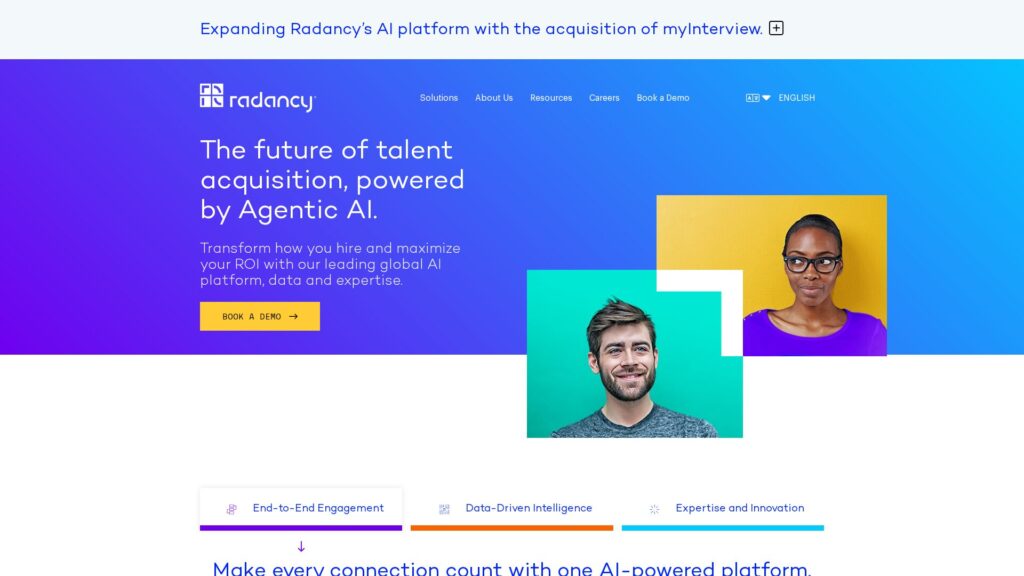
Radancy is an enterprise talent acquisition cloud platform that uses AI to help large organizations attract, engage, and hire candidates more efficiently across the full funnel.
After analyzing Radancy in depth, this review focuses on how well it actually serves modern talent acquisition teams, beyond the marketing claims. If you are comparing options in the broader talent acquisition platform space, you may also want to review our category guides on CX Everywhere, such as our coverage of leading ATS and recruitment marketing tools, to see where Radancy fits in the ecosystem.
Radancy is widely known among large employers as a recruitment marketing and talent acquisition cloud, especially for organizations that need to hire at scale and protect a strong employer brand. Yet for many buyers, it is not immediately obvious how it differs from an ATS, or from lighter-weight tools aimed at SMBs. That ambiguity is exactly why a deeper evaluation is useful.
In this review, you will learn Radancy’s main strengths and weaknesses, which features matter most in real-world use, and what types of organizations are most likely to see a strong return on investment. The goal is to help you decide whether Radancy is a strategic fit for your talent acquisition roadmap or whether a different class of tool might be more appropriate.
This review is written for talent acquisition leaders, HR executives, and recruiting operations teams at mid-sized to large organizations. If you are responsible for employer branding, high-volume hiring, or optimizing the overall candidate journey, understanding what Radancy does and where it excels will help you make a more confident technology decision.
Radancy Review Summary
Radancy delivers a robust, AI-enabled talent acquisition cloud that is particularly compelling for enterprise organizations with complex hiring needs and strong employer brand ambitions. Its biggest advantage is unifying media, content, candidate engagement, and analytics so TA teams can manage the entire funnel from a single platform layered on top of their ATS.
That depth comes with enterprise-style tradeoffs: a more involved implementation, sales-led pricing, and a steeper learning curve than simpler tools. If your organization has the scale, resources, and maturity to invest in a strategic TA platform, Radancy is well worth a close look. If your needs are basic or your volume is low, it will likely be overkill compared to more lightweight solutions.
How We Review Tools and Assign the CX Score
We've developed a comprehensive scoring system to evaluate software tools objectively. Our CX Score (1.0–5.0) reflects how strong a product is within its category, based on hands-on testing and analysis across multiple criteria.
Core Functionality
Does the tool deliver the essential features users expect? We assess whether core capabilities meet category standards and if key features are accessible across pricing tiers.
Standout Features
We evaluate unique capabilities that go beyond the basics—features that make the product faster, more efficient, or offer additional value compared to competitors.
Ease of Use
How intuitive is the interface? We consider design quality, mobile apps, templates, and whether complex tasks feel simple to execute.
Onboarding
We measure how quickly new users can get productive with minimal training. High-scoring tools require little to no external support to get started.
Integrations
We assess native integrations, third-party connections, and API access. Tools that connect easily with common tech stacks score higher.
Customer Support
How easy is it to get help? We evaluate support channels, response times, and quality of documentation. Real-time human support scores best.
Value for Money
We compare pricing against features delivered. Software that offers more functionality at competitive prices receives higher marks.
Features of Radancy
- AI-driven sourcing optimization
- Career site personalization
- Recruitment marketing and media management
- Talent CRM and pipeline management
- Candidate analytics and reporting
- Employer brand content management
- ATS integrations
- Open API
- Multi-region and multi-brand support
- On-premise deployment
- Mobile-optimized candidate experience
- High-volume hiring support
- Automated candidate routing and scoring
- Built-in core ATS
AI-Optimized Job Visibility and Sourcing
Radancy’s attract and source capabilities focus on pushing the right jobs to the right audiences through a multi-faceted, automation-driven approach. AI supports decisions on where to promote roles, how to allocate budget, and how to prioritize channels based on past performance and candidate behavior. Compared to traditional media buying or static job board postings, this enables more efficient reach and better-qualified applicants at scale.
For large employers, this means less manual campaign management and a higher likelihood that hard-to-fill and priority roles get consistent attention. While many recruitment marketing tools offer programmatic job advertising, Radancy’s differentiator is how closely this sourcing layer ties back into personalized career site experiences and downstream candidate engagement.
Personalized Candidate Engagement and Education
The engage and inform layer of Radancy is all about helping candidates understand their fit with open roles and the organization overall. The platform uses data-driven personalization to surface relevant roles, stories, and content as candidates browse, creating a more tailored experience than generic “wall of jobs” career sites. This includes adapting messaging based on location, skills, interests, or past interactions.
In real-world workflows, this matters because candidates expect consumer-grade experiences when researching employers. Radancy enables employer brand and TA teams to deliver those experiences centrally, rather than hand-coding career pages or relying on static microsites. Compared to many ATS-hosted career pages, the level of control and personalization is typically much higher.
Data-Driven Talent Pipeline Capture
Radancy’s capture and convert capabilities focus on turning anonymous visitors and casual browsers into known, re-engageable talent. Through forms, talent networks, and behavioral tracking across the candidate journey, the platform collects structured data that can power future campaigns and nurture programs. This goes beyond simple application capture by building a broader, more flexible talent pipeline.
For organizations that regularly rehire in the same roles or seasonal cycles, this pipeline-first approach can significantly reduce time to fill. It also means you are not constantly starting from zero for every requisition, which is a common limitation of ATS-only environments where passive or unqualified candidates are difficult to segment and re-target effectively.
Automated Candidate Evaluation and Advancement
On the evaluate and advance side, Radancy supports recruiters by streamlining how candidates are prioritized and progressed. AI can help elevate the best matches based on skills, behavior, and role requirements, reducing manual screening and allowing recruiters to spend more time on high-value interactions. Automation can also standardize routing rules, ensuring candidates move efficiently into the ATS or to the right hiring teams.
While Radancy is not positioned as a full ATS, this layer bridges the gap between marketing-style engagement and operational recruiting. Compared to tools that stop at lead generation, Radancy provides a clearer path from interest to qualified candidate, which can be especially valuable in high-volume or decentralized recruiting environments.
Centralized Employer Brand and Content Management
A key feature for brand-conscious organizations is Radancy’s ability to centralize employer brand assets and messaging across multiple properties and campaigns. Rather than each region or business unit creating its own ad hoc career content, Radancy offers a structured way to deploy and govern brand narratives while still allowing for localized nuance.
This centralization reduces inconsistent messaging and design that can confuse candidates or dilute the employer value proposition. It also simplifies collaboration between corporate communications, marketing, and TA. In contrast, many smaller tools treat branding as an afterthought, focusing only on jobs and applications rather than the holistic narrative that attracts quality talent.
Unified Talent Acquisition Analytics
Radancy’s analytics capabilities bring together data from sourcing, engagement, and candidate progression to show which channels, content, and experiences are actually driving qualified pipeline and hires. Instead of TA leaders juggling separate reports from job boards, social platforms, and point solutions, Radancy aims to provide a single, interpretable view of ROI across the funnel.
In a category where many tools report vanity metrics like clicks and impressions, this emphasis on pipeline quality and conversion is a notable strength. It aligns better with how executives think about investment and performance, helping TA teams demonstrate impact in terms that finance and business leaders can understand.
Radancy is designed for sophisticated talent acquisition teams, which means it is not as plug-and-play as SMB-focused recruiting tools. Implementation typically involves mapping existing workflows, integrating with your ATS and possibly your HRIS or analytics stack, and configuring brand and content structures. Organizations that approach it as a strategic project rather than a quick switch-on tend to unlock more value.
Once implemented, day-to-day usability is solid for users who live in talent marketing and operations. The platform centralizes campaign management, content, and reporting, reducing the need to bounce between multiple point solutions. However, casual users or smaller teams may find the breadth of options overwhelming at first. Effective onboarding, internal enablement, and clear role-based access are important to keep the learning curve manageable.
Radancy is built to sit alongside and on top of existing HR technology, especially the applicant tracking system. In practice, that means integrations to push high-intent candidates into the ATS, pull back hiring outcomes for analytics, and synchronize job and requisition data for accurate listings and campaigns. Many enterprise ATS platforms are supported, but buyers should confirm native or certified integrations for their specific stack during the evaluation process.
Beyond ATS connections, organizations often integrate Radancy with web analytics tools, CRM or marketing platforms, and sometimes HRIS or data warehouses to complete their reporting picture. There is typically an API layer to support more advanced or bespoke use cases, though details vary by deployment. Because integration quality can make or break the experience, prospective customers should ask for reference architectures and talk to reference customers with similar systems and scale.
Radancy Overview
Pros
- Full-funnel talent acquisition platform spanning attract, engage, capture, and advance stages
- Strong AI capabilities for optimizing job visibility and candidate experiences
- Well suited for large, complex enterprises with high-volume hiring needs
- Centralized control of employer brand and content across regions and campaigns
- Unified analytics tying media, engagement, and hiring outcomes together
- Designed to complement and integrate with existing ATS environments
- Helps build reusable talent pipelines instead of one-off application flows
Cons
- Enterprise-level implementation effort, not a quick plug-and-play solution
- Sales-led, quote-based pricing can make cost comparisons harder
- Likely overkill for small businesses or low-volume hiring teams
- Requires mature TA operations to fully leverage advanced capabilities
- Complexity may feel heavy for organizations without dedicated TA tech ownership
Radancy: Frequently Asked Questions
Is Radancy an ATS or a talent acquisition layer?
Radancy is primarily a talent acquisition and recruitment marketing cloud that sits alongside and on top of your ATS, rather than replacing it as the system of record for applicants.
What types of companies get the most value from Radancy?
Radancy is best for mid-sized to large enterprises with high-volume or complex hiring needs, multiple regions or brands, and a strong focus on employer brand and candidate experience.
How difficult is it to implement Radancy?
Implementation typically requires coordinated work across TA, IT, and brand teams, as well as integrations with your ATS and other systems, so it should be treated as a strategic project rather than a quick setup.
Does Radancy support AI for candidate matching and prioritization?
Yes, Radancy uses AI to help optimize job visibility, personalize candidate experiences, and elevate high-fit candidates for recruiters to review and advance.
Can Radancy replace our career site?
Radancy can power highly customized, branded career experiences that often replace or significantly upgrade ATS-hosted career pages, offering more personalization and control.
How does Radancy integrate with existing ATS platforms?
Radancy typically connects to your ATS to sync jobs, route qualified candidates, and pull hiring outcomes for analytics, though specific integration depth depends on your ATS and configuration.
Is Radancy suitable for small businesses with limited hiring?
Generally no; for organizations with modest hiring volume or simple needs, Radancy’s depth and implementation effort will likely exceed what is necessary.
What kind of analytics does Radancy provide?
Radancy offers analytics across sourcing channels, candidate engagement, and conversion, helping TA leaders understand which investments drive qualified pipeline and hires rather than just clicks.
Does Radancy help build and manage talent pools?
Yes, Radancy focuses on capturing candidate data throughout the journey so you can create and nurture segmented talent pipelines instead of relying only on one-off applications.
Is Radancy available as an on-premise deployment?
Radancy is delivered as a cloud-based platform and is not positioned as an on-premise solution.
