
Remote Review: Global HR and Payroll Platform for Distributed Teams 2026
 Jan 08,2026

Remote is a global HR, payroll, and compliance platform that helps companies hire, pay, and manage international employees and contractors through EOR, payroll, and HRIS tools.
After analyzing Remote in depth across features, workflows, and real-world implementations, this review lays out how it actually performs as a global HR and payroll platform for distributed teams. If you are still exploring the broader space of global HR and payroll software, it is worth comparing Remote against other tools in our global-hr-and-payroll-software guide so you can see where it fits in the landscape.
Remote has become one of the more visible names in global employment, especially for startups and remote-first companies that want to hire talent anywhere without opening local entities. That visibility, however, can make it hard to separate marketing from what the product and service really deliver once you put people and payroll on it.
In this review, you will find an honest assessment of Remote’s strengths and weaknesses, its core capabilities across EOR, payroll, and contractor management, and guidance on whether it fits your specific use cases and tech stack. The goal is to help founders, HR leaders, and finance teams decide where Remote makes sense and where another approach might be better.
This review is particularly relevant for companies from roughly 10 to a few thousand employees that either already employ people in multiple countries or are planning to expand internationally. Remote’s core value is solving the problem of compliantly hiring, paying, and supporting employees and contractors across borders, so we will focus on how well it handles those workflows in practice.
Remote Review Summary
Overall, Remote offers a strong, modern solution for companies that need to hire and pay people around the world without building their own network of entities and local vendors. Its combination of EOR, contractor management, global payroll, and PEO in a single platform is compelling, especially for remote-first and fast-growing teams that would otherwise juggle multiple tools and legal relationships.
At the same time, Remote is not a universal replacement for a full enterprise HCM or every local payroll provider. Its sweet spot is acting as the global employment and payroll layer in your stack, backed by a service model and country-specific expertise that de-risk international hiring. If you align expectations accordingly and plan for integrations and long-term cost dynamics, Remote can be a very effective cornerstone for building a distributed team.
How We Review Tools and Assign the CX Score
We've developed a comprehensive scoring system to evaluate software tools objectively. Our CX Score (1.0–5.0) reflects how strong a product is within its category, based on hands-on testing and analysis across multiple criteria.
Core Functionality
Does the tool deliver the essential features users expect? We assess whether core capabilities meet category standards and if key features are accessible across pricing tiers.
Standout Features
We evaluate unique capabilities that go beyond the basics—features that make the product faster, more efficient, or offer additional value compared to competitors.
Ease of Use
How intuitive is the interface? We consider design quality, mobile apps, templates, and whether complex tasks feel simple to execute.
Onboarding
We measure how quickly new users can get productive with minimal training. High-scoring tools require little to no external support to get started.
Integrations
We assess native integrations, third-party connections, and API access. Tools that connect easily with common tech stacks score higher.
Customer Support
How easy is it to get help? We evaluate support channels, response times, and quality of documentation. Real-time human support scores best.
Value for Money
We compare pricing against features delivered. Software that offers more functionality at competitive prices receives higher marks.
Features of Remote
- Global payroll
- Employer of Record (EOR)
- Contractor of Record (COR)
- Contractor management
- US PEO services
- Core HRIS / employee records
- Employee self-service portal
- Time tracking
- Performance management
- Learning and development module
- Expense management
- Compliance and legal support
- Local benefits administration
- Multi-currency support
- Multi-country tax handling
- Analytics and reporting
- Open API
- Native HRIS integrations
- Accounting / ERP integrations
- SSO / SAML support
- Mobile app
- Role-based access controls
- Data export tools
- On-premise deployment
- GDPR compliance
- Dedicated customer success
- 24/7 support
Unified Global Payroll for Salaries, Taxes, and Benefits
Remote’s core payroll engine lets you handle employee salaries, statutory taxes, and benefits contributions across multiple countries through a single platform. Rather than managing separate local vendors, HR and finance teams run consolidated payroll while the system applies local rules under the hood, which is crucial for avoiding compliance errors and late filings.
Compared with traditional global payroll aggregators, Remote’s emphasis on local expertise and entity ownership often results in more predictable processes and clearer visibility into payroll runs. That said, the richness of local configuration can vary by country, so complex enterprises may still supplement it with local tools in some markets.
Employer of Record Employment Without Local Entities
The Employer of Record (EOR) service is one of Remote’s flagship features, allowing you to employ full-time workers in countries where you do not have a legal entity. Remote becomes the official employer for tax and legal purposes, while you manage day-to-day activities, giving your hires local contracts, compliant benefits, and payroll.
This model dramatically shortens time-to-hire in new markets and removes much of the risk associated with misapplied labor law. It compares favorably to alternatives that rely heavily on third-party partners, but it does introduce tradeoffs in control and cost once you grow large in a single country.
Contractor of Record and Global Contractor Management
Remote also offers Contractor of Record (COR) and contractor management capabilities, designed to help companies engage international freelancers and independent contractors more safely. You can onboard contractors, generate localized contracts, manage documentation, and pay them in their local currency from one place.
Beyond convenience, this helps reduce misclassification risks by giving you better visibility into where and how contractors operate. While no platform can eliminate all misclassification exposure, Remote’s workflows and guidance are significantly more robust than generic payment processors or ad hoc arrangements.
Professional Employer Organization for US Teams
For companies hiring in the United States, Remote provides a Professional Employer Organization (PEO) model, where it shares employer responsibilities and handles payroll, taxes, and benefits administration. This is useful for non-US companies hiring their first US employees as well as US-based teams that want to simplify multi-state compliance.
Compared with dedicated PEO-only providers, Remote’s advantage is the ability to manage US employees alongside international EOR and contractors in the same platform. However, some larger or US-centric organizations may still find deeper benefits design and HR services with a specialist PEO vendor.
HRIS Capabilities and Employee Self-Service
Remote includes HRIS-style features for storing employee data, contracts, bank details, and compliance documents, along with self-service access for employees to view payslips and personal information. This creates a central record for global team members who might otherwise be tracked in disparate spreadsheets or local tools.
While these HRIS features cover essential needs for smaller and mid-sized teams, they are intentionally lighter than full HCM suites. Performance management, advanced workflows, or complex org structures typically require pairing Remote with an external HRIS as your long-term system of record.
Compliance, Local Benefits, and Risk Management
Compliance is baked into Remote’s offering, from local employment contracts and statutory benefits to tax calculations and reporting. By using local legal entities and in-country experts, Remote helps ensure that employees receive the protections and benefits they are entitled to while lowering your exposure to fines and disputes.
This is a key differentiator versus piecemeal solutions or pure payment platforms. The main limitation is that you still need to understand key compliance concepts and work with Remote’s guidance to structure roles and working relationships appropriately, especially in edge cases like terminations or reorganizations.
Analytics and Visibility Into Global Workforce Costs
Remote provides reporting and analytics to help finance and HR teams understand headcount, payroll costs, and contractor spend across countries and engagement models. Having this consolidated view is critical when budgeting for new hires, evaluating market expansions, or communicating workforce costs to leadership.
The analytics are generally sufficient for small to mid-sized companies, but enterprises with complex reporting needs may continue to rely on BI tools or ERP reporting, using Remote as a data source rather than the final analytics layer.
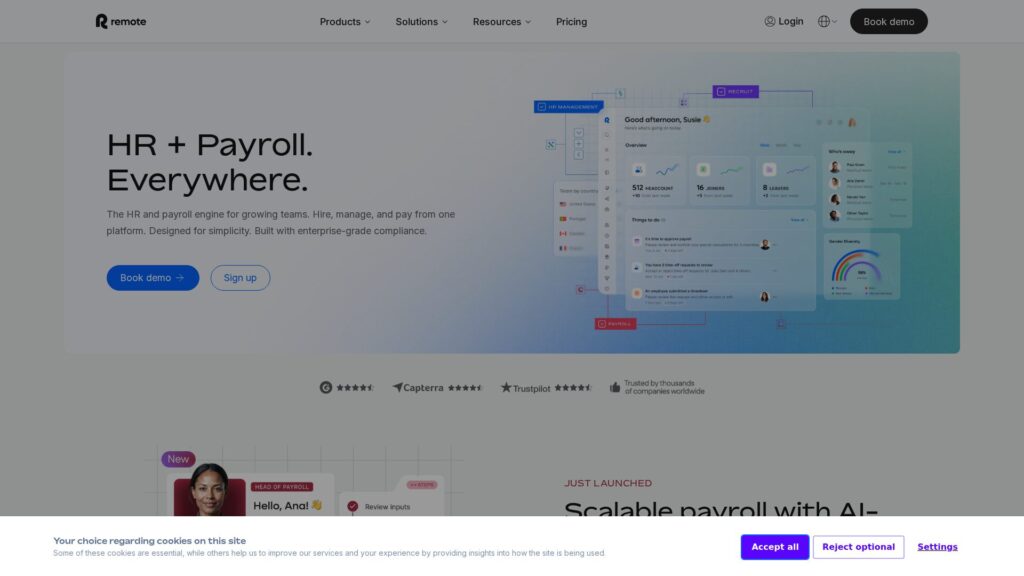
Remote is designed with a modern, web-based interface that most HR and finance teams can adapt to quickly. Onboarding new employees or contractors typically follows guided workflows that surface country-specific requirements, which reduces the need for users to memorize local rules. The self-service experience for employees is straightforward, allowing them to access payslips, update certain personal details, and review contracts without constant HR intervention.
Implementation effort largely depends on your starting point. For organizations without prior global payroll infrastructure, standing up Remote is usually faster than stitching together multiple local vendors. However, if you already have an HRIS, identity provider, or ERP in place, you will need to plan integration and data mapping. There is also a conceptual learning curve around EOR and PEO models, especially for teams used only to domestic employment, but this tends to smooth out after the first few hires in each country.
Remote fits into a broader HR and finance stack rather than replacing it outright. It typically integrates with HRIS platforms, identity providers, and accounting or ERP systems so that employee data, payroll information, and cost allocations can move between systems. Native integrations exist with popular HR and collaboration tools, and an API is available to support more customized data flows or connections to in-house systems.
That said, the depth and availability of specific integrations can vary, and larger organizations with complex architecture should conduct a careful review of supported connectors and the API’s capabilities. Prospective buyers should ask about bidirectional sync behavior, data ownership, and how frequently data is updated, as these factors will determine whether Remote can act as a reliable source of truth or a downstream system in your architecture.
Remote Overview
Pros
- Strong unified platform combining EOR, contractors, payroll, and PEO in one place
- Owned local entities and in-country expertise improve compliance and employee experience
- Modern, user-friendly interface for HR, finance, and employees
- Guided onboarding workflows simplify hiring across multiple countries
- Good fit for remote-first startups and mid-market companies expanding globally
- Consolidated reporting helps finance understand global payroll and contractor spend
- Contractor of Record capabilities reduce misclassification and payment risk
- Scales faster than setting up and managing your own foreign entities
Cons
- Advanced HR modules like performance and learning are relatively limited
- Depth of features and benefits can vary by country and jurisdiction
- EOR pricing can become less economical as headcount grows in one country
- Requires integration work if you already have an established HRIS or ERP
- Not a full replacement for enterprise HCM suites in complex organizations
Remote: Frequently Asked Questions
What is Remote used for?
Remote is used to hire, pay, and manage international employees and contractors through global payroll, employer of record, contractor management, and PEO services.
Who is Remote best suited for?
Remote is best for startups and mid-market companies with distributed teams or plans to hire across multiple countries without setting up local entities.
Can Remote replace my existing HRIS or HCM?
Remote includes core HRIS capabilities but is not a full replacement for enterprise HCM; many companies integrate it with an existing HRIS for complete HR workflows.
How does Remote help with compliance?
Remote operates local entities and works with in-country experts to provide compliant contracts, benefits, and tax handling, reducing legal and payroll risks when hiring globally.
Does Remote support contractors as well as employees?
Yes, Remote supports both employees through EOR and PEO models and independent contractors through Contractor of Record and contractor management tools.
Can I migrate from Remote EOR to my own entity later?
Yes, many companies start with Remote’s EOR to move quickly, then later open local entities and transition employment and payroll, though this requires planning and coordination.
Is Remote suitable for very large enterprises?
Large enterprises can use Remote, often as a specialized layer for certain countries or worker types, but typically still rely on a primary HCM and complex integrations.
What should I verify before adopting Remote?
You should verify country coverage for your target markets, available integrations with your HRIS and ERP, support model, and the long-term cost as headcount grows in specific countries.
